


Web3 Social Proof: What to Fix Before KOLs, Ads, Listings, or Fundraising
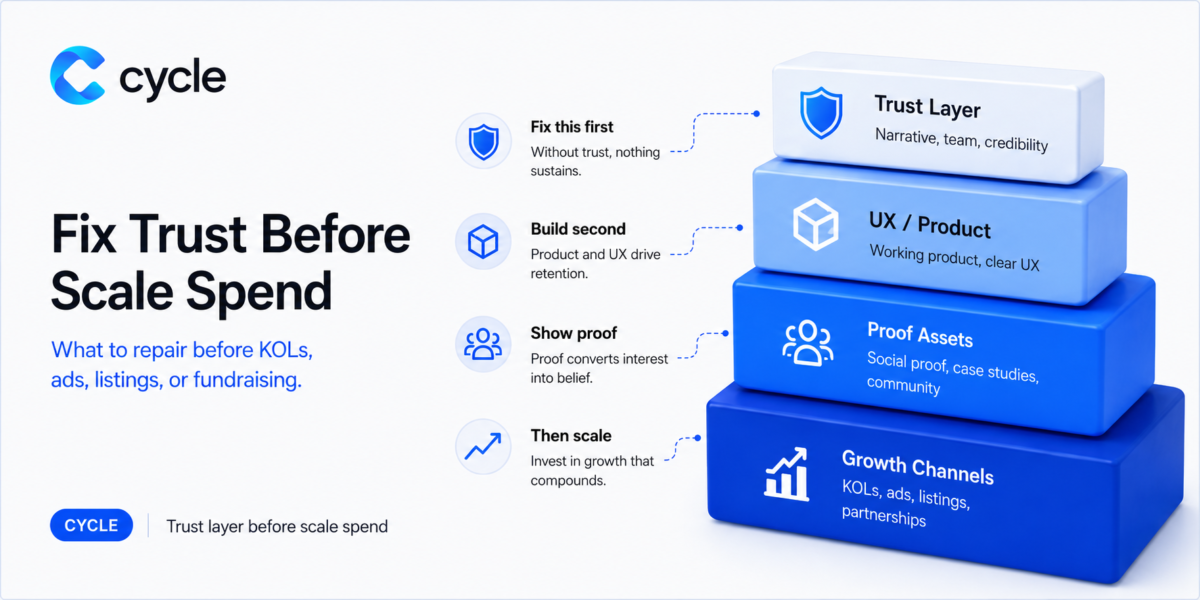
Short answer: Web3 social proof is the visible trust layer around a project: active social channels, credible community signal, clear founder presence, real proof assets, useful conversations, and public evidence that people already care. Before a project spends heavily on KOLs, ads, exchange listings, or fundraising, it should make sure that anyone who clicks through sees a project that looks alive, specific, and safe to engage with.
For a newer crypto-specific companion, see crypto social proof before KOL traffic.
That sounds obvious. It is also where many Web3 campaigns leak money.
A user sees a KOL post. They click to X. The last strong post was three weeks ago.
A fund gets a deck. They search the founder. Nothing useful appears.
An exchange BD checks the Telegram. The group is quiet, pinned messages are vague, and the community looks inflated instead of engaged.
The campaign did its job. It created attention. The project surface failed to convert that attention into trust.
What Social Proof Means in Web3
In ordinary SaaS, social proof might mean logos, testimonials, reviews, or case studies.
In Web3, the trust layer is more public and more chaotic. People judge the project through X, Telegram, Discord, website copy, founder accounts, ecosystem mentions, search results, media coverage, community replies, AMAs, on-chain traction, and the quality of visible conversations around the project.
Good Web3 social proof answers five questions fast:
- Is this project alive?
- Do real people care?
- Can I understand what it does?
- Is there credible proof behind the claims?
- Does the team look capable of executing?
If the answer is unclear, paid distribution only makes the weakness more visible.
The 2026 Shift: Hype Got More Expensive, Trust Got More Valuable
Crypto marketing has matured. The easy 2021-2022 playbook of loud announcements, generic hype, and paid influencer bursts is weaker now.
Blokhaus described the 2026 market as more disciplined, more community-led, and less forgiving of vague "Web3 is the future" messaging. Their report also notes that long-form content now needs depth, original frameworks, named authors, dates, citations, and clear authority signals if it is going to rank or be cited by AI search systems.
That matters because buyers, users, funds, and partners are doing more research before they engage.
They are not just asking, "Did I see this project somewhere?"
They are asking, "When I check the project, does the public evidence match the ambition?"
The Trust Gap That Breaks Campaigns
Most underperforming Web3 campaigns have the same hidden problem: the project is buying attention before it has fixed the destination.
The destination is not just the landing page. It is the full public surface.
A KOL thread sends traffic to X. Ads send traffic to the website. A listing announcement sends people to Telegram. A fundraising intro sends investors to founder profiles, case studies, and search results.
Each channel creates a check.
If the project looks thin, quiet, confusing, or over-promotional, the user does not need to write a complaint. They just leave.
That is the expensive part. The spend is visible. The lost trust is not.
Social Proof Comes Before Scale Spend
There is a cleaner order of operations:
- Fix the narrative.
- Fix the proof assets.
- Fix the visible community layer.
- Create public conversations.
- Then scale through KOLs, ads, PR, listings, and partner channels.
This does not mean a project needs to wait months before distribution. A good trust-layer sprint can happen in weeks.
The point is sequence. Make the project easier to believe before paying to show it to more people.
What a Proof Layer Audit Should Check
1. Narrative Clarity
The homepage, X bio, pinned posts, deck, Telegram intro, and founder explanation should all point in the same direction.
Weak narrative sounds like this:
- "We are building the future of decentralized finance."
- "The next generation ecosystem for Web3 users."
- "A revolutionary AI-powered platform."
Stronger narrative is specific:
- What category are you in?
- Who is it for?
- What painful problem do you solve?
- What is the proof that it is working?
- Why now?
Specificity is not decoration. It is a trust signal.
2. Founder and Team Visibility
In Web3, team signal matters because users and partners carry real risk.
A project does not always need a fully public team, but it needs a credible explanation of who is behind the work, what they have built before, and why they are qualified to execute this roadmap.
If the founders are public, their profiles should support the project story.
If the team is partly anonymous, the project needs stronger alternative proof: audits, partners, product demos, public contributors, ecosystem validation, strong documentation, or transparent operating updates.
Silence is not neutral. In a trust-sensitive market, silence becomes an assumption.
3. Community Surface
Telegram and Discord are not just support channels. They are conversion rooms.
When a user joins, they scan:
- pinned messages;
- admin responsiveness;
- question quality;
- repeated community members;
- announcement cadence;
- visible safety and moderation;
- whether the chat feels organic or staged.
Telegram passed 1 billion monthly active users in 2025, and crypto remains one of the categories where the app is deeply embedded. That makes Telegram-native trust work important, especially for token launches, mini-apps, exchange communities, and retail-facing products.
When community is treated as visible evidence instead of background chat, it becomes part of a Web3 community growth proof system.
But "having a Telegram" is not a strategy. The group needs to answer the same question as the website: why should anyone believe this is worth their time?
4. X/Twitter Proof
X is still the center of crypto-native conversation, but broadcasting into the feed is less reliable than it used to be.
The useful question is not "How many followers do we have?"
It is:
- Are the right people replying?
- Do posts create conversation or just impressions?
- Can a new visitor quickly see what the project is doing now?
- Are important updates pinned, threaded, and easy to understand?
- Is there a reply layer under key posts, or do announcements look abandoned?
Followers are a weak signal if no one credible engages.
5. Proof Assets
Every serious campaign needs assets that reduce doubt.
Depending on the project, this can include:
- product demo;
- roadmap with completed milestones;
- traction dashboard;
- case study;
- investor or partner page;
- founder interview;
- security audit;
- technical explainer;
- ecosystem map;
- community proof screenshots;
- AMA recording;
- media mention;
- launch recap.
The best proof asset is not always the most polished one. It is the one that answers the buyer's next objection.
Why KOLs Still Matter, but Not Alone
KOLs are still useful. They can create awareness, validation, conversation, and fast distribution.
The mistake is treating a KOL campaign as the whole strategy.
Lunar Strategy's 2026 KOL marketing analysis frames KOLs around trust, growth, and on-chain outcomes, not just reach. That is the right direction. A strong KOL campaign should amplify a project that already has substance.
When the trust layer is weak, KOL spend creates a short spike and a fast drop-off.
When the trust layer is strong, KOL traffic has somewhere to land.
The same pattern applies to media outreach: crypto PR needs a proof layer because articles and announcements expand inspection instead of replacing it.
Why Ads Still Need a Trust Layer
Performance ads can create scale, but Web3 users are trained to be skeptical.
If someone clicks an ad and lands on a project with vague claims, no founder signal, no community activity, and no proof assets, the ad network did not fail. The project failed the trust check.
For many Web3 projects, the first ad budget should not be spent only on traffic. It should be paired with conversion assets:
- landing page refinement;
- retargeting audiences;
- founder clips;
- FAQ pages;
- proof-led content;
- trust badges where legitimate;
- community onboarding flows.
Attention without trust becomes expensive noise.
Why Listings and Fundraising Need the Same Work
Exchange listings and fundraising both expose a project to more sophisticated due diligence.
For listings, partners care about demand, community activity, narrative clarity, and whether the market can understand the project.
For fundraising, investors care about market timing, team quality, traction, distribution, and whether the project can build a category narrative.
The same public assets help both:
- strong homepage;
- clear deck;
- active X;
- well-run Telegram;
- founder visibility;
- proof of traction;
- thoughtful long-form content;
- media or ecosystem validation.
The audience changes. The trust mechanics stay similar.
For token launches, this is why trust before TGE has to be built before the market starts inspecting the project under pressure.
A Practical 14-Day Social Proof Sprint
Here is a realistic first sprint for a Web3 project that needs to look more credible before bigger distribution.
Days 1-2: Audit the Public Surface
Review website, X, Telegram, Discord, founder profiles, search results, documentation, deck, media mentions, and competitor positioning.
Output: one priority list of trust gaps, ranked by business impact.
Days 3-5: Fix the Narrative
Rewrite the short explanation of the project across homepage, X bio, pinned post, Telegram intro, deck intro, and founder profile.
Output: one consistent story that a new user can understand in under 30 seconds.
Days 6-8: Build Proof Assets
Create the most important assets needed for the next conversion step: demo, case, traction recap, AMA outline, FAQ, founder post, investor note, or launch explainer.
Output: proof assets that answer real objections.
Days 9-11: Activate Conversation
Plan and run visible conversations: founder post, AMA, partner thread, community prompt, reply layer under key posts, and native comments in relevant crypto discussions.
Output: public activity that looks organic because it is tied to real substance.
Days 12-14: Prepare Distribution
Only after the surface is stronger, prepare the KOL, ad, PR, listing, or fundraising push.
Output: distribution plan connected to trust assets, not detached from them.
What CYCLE Fixes
CYCLE helps founder-led Web3 and trust-sensitive teams fix the proof layer before distribution scales: narrative, public surface, founder signal, proof assets, community readiness, PR/KOL coordination, and execution rhythm.
The practical work often starts with the trust layer: making the project look alive, specific, and credible before larger distribution spend.
That can include:
- social proof audit;
- X and Telegram engagement layer;
- narrative cleanup;
- founder visibility;
- AMA and community moments;
- PR hooks;
- ambassador activation;
- proof assets for fundraising, listings, or launch.
The goal is not fake hype. The goal is to make the public surface match the project's real ambition.
The Bottom Line
Web3 marketing in 2026 is less forgiving than it used to be.
People still respond to momentum, but they check more. They look for substance. They compare claims against public evidence. They notice when a project buys attention before earning trust.
Before the next KOL burst, ad campaign, listing push, or investor intro, fix the social proof layer.
It is not the glamorous part of growth. It is the part that makes the glamorous spend convert.
Related CYCLE Services
Use Proof Layer Audit when the trust gaps are unclear. Use Social Proof Package when the project needs a focused proof-building sprint before larger distribution. If the next motion includes creators, PR, or launch coordination, connect the work to Trusted Distribution System or Launch & Listing Readiness.
Related Proof
- OKX CIS Brand Awareness shows how PR and brand visibility depend on credible public context.
- CYBERBASE Telegram Mini App shows community activation as a visible proof layer.
- Web3 Epic Challenge / Bybit Partnership shows how partner and quest campaigns can create public engagement loops.
FAQ
What is Web3 social proof?
Web3 social proof is the visible evidence that a project is active, trusted, and worth engaging with. It can include community activity, credible replies, founder visibility, proof assets, AMAs, partner mentions, user traction, media coverage, and clear public communication.
Why should social proof come before KOL marketing?
KOL marketing creates attention, but users still click through and judge the project. If the project's X, Telegram, website, or proof assets look weak, the campaign loses conversion. Social proof gives KOL traffic a stronger place to land.
Is social proof the same as fake engagement?
No. Fake engagement tries to simulate interest without substance. Real social proof makes actual project strengths more visible: clear messaging, real conversations, responsive community management, founder presence, proof assets, AMAs, and credible third-party validation.
How long does a Web3 social proof sprint take?
A focused first sprint can take 14 days. That is enough to audit the public surface, clean up narrative, create basic proof assets, improve X and Telegram presentation, and prepare a better distribution push. More mature programs usually run this as an ongoing operating loop.
What should a token launch fix before paid ads?
Before paid ads, a token launch should fix its landing page, X profile, Telegram onboarding, token utility explanation, founder/team proof, FAQ, risk disclosures, community moderation, and the proof assets that explain why the project deserves attention now.