


DePIN Go-to-Market Strategy: From Network Supply to Paid Usage
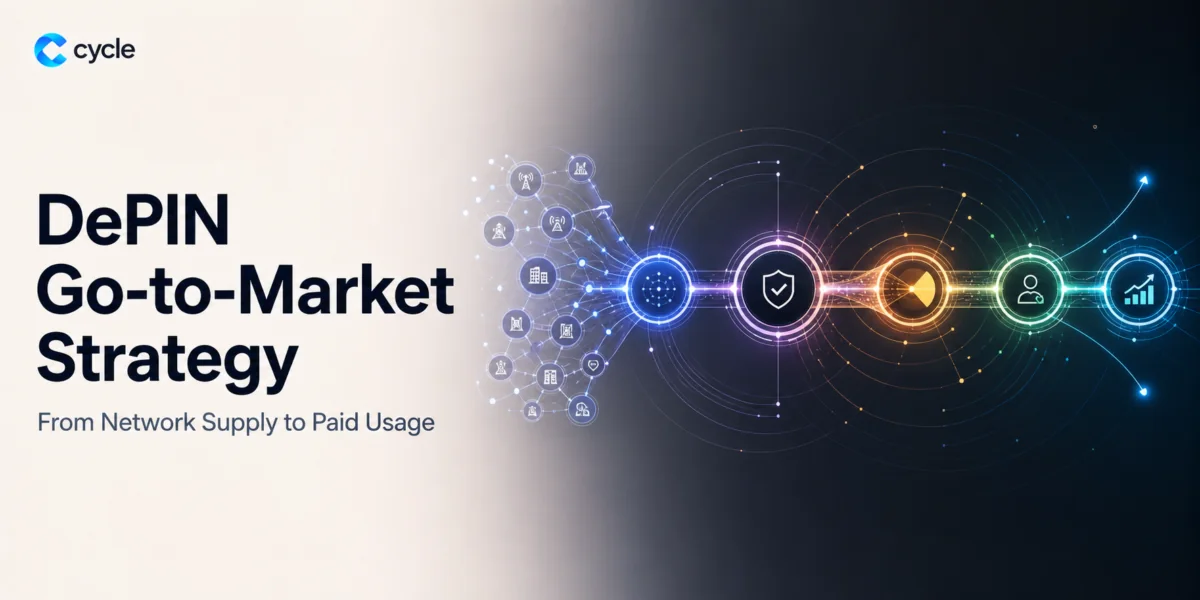
Short answer: a DePIN go-to-market strategy should not optimize node count, token attention, partnerships, and customer demand at the same time. It should identify the network's current constraint and remove it in sequence: prove useful supply, make the service usable, win one demand wedge, create a commercial path, publish inspectable market proof, and then repeat what converts into paid usage.
Node growth is not the same as network growth.
A DePIN project can attract operators, deploy hardware, display coverage, and generate ecosystem attention while remaining commercially unclear. The difficult question arrives later: who uses the infrastructure, for what job, through which product path, with what service expectation, and why will they pay again?
That is the real DePIN GTM problem. Supply and demand must be developed together, but they rarely become credible at the same speed. The strategy is therefore not a balanced list of channels. It is a sequence of constraints.
What is a DePIN go-to-market strategy?
A DePIN go-to-market strategy is the operating plan that connects a physical resource network to repeatable usage and revenue.
It has to coordinate several markets:
- operators who contribute hardware, energy, coverage, compute, storage, bandwidth, mobility data, or another resource;
- customers who use and pay for the resulting service;
- developers who integrate the infrastructure into products;
- partners who improve access, hardware, geography, distribution, or trust;
- community participants who need accurate context about the network;
- founders, media, and ecosystem voices that make the category understandable.
Each audience needs a different answer. Operators evaluate the work and risk of contributing supply. Buyers evaluate service quality, accountability, integration, and economics. Developers evaluate access and documentation. Partners evaluate the exact relationship and mutual value.
One generic "grow the community" plan cannot resolve those decisions.
CYCLE's DePIN POV: node count is an input, not a GTM outcome
Supply matters. A physical network cannot serve demand without enough usable capacity, coverage, data, or energy. But the public number is often less meaningful than the operating reality behind it.
A serious GTM review asks:
- Is the resource active, available, and measurable?
- Does it meet the quality threshold required by a real use case?
- Is it located where demand exists?
- Can a buyer or developer access it through a clear product path?
- Can the team distinguish registered, shipped, deployed, active, and productive nodes?
- Does greater supply improve a service someone is willing to use?
If those questions are unanswered, acquiring more operators can enlarge the network map without improving the product.
The same principle applies to demand. A partnership logo, waitlist, free pilot, developer registration, and paid recurring customer are not interchangeable signals. The GTM system should name the signal precisely and use it to decide the next move.
The CYCLE DePIN Supply-to-Usage Gates
CYCLE uses six gates to move a DePIN network from supply formation toward repeatable paid usage. A gate is not a campaign phase with a fixed end date. It is an operating condition that should be observable before the next constraint receives more budget.
| Gate | What must become true | Evidence to inspect | Premature scale signal |
|---|---|---|---|
| 1. Resource proof | The network can attract and verify the physical resource it coordinates | Active-resource definitions, deployment status, geography, verification method, operator path | Celebrating registrations or shipments as usable network capacity |
| 2. Service quality | The supply can deliver a reliable service for a specific job | Availability, coverage, uptime, latency, accuracy, throughput, or another use-case threshold | Adding nodes that do not improve the buyer's experience |
| 3. Demand wedge | One buyer or developer segment has a painful, specific reason to use the network | Clear job-to-be-done, buyer language, product path, qualified conversations, usage signal | Listing many industries without winning one use case |
| 4. Commercial path | The user can evaluate, access, pay for, and receive accountable service | Packaging, pricing logic, integration steps, commercial owner, support and follow-up | Calling interest or a free pilot recurring demand |
| 5. Market proof | The team can publish an accurate, inspectable account of supply and usage | Product evidence, approved customer or partner context, case material, founder explanation | Amplifying a milestone whose boundaries cannot survive inspection |
| 6. Repeatability | The team knows which motion creates retained or expanding usage | Activation, conversion, paid usage, retention, expansion, objections, cycle time | Expanding channels or geographies before the first motion is understood |
The operating rule is sharper:
Run parallel tests. Scale budget sequentially.
Supply and demand learning can happen at the same time. Material spend should follow the current constraint, not a generic plan to make every number grow.
CYCLE evidence rule: never report one level of evidence as the next. Supply moves from registered → deployed → active → productive. Demand moves from interest → evaluation → pilot → paid → retained. A number only matters when the team can name which level it represents.
Gate 1: define useful supply before acquiring more of it
The supply plan should begin with the service the network intends to provide, not with the largest available operator audience.
Define the minimum credible network for the first use case:
- which resource must be present;
- where it must be available;
- what quality threshold it must meet;
- how activity is verified;
- what an operator must install, contribute, maintain, or risk;
- what support the operator receives;
- which supply metric matters to the eventual customer.
The operator message should explain that job, not only invite people to "join the network."
Gate 2: turn network coverage into service quality
A node map can show geographic ambition. It does not automatically show whether the network can deliver the promised outcome.
The right quality metric depends on the category. A wireless network may care about coverage and reliability. A compute network may care about available capacity, performance, orchestration, and job completion. A sensing network may care about accuracy, freshness, and geographic density. An energy network may care about verified production and settlement logic.
Marketing should translate these measures into buyer-readable service expectations without flattening the technical truth. If more supply does not improve a named customer outcome, scale is the wrong headline.
Gate 3: choose one demand wedge
"Enterprise demand" is not a segment. Neither is "AI," "mobility," or "energy."
A demand wedge combines:
- one identifiable user or buyer;
- one urgent job;
- one reason the decentralized network is useful;
- one product or integration path;
- one measurable usage event;
- one owner for commercial follow-up.
The wedge should be narrow enough that the team hears repeated objections and improves the same path. This does not limit the eventual market. It creates the first repeatable proof that the network solves a paid problem.
Gate 4: build the commercial path before calling usage demand
Teams often find early interest through founders, ecosystem partners, grants, hackathons, or personal introductions. That interest becomes GTM evidence only when the next step is explicit.
The buyer or developer should be able to understand:
- what can be used now;
- how access or integration works;
- what the commercial unit is;
- whether the engagement is free, subsidized, paid, or revenue-generating;
- who provides support and accountability;
- what success looks like;
- what happens after the pilot or initial workload.
A pilot can be strategically valuable without being paid usage. A partnership can improve access without being a customer. Accurate language makes the proof stronger, not smaller.
Gate 5: turn operating evidence into market proof
When supply and usage become visible, the public story should make their relationship inspectable.
That may require:
- a clear definition of active supply;
- a product or integration explanation;
- a use-case page or case study;
- approved customer, pilot, or partner context;
- a founder explanation of why the network design matters;
- a consistent claim base for the website, community, media, and partner channels;
- an announcement that names the boundaries of the milestone.
The companion guide to DePIN PR strategy explains the proof gate for nodes, pilots, and partnerships. PR should distribute a coherent milestone, not discover what the claim means after publication.
Gate 6: scale the motion that creates retained usage
Repeatability is not the volume of activity. It is the ability to explain why a defined audience moved from interest to use, payment, retention, or expansion.
Track the network as a connected system:
| Layer | Useful GTM questions |
|---|---|
| Supply | Which operators become active? How quickly? What resource quality do they add? Why do they remain? |
| Service | Does new supply improve availability, performance, coverage, accuracy, or another buyer outcome? |
| Demand | Which use case creates qualified evaluation, integration, or usage? Which objections repeat? |
| Commercial | What converts to paid usage? How long does it take? Who owns the next step? |
| Retention | Does usage repeat or expand? What operational issue causes drop-off? |
| Trust | Which proof asset, founder explanation, partner signal, or technical evidence helps the decision? |
These measures prevent operator growth, impressions, press mentions, and community activity from becoming a substitute for commercial learning.
Illustrative scenario: another supply campaign or a demand wedge?
The following numbers are hypothetical, not a CYCLE client claim.
An energy DePIN reports 1,400 registered producers, 430 active installations, and verified output across two markets. The team is considering an $80,000 campaign to acquire another 1,000 producers.
Its demand evidence is weaker: 22 enterprise conversations, four unpaid pilots, no defined commercial unit, and no owner for converting a pilot into a paid account.
The constraint is not the size of the top-of-funnel supply audience. It is Gate 3 and Gate 4: the demand wedge and commercial path. The next budget should test whether one buyer type will repeatedly pay for one defined output. More producers become the scale priority only when additional supply improves that service.
The sequence is concrete: choose the buyer and job, define the access and payment unit, convert or disqualify the pilots, publish an inspectable use-case asset, then acquire the supply required by the proven demand path.
The Solarious Energy DePIN GTM case demonstrates a different but related gate: translating renewable-energy production, hardware verification, blockchain settlement, individual producers, and Proof-of-Energy into a market-readable claim hierarchy. CYCLE supported the GTM, narrative, media-readiness, and public proof layer; the case does not claim that CYCLE built the protocol, hardware, customer demand, or paid usage.
How to allocate the DePIN GTM budget
Budget follows the blocked gate: resource proof and onboarding for weak supply; instrumentation for unclear service quality; founder-led discovery and buyer assets for a broad demand story; packaging and follow-up for failed conversion; trusted distribution for strong but invisible proof; retention learning before market expansion.
The DePIN marketing cost guide provides the full six-ledger model and planning bands. Its core rule applies here: broad distribution is the last budget to scale, not the first.
The DePIN GTM gate check
Use three verdicts:
- Blocked: a critical assumption has no observable evidence;
- Observable: evidence exists, but not enough to justify materially higher spend;
- Ready: evidence supports investment in the next constraint.
Answer each gate with yes or no, then assign the verdict.
| Gate | Binary checks |
|---|---|
| Resource proof | Can we distinguish registered, deployed, active, and productive supply? Can we verify the resource and location? Does the operator path explain the job and risk? |
| Service quality | Is there a buyer-relevant quality threshold? Does current supply meet it? Would more supply improve the first use case? |
| Demand wedge | Can we name one buyer role and urgent job? Have multiple qualified prospects independently shown that need? Is there a usable product path? |
| Commercial path | Is the unit of access or payment defined? Is free, subsidized, and paid activity separated? Does one person own conversion and support? |
| Market proof | Does every main claim have visible evidence? Do counterparties approve the same language? Can an outsider inspect the milestone? |
| Repeatability | Can we measure paid usage and retention? Do we know the repeated conversion path? Do we know why usage stops or expands? |
Three evidenced yes answers make a gate Ready. Partial evidence makes it Observable. A missing critical definition or evidence source makes it Blocked. Do not average the verdicts into a reassuring score. The first blocked gate is the current GTM constraint.
How CYCLE supports DePIN GTM
CYCLE helps DePIN teams identify the blocked gate, build the missing proof or commercial path, and coordinate the founder, product, PR, community, partner, and distribution work required to move it.
If the team cannot clearly name its current blocked gate, start with a GTM diagnosis. CYCLE's DePIN marketing service is built around identifying and moving that constraint. If the gate is known but execution is fragmented across functions and vendors, the GTM Control Room is the stronger operating fit.
FAQ
What should a DePIN go-to-market strategy include?
It should define useful supply, the service-quality threshold, one demand wedge, the commercial path, the public proof layer, and the measures for paid usage and retention. It should also name owners for operator support, buyer or developer follow-up, partner claims, community response, and GTM decisions.
Should a DePIN project build supply or demand first?
The project needs enough credible supply for the first use case, but it should test demand before maximizing supply. Build the minimum credible network for a specific job, learn what the buyer or developer requires, and then acquire the supply that improves that service.
Are token incentives part of DePIN GTM?
They can help coordinate operators or community participation, but they are not a complete GTM strategy. Incentives do not replace service quality, buyer demand, a commercial path, accurate public proof, or retained usage.
What counts as paid usage in DePIN?
Paid usage means a customer or user pays for access to the network's service, resource, data, workload, or another defined commercial unit. A grant, token reward, free pilot, letter of intent, integration announcement, or partner logo may be useful evidence, but it should not be presented as recurring customer revenue unless that is accurate.
Which metrics matter most for DePIN growth?
Track active and useful supply, service quality, qualified demand, activation, integration or evaluation progress, paid usage, retention, expansion, and repeated objections. Node count, impressions, mentions, and community size are supporting metrics unless they connect to those outcomes.
When should a DePIN project scale PR, KOLs, or paid reach?
Scale distribution when the current claim is supported by visible evidence, the audience has a clear next action, and the team can respond to the resulting questions and leads. If attention exposes a blocked gate, fix the gate before buying more reach.