


Crypto Community Management vs Community Growth: What You Actually Need
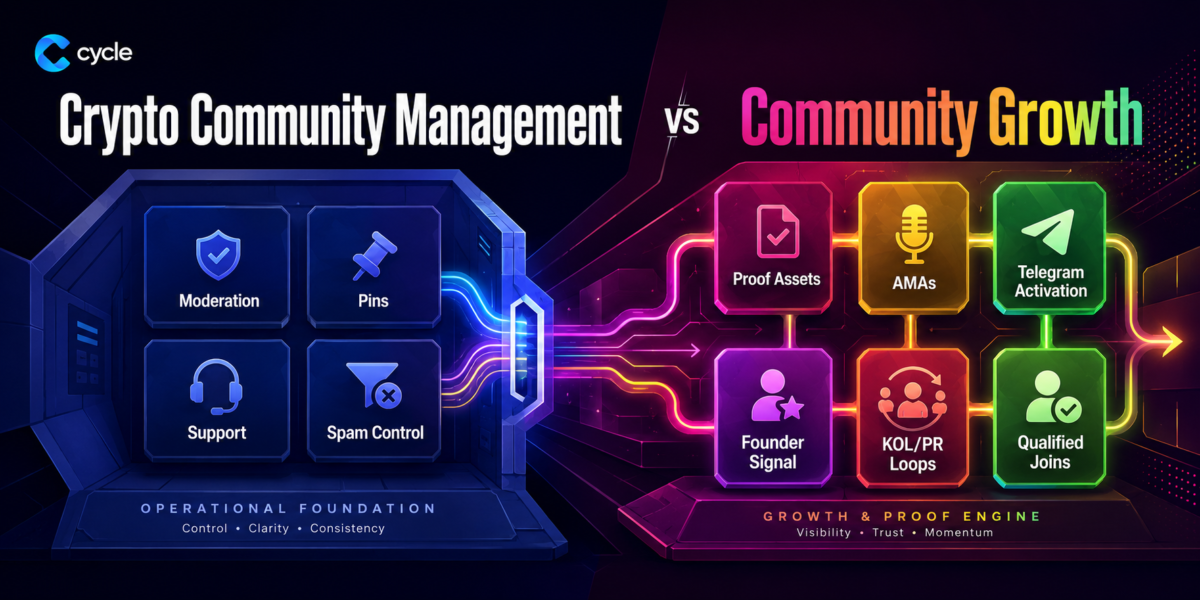
Short answer: crypto community management keeps Telegram, Discord, and social community spaces usable: moderation, spam control, pinned messages, support routing, daily answers, and basic rhythm. Crypto community growth turns those spaces into a proof and activation system: narrative, onboarding, AMAs, founder signal, campaign coordination, qualified joins, product actions, and reporting. Management keeps the room healthy. Growth makes the room create market movement.
Many Web3 teams buy the wrong community service.
They ask for crypto community management when the real problem is weak web3 community growth. Or they ask for growth when the room is too messy to receive new people.
Both mistakes are expensive.
If the channel is full of spam, scams, stale pins, broken links, unanswered questions, and confused moderators, growth will amplify chaos.
If the channel is clean but nobody understands the project, joins for the right reason, attends AMAs, uses the product, asks useful questions, or creates proof, management alone will create clean stagnation.
The buyer question is not:
Do we need a community manager?
The better question is:
Are we trying to keep the room healthy, or are we trying to turn community attention into trust, action, and proof?
Those are different jobs.
The sharp POV: management is hygiene, growth is market movement
Crypto community management is not a small job.
A badly managed Telegram or Discord can damage trust fast. Spam, impersonators, unanswered questions, unclear links, low-quality replies, and outdated pins make a real project look risky.
Management protects the room.
But management is not the same as growth.
A clean room can still fail commercially if it does not help the market understand what the project does, why it matters, what proof exists, and what a serious visitor should do next.
That is where community growth starts.
Community growth is not only increasing member count. It is making community surfaces work as part of the public proof layer: Telegram, Discord, X, AMAs, founder posts, KOL comments, partner campaigns, quest pages, product links, and support answers all reinforcing one story.
The simple distinction:
Community management reduces community risk. Community growth creates community signal.
A Web3 team often needs both.
But it should not confuse them.
What crypto community management should own
Crypto community management is the operating hygiene layer.
It keeps the community safe, understandable, and usable.
A strong community management scope usually includes:
- moderation and spam control;
- scam and impersonation prevention;
- pinned message updates;
- official link management;
- basic onboarding answers;
- daily community presence;
- support routing;
- announcement posting;
- FAQ maintenance;
- admin escalation;
- Telegram or Discord rules;
- simple sentiment notes;
- response consistency across recurring questions.
This matters because crypto communities are inspection surfaces.
A new visitor may judge the project in less than a minute by scanning the pinned post, admin replies, recent questions, scam warnings, and whether the room looks alive or abandoned.
Good management prevents avoidable trust loss.
But it does not automatically create demand.
A community manager can keep the lights on. That does not mean the market is becoming more convinced.
What crypto community growth should own
Crypto community growth is the market-facing layer.
It turns community attention into trust, participation, product movement, and reusable proof.
A strong web3 community growth scope can include:
- community positioning and narrative alignment;
- Telegram onboarding that acts like a lightweight landing page;
- AMA strategy and reuse;
- founder/community response moments;
- campaign calendars around launches, quests, PR, KOLs, and partners;
- proof assets for repeated questions;
- activation paths for different visitor types;
- ambassador or contributor paths;
- telegram community growth focused on qualified joins, not raw headcount;
- KOL and community brief alignment;
- reporting on signal quality, not only member count.
The growth operator asks different questions from the moderator.
Not only:
- Was spam removed?
- Were questions answered?
- Was the announcement posted?
But also:
- What are new visitors supposed to believe?
- What proof can the community point to?
- Which questions repeat because the public surface is weak?
- Which traffic sources bring qualified users?
- What does an AMA create after the live event ends?
- Which community activity can be reused as proof for PR, partners, fundraising, or launch follow-up?
Community growth does not replace management.
It builds on top of management.
Management vs growth: the buyer decision table
Use this table when deciding what to buy.
| Buyer problem | You likely need | Why |
|---|---|---|
| Spam, scams, impersonators, and low-quality messages are damaging trust | Crypto community management | The room needs safety and hygiene before attention scales |
| Pinned messages, links, and basic answers are outdated | Crypto community management | New visitors need a usable entry point |
| Admins answer inconsistently or escalate poorly | Crypto community management | Response consistency is an operating issue |
| Telegram is clean but quiet, passive, or commercially weak | Community growth | The room is managed but not creating market signal |
| New joins do not understand the project | Community growth | The narrative and onboarding path are weak |
| KOL traffic arrives and disappears | Community growth | The community surface is not converting attention into trust or action |
| AMAs happen but leave no useful proof | Community growth | Events are being treated as calendar activity instead of proof assets |
| Quests, campaigns, PR, and Telegram are disconnected | Community growth plus distribution coordination | The project needs one campaign sequence across channels |
| Founders are stuck coordinating community, KOLs, PR, and partners manually | GTM operating layer | The issue is larger than community execution |
The mistake is buying one service and expecting it to behave like the other.
A moderator should not be expected to invent the GTM sequence.
A growth operator should not have to build on a room full of scams, broken links, and unmanaged support debt.
The CYCLE community buyer framework
CYCLE separates community work into five layers:
Hygiene → Readability → Proof → Activation → Signal.
This framework helps a buyer decide whether the project needs management, growth, or a larger operating system.
1. Hygiene
Can people safely and clearly use the room?
Hygiene includes moderation, scam control, official links, admin presence, rules, pinned posts, and escalation.
If hygiene is weak, growth should wait.
More traffic will not fix a confusing or unsafe community. It will make the confusion more visible.
2. Readability
Can a new visitor understand the project quickly?
Readability includes the project one-liner, current campaign context, pinned onboarding, X bio, website consistency, founder signal, and FAQ.
A readable community does not force visitors to ask basic questions that should have been answered before they arrived.
If every new person asks “what is this?” the community is not growth-ready.
3. Proof
Can the community point to evidence?
Proof can include product demos, screenshots, campaign recaps, partner context, founder notes, AMA clips, user questions, roadmap progress, or public explanations.
Without proof, admins are forced to improvise.
With proof, every repeated question becomes a linkable asset.
4. Activation
What should the visitor do next?
Activation depends on the project stage.
A visitor may need to:
- follow X;
- join Telegram;
- attend an AMA;
- use a product;
- join a quest;
- read a launch page;
- submit feedback;
- invite a relevant user;
- apply as a partner;
- become a tester, ambassador, or contributor.
If the next step is unclear, community growth becomes passive attention.
5. Signal
What did the community prove?
Signal is the difference between vanity reporting and useful reporting.
Weak report:
- Telegram grew by 3,000 members.
- AMA had 600 listeners.
- The campaign received 200 comments.
Stronger report:
- Which traffic sources brought qualified users?
- Which questions repeated?
- Which proof asset reduced doubt?
- Which AMA answer should become a clip or FAQ?
- Which KOL sent people who actually joined, asked questions, or used the product?
- Which community replies created trust?
- Which objections need a founder response before the next push?
Management reports room health.
Growth reports market movement.
Why Telegram community growth is not member acquisition
Telegram is often the main community surface for crypto projects.
That makes telegram community growth tempting to buy as a number: more members, more comments, more visible activity.
But Telegram growth without readiness can hurt the project.
If new people enter and see unclear pins, broken links, admin confusion, scam warnings with no structure, reward-only conversation, or no proof assets, the member count may rise while trust falls.
Qualified Telegram growth should answer four questions:
- Who should join? Users, traders, builders, players, testers, creators, partners, or community advocates are not the same audience.
- Why should they stay? There must be a current reason: product access, useful updates, AMAs, campaign participation, support, learning, contributor path, or partner context.
- What proof do they see? The channel should point to visible evidence, not only admin claims.
- What action should they take next? The first action should match the campaign and visitor intent.
Telegram should act like a conversion room, not a waiting room.
That requires management hygiene and growth design.
Crypto AMA marketing: management activity or growth asset?
AMAs are a good example of the difference.
From a community management view, an AMA is an event to schedule, announce, moderate, and keep orderly.
That matters.
But from a growth view, crypto AMA marketing should create proof before, during, and after the event.
A growth-led AMA has:
- a clear reason for existing;
- a founder or operator who can explain the project;
- questions mapped to real objections;
- approved claims and banned claims;
- links to proof assets;
- community questions collected in advance;
- clips, recap posts, FAQ updates, and founder notes after the event;
- a next step for listeners.
A weak AMA creates a one-hour activity spike.
A useful AMA creates reusable trust.
The question is not only “how many people attended?”
The better question is:
What did the AMA make easier to believe?
Operational example: the clean room that does not grow
A DeFi project has a managed Telegram group.
The admins are responsive. Spam is removed. Announcements go out on time. Pinned messages are current. The support flow works. The room is not chaotic.
On paper, community management is doing its job.
But the founder is frustrated.
KOL traffic arrives and leaves. AMAs happen but do not change perception. New members ask basic questions about the product. Few people click the app. The same doubts repeat: what is live, why the protocol matters, who uses it, how the token fits, what proof exists, and why now is the right moment.
The team thinks the community manager is underperforming.
But the core issue is not moderation.
The issue is missing community growth architecture.
The fix is different:
- rewrite the Telegram pinned message as an onboarding surface;
- create a product proof asset;
- prepare a founder explanation thread;
- map the top 20 recurring questions;
- turn the next AMA into a proof event;
- brief KOLs with the same story;
- define qualified actions after joining;
- report on questions, clicks, product actions, and retained contributors, not only members.
The management layer was fine.
The growth layer was missing.
The crypto community scope checklist
Use this checklist before hiring a community manager, community growth partner, or Telegram growth vendor.
If you need management, scope these outputs
- Moderation coverage windows.
- Spam and scam response process.
- Official link control.
- Pinned message updates.
- Basic FAQ and answer scripts.
- Support and escalation routing.
- Announcement posting rhythm.
- Admin tone and response rules.
- Simple weekly room-health report.
If you need growth, scope these outputs
- Community narrative and onboarding path.
- Telegram entry-point redesign.
- Proof asset library for recurring questions.
- AMA strategy, question map, and recap system.
- Campaign calendar tied to launches, KOLs, PR, quests, or partner moments.
- Founder/community interaction plan.
- Activation path by visitor type.
- Contributor or ambassador path where relevant.
- Reporting on qualified joins, useful questions, product actions, proof created, retention, and signal quality.
If you need both, sequence them
Do not scale growth into a broken room.
First stabilize hygiene:
- Clean spam and scam risks.
- Fix official links.
- Update pinned onboarding.
- Align admin answers.
- Prepare escalation.
Then design growth:
- Clarify the story.
- Build proof assets.
- Create activation paths.
- Run AMAs, KOLs, PR, quests, or partner campaigns into the prepared room.
- Report on signal quality.
This sequence prevents a common failure: paying for growth while community debt eats the result.
The community buyer scorecard
Score each area from 0 to 2.
| Area | 0 | 1 | 2 |
|---|---|---|---|
| Room safety | Spam, scams, or impersonators are visible | Some controls exist | Moderation and scam response are stable |
| Entry point | Pins and links are stale or confusing | Basic onboarding exists | Telegram/Discord explains the project, current moment, proof, and next step |
| Answer quality | Admins improvise or contradict each other | Answers are partly consistent | Recurring questions have clear scripts and proof links |
| Narrative | Community cannot explain the project | Story is clear internally but not in the room | Community surfaces repeat the same clear story |
| Proof | Claims rely on admin statements | Some proof exists but is scattered | Proof assets are easy to link and reuse |
| Activation | New visitors do not know what to do | CTA exists but is weak | Next steps match visitor intent and campaign goals |
| AMA value | AMAs are one-off events | AMAs create some recap material | AMAs create proof assets, founder signal, FAQ updates, and follow-up actions |
| Reporting | Only member count and messages are tracked | Some qualitative notes exist | Reporting tracks qualified joins, questions, actions, retention, and proof created |
Interpretation:
- 0-6: fix community management hygiene first.
- 7-11: management is partly stable; add growth only in controlled loops.
- 12-16: the room can support community growth, KOL traffic, AMAs, PR, or partner campaigns.
Hard rule: if room safety, entry point, or answer quality scores 0, do not buy telegram community growth yet.
Fix the room before sending more people into it.
Where CYCLE fits
CYCLE treats community as part of the market-facing proof surface, not a back-office chat function.
Use Community Growth when Telegram, Discord, X, AMAs, ambassadors, and campaign moments need to become clearer proof, stronger activation, and better market signal.
Use Social Proof Package when the project has real substance but the public surface does not yet make that substance easy to see.
Use Trusted Distribution System when community needs to move with KOLs, PR, AMAs, founder posts, launch assets, and partner distribution around one sequence.
Use GTM Control Room when the founder needs a senior operating layer to coordinate community, PR, KOLs, partners, launches, and proof instead of managing separate vendors manually.
For the broader proof-system view, read Web3 Community Growth Is a Proof System, Not a Chat Room. This article is the buyer distinction: what to buy, when to buy it, and what each scope should be responsible for.
The goal is not to make the room busier.
The goal is to make the project easier to understand, trust, join, use, discuss, and buy from.
FAQ
What is crypto community management?
Crypto community management is the daily operating work that keeps Telegram, Discord, and other community spaces usable. It includes moderation, spam control, scam prevention, pinned messages, official links, support routing, announcements, basic FAQ answers, and admin escalation.
What is the difference between crypto community management and community growth?
Crypto community management protects room health. Community growth creates market movement. Management keeps the channel safe and understandable. Growth connects narrative, proof assets, AMAs, KOL or PR traffic, Telegram onboarding, activation paths, and reporting so community attention becomes trust and action.
Do we need Telegram community growth or moderation first?
If the room has spam, scams, broken links, stale pins, or inconsistent answers, start with moderation and community management. If the room is clean but does not create trust, qualified joins, product actions, or reusable proof, add community growth.
Are AMAs community management or community growth?
They can be either. A management-led AMA is a moderated event. A growth-led AMA is a proof asset: it answers real objections, creates founder signal, produces clips or recaps, updates FAQs, and gives listeners a next step.
Can a community manager grow a crypto community?
Some community managers can support growth, especially if they understand narrative, proof, activation, and reporting. But many management scopes are designed for hygiene, not market movement. If growth is expected, define growth outputs explicitly instead of assuming moderation will create demand.
What metrics should Web3 community teams track?
Track both hygiene and growth. Hygiene metrics include response time, spam incidents, unresolved questions, scam reports, and pinned-message freshness. Growth metrics include qualified joins, useful questions, AMA retention, product clicks, proof assets created, activation actions, retained contributors, KOL traffic quality, and repeated objections.