


Founder-Led Positioning Audit: What to Fix Before More Marketing
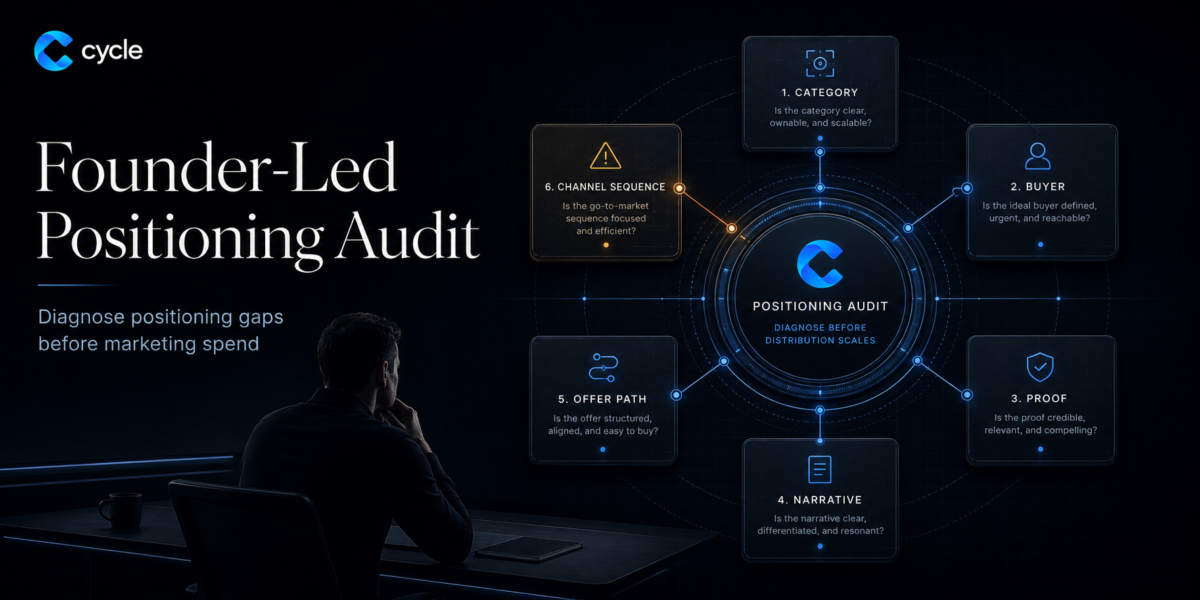
Short answer: a founder-led positioning audit checks whether the market can understand what the company does, who it is for, why it matters now, and what proof supports the claim before more marketing activity is added. It is the step that prevents founders from buying content, PR, ads, KOLs, partnerships, or agencies before the core market story is clear enough to carry attention.
Most founder-led companies do not have a motivation problem. They have a translation problem. The founder can explain the product on a call. The team understands the architecture, roadmap, customer pain, and timing. But the public surface often says something broader, softer, or less convincing than what the founder knows.
That gap is expensive. It makes every next marketing move work harder.
A positioning audit is not a slogan workshop. It is a GTM diagnostic. The goal is to find the points where the market loses the thread: category, ICP, pain, proof, timing, founder signal, offer path, and distribution sequence.
Why more marketing does not fix weak positioning
When positioning is unclear, more marketing usually multiplies the confusion.
The company may publish more posts, launch more ads, brief more creators, pitch more media, or hire more vendors. But if the underlying message is not stable, every channel starts translating the company differently.
Common symptoms look like this:
- the homepage sounds like a broad platform, but sales calls are specific;
- the pitch deck explains the company better than the public website;
- PR angles sound impressive but do not connect to a buyer problem;
- founder posts get respect but do not connect to the offer;
- community members cannot explain the project in one sentence;
- paid traffic lands on claims that are not backed by visible proof;
- vendors ask for briefs because the company has not decided the GTM story.
The founder feels like the company is “not loud enough.” The real issue is often that the market does not know what to believe first.
What a founder-led positioning audit checks
A useful audit looks at the market story as an operating system, not as isolated copy.
| Audit layer | Question to answer | What gets fixed |
|---|---|---|
| Category | What box should the market put us in first? | Category language, comparisons, market frame |
| Buyer | Who should care now, not eventually? | ICP clarity, use cases, buying trigger |
| Pain | What problem is urgent enough to act on? | Problem hierarchy, stakes, timing |
| Claim | What are we asking the market to believe? | Main promise, proof burden, unsupported claims |
| Proof | What can people verify without a sales call? | Case studies, traction, product evidence, founder credibility |
| Founder signal | What does the founder know that the market needs to hear? | POV, narrative, category insight, public authority |
| Offer path | What should an interested person do next? | CTA, service bridge, diagnostic path |
| Channel sequence | Which channels should wait until the message is stable? | PR, content, paid, KOLs, partnerships, community |
This is why positioning belongs inside the GTM operating layer. It is not only a brand decision. It decides what every later channel can safely repeat.
The CYCLE positioning audit sequence
CYCLE uses a practical sequence before recommending more execution.
1. Compress the category
The first question is not “what do we call ourselves?” It is: what category helps the right market understand the company fastest?
Technical teams often describe themselves through architecture. Buyers and partners usually need a simpler starting point. The category does not have to be perfect forever. It has to make the first conversation easier.
A useful category line should answer:
- what market the company belongs to;
- what old approach it is replacing or improving;
- what kind of buyer or ecosystem participant should pay attention;
- why the timing matters now.
2. Separate product depth from market entry point
The founder may know twenty reasons the product matters. The market usually needs one entry point first.
A positioning audit chooses the first believable angle. That does not mean hiding the depth. It means deciding which proof, use case, or pain should introduce the company before the deeper system is explained.
For technical founders, this is often the hardest part. Everything feels connected. But if the first layer is too broad, the market never reaches the depth.
3. Identify the proof burden
Every strong claim creates a proof burden.
If the company says it is trusted, the market looks for customer proof. If it says it is infrastructure, the market looks for reliability signals. If it says it is a category leader, the market looks for traction, partners, use cases, or public authority. If it says it is safer or more efficient, the market looks for concrete evidence.
The audit should list the top claims and the proof required for each one.
| Claim type | Proof the market expects |
|---|---|
| “We are trusted” | customers, partners, community signal, security/compliance cues |
| “We are different” | clear contrast with the old way, not just feature language |
| “We are ready for market” | launch assets, case examples, roadmap clarity, team credibility |
| “We are technical” | product explanation, architecture clarity, demos, docs, founder depth |
| “We are investable” | traction, category timing, credible narrative, proof of demand |
This is where positioning and a Proof Layer Audit overlap. The message and the evidence have to move together.
4. Extract the founder signal
In founder-led companies, the founder usually holds the strongest positioning material.
The founder knows why the product exists, what customers misunderstand, what the category is becoming, what competitors are missing, and why the timing matters. But that knowledge often stays trapped in calls, investor conversations, private notes, or product discussions.
The audit should turn founder context into public GTM assets:
- sharper homepage language;
- founder POV posts;
- investor narrative;
- PR angles;
- FAQ answers;
- sales conversation prompts;
- partner and creator briefing language.
This is not ghostwriting for the sake of content. It is converting founder judgment into market-readable proof.
5. Decide what not to market yet
A good positioning audit also says what should wait.
Some channels create inspection before the company is ready for inspection. Paid traffic, PR, KOLs, partnerships, launch announcements, and founder content can all work. But if the proof layer is thin, the website is vague, or the claim hierarchy is confused, more attention can expose the gap.
The audit should produce a simple traffic-light decision:
| Status | Meaning | Action |
|---|---|---|
| Red | The market story is too unclear for distribution | Fix category, ICP, proof, homepage, offer path |
| Yellow | Some channels can run, but claims need guardrails | Use narrow briefs and proof-backed messages |
| Green | The story and proof can carry attention | Scale content, PR, paid, KOLs, partnerships, community |
Operational example
Imagine a technical infrastructure startup. The founder can explain the product clearly in a 30-minute call. The team has a strong roadmap, early users, and real engineering depth. But the website says “next-generation infrastructure for modern teams.” The deck says something more specific. The founder's posts are thoughtful but disconnected from the homepage. PR outreach talks about innovation, while sales calls focus on reducing operational risk.
A channel vendor could create more content. A PR agency could pitch more outlets. A paid team could send more visitors. But the market would still see fragments.
The positioning audit would fix the sequence:
- Define the category entry point.
- Choose the primary buyer trigger.
- Rewrite the main claim around the specific operational pain.
- Map the proof needed to support that claim.
- Turn founder insight into public POV.
- Update the homepage, deck, FAQ, and first content themes.
- Then brief distribution channels around one story.
That is the difference between more marketing activity and a stronger GTM system.
What the audit should produce
A founder-led positioning audit should not end with vague recommendations. It should produce assets the team can use immediately.
Useful outputs include:
- current positioning diagnosis;
- category and ICP recommendation;
- claim hierarchy;
- proof gap list;
- founder narrative angles;
- homepage and deck messaging priorities;
- FAQ and objection map;
- channel sequence recommendation;
- first 2-4 weeks of market-facing priorities.
If the output cannot change what the team says, ships, briefs, or measures next week, the audit is too abstract.
How this connects to CYCLE
CYCLE treats positioning as part of the external GTM control room, not as a standalone copy exercise.
A founder-led positioning audit often leads into two paths:
- A Proof Layer Audit when the company needs to make claims more verifiable.
- A GTM Control Room when the founder needs an operating layer to connect positioning, proof, content, PR, vendors, and execution.
The goal is not to make the company sound polished. The goal is to make the company easier to understand, trust, introduce, discuss, and buy from before more channels enter the room.
FAQ
What is a founder-led positioning audit?
A founder-led positioning audit is a GTM diagnostic that checks whether the market can understand the company's category, buyer, problem, proof, founder narrative, and offer path before more marketing activity is added.
How is it different from a brand audit?
A brand audit often focuses on identity, voice, and presentation. A founder-led positioning audit focuses on GTM clarity: what the market should believe, what proof supports it, and what channels can safely repeat it.
When should a startup run a positioning audit?
Run one before a launch, fundraising push, PR campaign, paid acquisition, website rewrite, agency engagement, or major founder-led content effort. It is especially useful when the founder explains the company better on calls than the public surface does.
Does positioning need to be finished before marketing starts?
No. But the core category, claim, proof burden, and offer path should be clear enough that marketing does not amplify confusion. Some execution can run in parallel once the message has guardrails.
What should CYCLE fix first?
CYCLE usually starts by clarifying the GTM sequence: category, buyer, proof, founder narrative, public surface, and channel priority. From there, the work can move into proof assets, content, PR, vendor coordination, or a broader GTM control room.