


Fractional CMO vs GTM Operator for Technical Founders
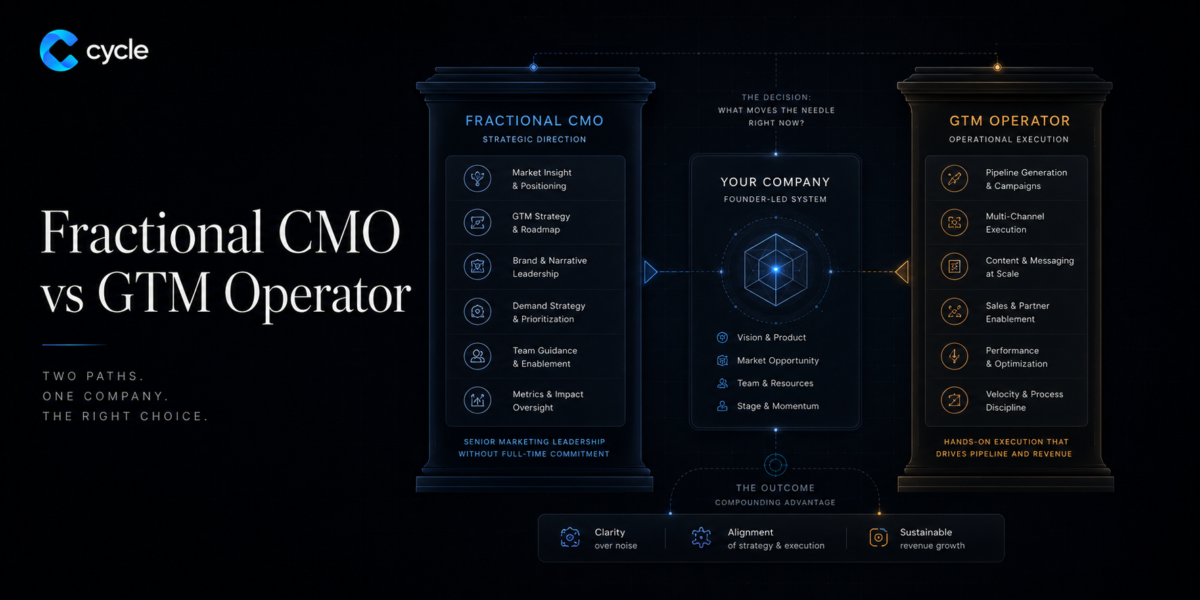
Short answer: fractional CMO vs GTM operator is a question of leadership model. A fractional CMO usually brings senior marketing direction. A GTM operator connects direction to weekly execution, proof, launch readiness, founder narrative, vendors, and market feedback.
For technical founders, the difference matters because the GTM problem is rarely only “we need a senior marketer.” The deeper problem is often that the product is complex, the market story is underdeveloped, and multiple execution pieces need to be coordinated before more attention helps.
A fractional CMO can be the right answer. A GTM operator can be the right answer. Sometimes the company needs both. The decision depends on what is actually broken.
What a fractional CMO usually solves
A fractional CMO is useful when a company needs senior marketing judgment but cannot yet hire a full-time CMO.
The role often helps with:
- marketing strategy;
- positioning review;
- channel planning;
- team structure;
- budget allocation;
- hiring priorities;
- agency/vendor selection;
- campaign direction;
- executive reporting;
- brand and growth planning.
For teams that already have execution resources, a fractional CMO can bring clarity and leadership. The person helps decide what marketing should do and how the function should mature.
That can be valuable when the company has enough internal capacity to turn direction into output.
Where fractional CMO support can fall short
The title alone does not guarantee operating ownership.
Some fractional CMOs stay at the strategy layer. They advise, review, and set direction, but the company still needs someone to translate that direction into briefs, assets, proof, content, PR angles, launch sequence, vendor coordination, and weekly execution.
That gap matters for founder-led technical companies.
If the founder is still the strongest source of market knowledge, the company may need someone close enough to extract founder context and turn it into assets. If the public proof layer is weak, the company may need someone to fix evidence and messaging before campaigns scale. If vendors are already active, the company may need someone to coordinate them instead of adding another strategic voice.
That is where a GTM operator becomes useful.
What a GTM operator solves
A GTM operator is closer to an execution-oriented control room.
The operator helps answer:
- What should the market understand first?
- What proof is missing?
- Which claims can we honestly make?
- What should the founder say publicly?
- Which assets should exist before PR, paid, or partnerships?
- Which vendor work is useful now?
- What should ship this week?
- What should be measured after the next campaign?
A GTM operator does not only define strategy. The operator keeps the system moving.
For CYCLE, this is why the GTM Control Room includes positioning, proof, content, PR/media readiness, launch readiness, public surface improvements, and vendor coordination.
Decision table
| Need | Fractional CMO | GTM operator |
|---|---|---|
| Senior marketing direction | Strong fit | Useful if tied to execution |
| Internal marketing team leadership | Strong fit | Secondary fit |
| Founder context extraction | Depends on scope | Strong fit |
| Proof-layer cleanup | Depends on scope | Strong fit |
| Weekly execution cadence | Depends on hours | Strong fit |
| Vendor coordination | Good if included | Strong fit |
| Launch readiness | Good if strategic | Strong if operating role |
| Public surface audit | Depends on background | Strong fit |
| Board-level marketing plan | Strong fit | Useful if paired with metrics |
| Early technical market clarity | Good | Strong fit |
The key question is not which title sounds more senior. It is whether the company needs direction, operating ownership, or both.
When to choose a fractional CMO
Choose a fractional CMO when:
- The company needs marketing leadership but already has execution capacity.
- The CEO wants senior planning, reporting, and prioritization.
- Channel owners need direction, not hands-on orchestration.
- The company is preparing to build an internal marketing function.
- The public narrative is mostly clear, but the marketing system needs leadership.
- There are enough team members or agencies to execute the plan.
This is often a better fit for companies that have moved past the earliest founder-led phase and need experienced functional leadership.
When to choose a GTM operator
Choose a GTM operator when:
- The founder still holds most of the strategic market context.
- The company needs to turn founder insight into public assets.
- The website, deck, content, PR, and proof do not tell one story.
- Agencies or freelancers are waiting for better briefs.
- Launch, fundraising, PR, or market expansion is approaching.
- The company needs proof and positioning fixed before bigger distribution.
- Weekly execution needs hands-on coordination.
This is often the better fit for technical founders who have substance but need a tighter market system.
Why technical founders feel this gap more sharply
Technical founders often have deep product truth but underdeveloped market translation.
They can explain the architecture, roadmap, risk, product logic, customer problem, or technical edge in detail. But the public surface may not carry that clarity. The website may sound generic. The pitch may be stronger than the homepage. The content may educate but not create demand. PR may be possible but not yet proof-ready.
A fractional CMO can diagnose this. A GTM operator should help turn the diagnosis into assets and execution.
That is the practical difference.
How CYCLE thinks about the roles
CYCLE does not frame this as a title debate. The stronger question is: who owns the operating system between founder signal and market trust?
Sometimes that person is called a fractional CMO. Sometimes they are called a GTM operator. Sometimes the founder needs a CMO-level advisor plus an operator layer.
For CYCLE, the work is founder-led GTM operation:
- sharpen the market narrative;
- audit the proof layer;
- improve the public surface;
- coordinate channel execution;
- translate founder judgment into assets;
- keep the weekly GTM rhythm moving.
The title matters less than the ownership model.
A simple diagnostic
Ask these questions before hiring:
- Do we know what our market should believe?
- Do we have visible proof to support that belief?
- Do our website, deck, founder narrative, and campaigns say the same thing?
- Do vendors know what to produce and why?
- Do we need a senior plan, or do we need someone to operate the plan?
- Can the founder's best sales explanation be turned into public assets?
- What must ship in the next two weeks?
If the answers are mostly strategic, hire senior marketing direction.
If the answers are stuck between strategy and execution, hire or embed a GTM operator.
The practical hiring sequence
For many technical founders, the best sequence is not “hire a CMO, then start marketing.” It is:
- Clarify the market story.
- Audit the proof layer.
- Fix the public surface.
- Define the operating cadence.
- Decide which specialist execution is worth buying.
- Decide whether the next leadership need is fractional CMO, GTM operator, internal hire, or agency.
This prevents a senior hire from inheriting a broken surface and a scattered vendor system.
If the company already has an internal team, a fractional CMO can make that team more strategic. If the company has founder context but not enough execution rhythm, a GTM operator may create more immediate leverage.
How to brief either role
Whether hiring a fractional CMO or GTM operator, the founder should prepare:
- the current pitch deck;
- the homepage and key landing pages;
- sales-call notes;
- investor objections;
- customer proof;
- PR or launch plans;
- current vendor list;
- existing content and analytics;
- the next 90-day business goal.
That context helps separate strategic leadership from operating work. It also makes it easier to judge whether the role is improving the system or just adding meetings.
For Web3-specific context, CYCLE's existing Fractional CMO for Web3 vs Marketing Agency article covers the narrower crypto/Web3 decision. This article should stay cross-market: AI, FinTech, Web3, B2B SaaS, DevTools, and other technical categories. If the main issue is credibility rather than leadership structure, What Is a Proof Layer Audit? is the better diagnostic path before hiring more senior marketing support.
FAQ
Can one person be both fractional CMO and GTM operator?
Yes, but only if the scope and hours support it. Some people can set strategy and operate execution. Others are stronger at one layer. The founder should hire for the real gap, not the title.
What if we already have agencies?
A GTM operator may be especially useful when agencies already exist. The operator can improve briefs, sequencing, proof, and feedback so vendor work supports one market story.
What should be measured first?
Before obsessing over channel metrics, measure whether the market surface is improving: clearer messaging, stronger proof, better internal links, stronger founder narrative, sharper campaign assets, and fewer disconnected vendor outputs.
Bottom line
A fractional CMO helps decide where marketing should go. A GTM operator helps turn founder context, proof, and market priorities into a working execution system.
For technical founders, the best next hire is the one that closes the real gap: direction, orchestration, or execution.