


GTM Readiness Scorecard for Founder-Led Startups
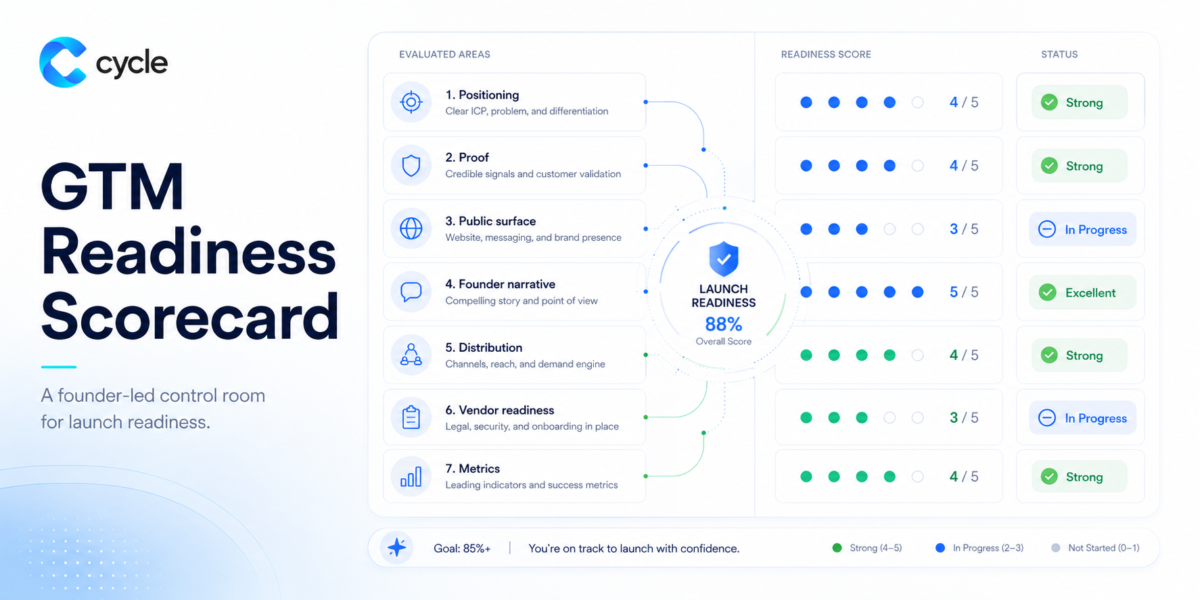
Short answer: a GTM readiness scorecard helps a founder-led startup decide whether it is ready for more market attention. It checks positioning, proof, public surface, founder narrative, distribution sequence, vendor readiness, and operating cadence before the team spends more money on PR, paid acquisition, creators, partnerships, content, or launch activity.
The scorecard is useful because many startups mistake activity for readiness.
They have a website. They have a deck. They have a product update. They may have a content calendar, a PR idea, a few agency calls, and a list of creators or partners. But the real question is different: if attention arrives tomorrow, will the market understand and trust the company fast enough to take the next step?
If the answer is no, more distribution may create more inspection than demand.
CYCLE GTM Readiness Scorecard v2.0 · Updated July 21, 2026 · Interactive and printable · 8 readiness areas · 0–16 points.
Use it before PR, paid acquisition, creator campaigns, partnerships, fundraising visibility, or a public launch. Re-score after the team completes its first remediation sprint.
Why GTM readiness matters before distribution
Founder-led companies usually move through windows of attention. A launch, funding announcement, listing, product release, major partnership, public demo, category trend, or founder post can create a short period where more people inspect the company.
That inspection is valuable only if the public surface is ready.
A readiness gap can show up in small but damaging ways:
- a strong founder post links to a vague homepage;
- PR coverage creates interest, but the proof layer is thin;
- paid traffic arrives before the offer path is clear;
- creator traffic lands on claims that do not have evidence;
- community members ask basic questions the website should answer;
- sales calls repeat explanations that should be visible publicly;
- vendors execute different versions of the story.
The issue is not that the team needs to pause every channel. The issue is that GTM needs a sequence.
The founder-led GTM readiness scorecard
Use the interactive diagnostic below for an immediate result, then keep the detailed rubric and worksheet as the evidence record. Score each area from 0 to 2.
Method: score the lowest state that can be supported with current evidence, not the state the team expects to reach. For every row, record one evidence item, one owner, and the next fix.
Evidence can be: a live URL, product screenshot, current deck section, analytics view, campaign brief, partner announcement, case study, or dated operating document.
Cadence: complete the baseline before distribution, run a 14-day remediation sprint, then score the same eight areas again.
Interactive founder-led GTM diagnostic
Calculate your GTM readiness score
Choose the state that can be proven today—not the state the team expects to reach. Your result appears after all eight areas are scored.
Your readiness band
Your three highest-priority gaps
Private by default: this diagnostic runs in your browser. CYCLE does not receive or store your answers.
0= not ready; likely to create confusion or waste.1= partially ready; can run with guardrails.2= ready enough to support distribution.
| Area | 0 — Not ready | 1 — Partial | 2 — Ready |
|---|---|---|---|
| Positioning | Market cannot quickly say what the company is | Category and ICP exist but are inconsistent | Category, ICP, pain, and timing are clear |
| Proof layer | Claims are mostly unsupported | Some proof exists but is scattered | Claims map to visible evidence |
| Public surface | Website/deck/socials contradict each other | Core pages work but gaps remain | Website, deck, FAQ, cases, and social proof align |
| Founder narrative | Founder insight stays private | Some public POV exists | Founder signal supports the category and proof |
| Offer path | Interested people do not know the next step | CTA exists but does not match buyer stage | Clear diagnostic, demo, audit, or contact path |
| Distribution sequence | Channels are chosen randomly | Priority channels exist but briefs are weak | Channels know what story and proof to repeat |
| Vendor readiness | Vendors ask basic strategy questions | Vendors can execute narrow tasks | Vendors get clear briefs, assets, and feedback loops |
| Metrics | Team tracks activity only | Some channel metrics exist | Weekly GTM metrics connect activity to market signal |
Copyable GTM readiness worksheet
Copy this table into a working document or print the page. Keep the evidence column specific enough that another operator can verify the score.
| Area | Score 0–2 | Evidence or link | Owner | Next fix |
|---|---|---|---|---|
| Positioning | ___ | ________________ | ________ | ________________ |
| Proof layer | ___ | ________________ | ________ | ________________ |
| Public surface | ___ | ________________ | ________ | ________________ |
| Founder narrative | ___ | ________________ | ________ | ________________ |
| Offer path | ___ | ________________ | ________ | ________________ |
| Distribution sequence | ___ | ________________ | ________ | ________________ |
| Vendor readiness | ___ | ________________ | ________ | ________________ |
| Metrics | ___ | ________________ | ________ | ________________ |
| Total | ___ / 16 | Baseline date: __________ · Re-score date: __________ | ||
Suggested citation: CYCLE, “GTM Readiness Scorecard for Founder-Led Startups,” version 2.0, July 2026. Author: Andre Dezigner.
This is an operator framework, not an academic benchmark. Teams should keep the same evidence standard when comparing scores over time.
Maximum score: 16.
The number is less important than the pattern. A startup with a high product score but weak proof and public surface is not ready for broad distribution. A startup with strong proof but weak channel sequence may be ready for focused content or PR, but not paid acquisition. A startup with clear positioning and proof but no operating cadence may need a GTM Control Room more than another vendor.
How to interpret the score
| Score | Meaning | Recommended action |
|---|---|---|
| 0-5 | Not ready for broad distribution | Fix positioning, proof, public surface, and offer path first |
| 6-10 | Ready for controlled market tests | Run narrow campaigns with strong guardrails and weekly review |
| 11-13 | Ready for focused distribution | Scale the channels that match proof and buyer stage |
| 14-16 | Ready for coordinated GTM push | Use PR, content, partnerships, paid, creators, and founder voice together |
A low score is not a failure. It is useful information. It tells the founder where market attention would break.
Readiness area 1: positioning
Positioning is ready when the market can quickly understand the company without the founder in the room.
Check:
- Can a buyer or partner describe the company in one sentence?
- Is the category clear without over-explaining the product?
- Is the ICP specific enough to make the offer feel relevant?
- Does the website explain why this matters now?
- Are the homepage, deck, founder bio, and PR language consistent?
If positioning is weak, do not start by increasing volume. Start by fixing the market entry point.
Readiness area 2: proof layer
Proof is ready when the company can support its claims in public.
Check:
- Which claims need customer, partner, product, traction, security, or founder evidence?
- Are proof points visible before a sales call?
- Do case studies, demos, screenshots, metrics, media, or partner signals exist?
- Are claims framed carefully enough for what the company can prove today?
- Does the proof support the category narrative?
This is why a Proof Layer Audit often comes before bigger campaigns. Distribution works better when attention lands on evidence.
Readiness area 3: public surface
The public surface includes the website, deck, blog, case studies, social profiles, launch pages, FAQ, community entry points, and founder presence.
A public surface is ready when those assets tell one story.
If the deck says one thing, the website says another, and founder posts say a third, every new channel adds friction. Buyers, investors, partners, media, creators, and community members do not inspect the company in the order the team expects. They jump between surfaces.
Readiness means those surfaces are aligned enough that inspection builds confidence instead of doubt.
Readiness area 4: founder narrative
Founder-led GTM works because the founder is still a trust asset.
But founder signal has to be operationalized. The founder does not need to become a content machine. The founder needs a repeatable way to make judgment visible.
Check:
- What does the founder believe about the category?
- What does the founder know that buyers do not yet understand?
- Which objections can only the founder answer credibly?
- What should the founder say before launch, fundraising, PR, or partnerships?
- How does founder voice support the public proof layer?
This connects directly to technical founder GTM: product depth has to become market-readable.
Readiness area 5: distribution sequence
Distribution is ready when the team knows which channels should run now and what each channel should prove.
PR, content, partnerships, paid acquisition, creators, community, founder posts, and sales enablement do not all need to start at once. The sequence depends on the readiness gaps.
A useful sequence might look like this:
- Fix category and proof.
- Update homepage, deck, FAQ, and founder narrative.
- Publish one or two proof-backed POV pieces.
- Brief PR or creators only on claims the company can support.
- Run paid only after the landing path is credible.
- Use weekly metrics to decide what to expand.
The scorecard should make this sequence visible.
Operational example
A founder-led AI startup completes the evidence-based worksheet and scores 10/16.
| Area | Score | Evidence observed |
|---|---|---|
| Positioning | 2 | ICP, pain, category, and timing are consistent across the homepage and deck. |
| Proof layer | 1 | Product proof exists, but customer evidence and case links are scattered. |
| Public surface | 1 | The homepage works, but the FAQ, proof pages, and founder profile do not yet align. |
| Founder narrative | 2 | The founder has a clear category point of view and credible product depth. |
| Offer path | 1 | A demo CTA exists, but it does not match different buyer stages. |
| Distribution sequence | 1 | PR and content are planned, but channel briefs do not share one proof hierarchy. |
| Vendor readiness | 1 | Vendors can execute tasks, but owners and approval loops remain unclear. |
| Metrics | 1 | The team tracks traffic and leads, but not qualified signal by proof asset or channel. |
Decision: do not scale paid acquisition yet. Spend the first 14 days consolidating proof, aligning the public surface, and briefing PR/content around the strongest evidence. Re-score the same worksheet before opening the paid channel.
That is how the scorecard prevents premature scaling: the total score identifies the operating mode, while the row-level evidence shows exactly what must change.
How CYCLE uses this scorecard
CYCLE uses GTM readiness as a decision layer before execution.
If the score is low, the work usually starts with proof, positioning, and public surface. If the score is medium, CYCLE can coordinate controlled distribution while fixing gaps. If the score is high, the work can move into a broader external GTM control room that connects channels, vendors, founder signal, and weekly execution.
The scorecard is not a replacement for judgment. It gives the founder and operator a shared map of what must be fixed before more attention is useful.
FAQ
What is a GTM readiness scorecard?
A GTM readiness scorecard is a diagnostic tool that checks whether a startup is ready for market-facing execution across positioning, proof, public surface, founder narrative, distribution, vendor coordination, and metrics.
Who should use a startup GTM scorecard?
Founder-led startups should use it before major launches, fundraising pushes, PR campaigns, paid acquisition, creator campaigns, partnerships, or agency engagements.
What is a good GTM readiness score?
A score above 11 usually means the company can support focused distribution. A lower score does not mean the company is weak; it means the team should fix specific market-readiness gaps before scaling attention.
Is GTM readiness the same as product readiness?
No. Product readiness means the product can deliver value. GTM readiness means the market can understand, trust, and act on that value through the company's public story, proof, channels, and operating cadence.
What should happen after the scorecard?
Turn the weakest areas into a 2-4 week GTM roadmap: fix the proof layer, sharpen positioning, align public surfaces, define channel sequence, and set weekly metrics. If several areas are weak at once, a GTM Control Room can coordinate the work.