


Technical Founder GTM: Turning Product Depth into Market Demand
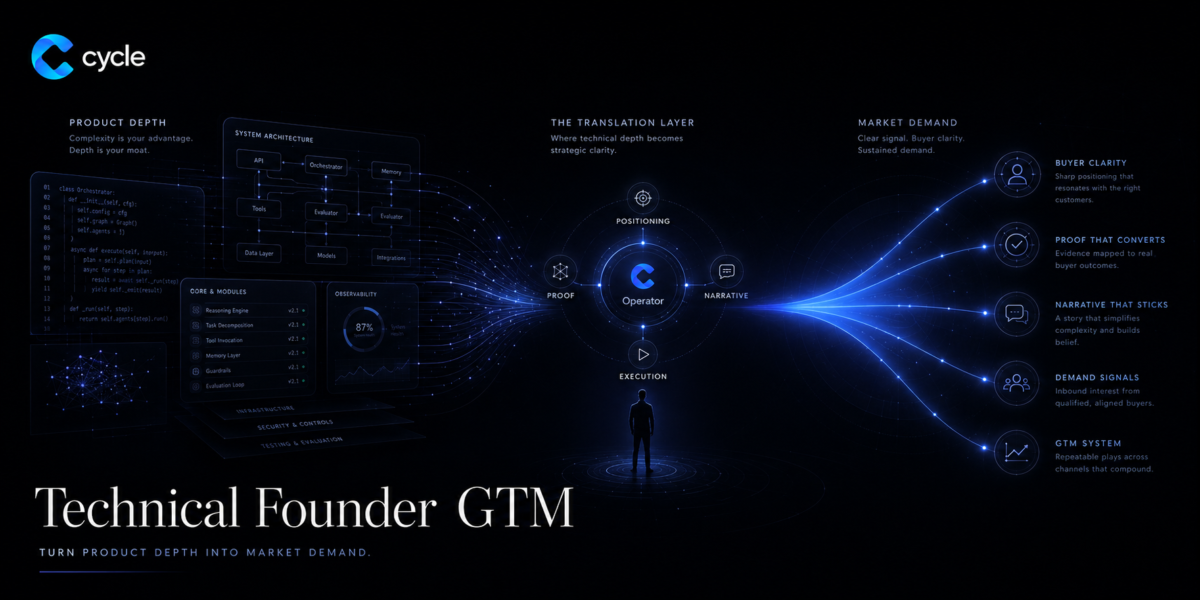
Short answer: technical founder GTM is the process of turning deep product knowledge into market clarity, trust, and demand. The founder does not need to become a full-time marketer. But the founder's judgment has to become visible through positioning, proof, content, launch assets, investor narrative, and sales-ready public surfaces.
Technical founders often have the hardest GTM translation problem. They know the product too well. They understand constraints, architecture, edge cases, roadmap, customer pain, technical tradeoffs, and why the product should exist. The market sees only a small part of that context.
The work is not to simplify the company into slogans. The work is to make the depth readable.
Why technical products struggle in the market
Technical products are often built from real insight. But real insight does not automatically create demand.
A strong AI product can look like another wrapper. A FinTech product can look risky before the trust layer is clear. A Web3 product can look speculative even when the infrastructure is serious. A DevTool can be technically elegant but commercially unclear. A cybersecurity product can be important but hard to evaluate quickly.
The market needs help answering:
- What problem is this really solving?
- Why is now the right time?
- Why should we trust this team?
- What proof exists beyond the claim?
- Who is this for first?
- What should we compare it against?
- What happens if we ignore it?
Technical founder GTM turns those answers into assets.
The founder is the strongest signal
In trust-sensitive technical markets, the founder often remains the strongest source of credibility.
That does not mean the founder should post constantly or become a personality brand. It means the founder's thinking should shape how the company explains itself.
The founder knows:
- what the market misunderstands;
- what customers ask on calls;
- what technical tradeoffs matter;
- which use cases are real;
- which claims are hype;
- where the category is moving;
- what proof should matter;
- why the product is not just another tool.
If that knowledge stays trapped in calls, investor meetings, or internal Slack threads, GTM becomes weaker than the product.
The technical founder GTM system
A GTM operator turns the founder’s product judgment and market signal into the repeatable operating layer behind these five parts.
A useful system has five layers.
1. Positioning from product truth
Positioning should not be invented in a workshop disconnected from the product. It should come from the founder's clearest understanding of the problem, the buyer, the timing, and the tradeoff.
For technical companies, the strongest positioning often comes from answering:
- What old assumption is breaking?
- What new capability is now possible?
- What buyer pain is becoming urgent?
- What category language helps the market understand this faster?
- What proof can support the claim?
The goal is not clever wording. The goal is market readability.
2. Proof before amplification
Technical founders often want to explain more. But the market usually needs to believe more first.
Proof can include:
- customer use cases;
- technical validation;
- security or compliance signals;
- partner announcements;
- product demos;
- benchmark context;
- traction metrics;
- case studies;
- founder credibility;
- community or ecosystem evidence.
A Proof Layer Audit helps identify which evidence is visible, which is missing, and what should be improved before distribution scales.
3. Founder narrative
Founder narrative is not a biography. It is the founder's point of view on the market.
A strong founder narrative explains:
- what the founder sees that others miss;
- why the category is changing;
- why the product was built this way;
- what tradeoffs the team refuses to make;
- what customers should understand before buying;
- how the company thinks about trust.
This narrative can power founder posts, homepage language, PR angles, investor updates, sales decks, launch announcements, and long-form content.
4. Public surface consistency
The website, deck, blog, docs, case studies, product pages, social channels, and PR assets should not feel like different companies.
A technical founder's best explanation should show up everywhere the market inspects the company.
That includes:
- homepage hero and section logic;
- use case pages;
- technical explainers;
- FAQ;
- proof assets;
- investor narrative;
- customer stories;
- launch materials;
- media kit;
- internal briefs for vendors.
When those surfaces align, the company becomes easier to trust.
5. GTM cadence
Technical founder GTM needs a rhythm. Otherwise every launch, post, PR push, or partner announcement becomes a one-off scramble.
The cadence should answer weekly:
- What market belief are we building?
- What proof did we add?
- What founder insight became public?
- Which page or asset improved?
- Which channel is active now?
- What did we learn?
- What should be fixed next?
This is the role of an external GTM Control Room: not just strategy, but operating rhythm.
What technical founders should not outsource too early
Technical founders should be careful about outsourcing the core story before it is clear.
Do not fully outsource:
- category definition;
- main market claim;
- proof hierarchy;
- founder POV;
- buyer urgency;
- product narrative;
- investor logic;
- trust standards.
Specialists can help express and distribute the story. But the founder's judgment has to shape it.
If a vendor writes the market story without enough founder input, the output may sound polished and still be wrong.
A practical technical founder GTM checklist
Before scaling content, PR, paid, partnerships, or launch activity, answer:
- Can a buyer understand the product in one paragraph?
- Can they understand why it matters now?
- Is the strongest proof visible on the website?
- Does the founder have a clear market POV?
- Does the homepage match the sales call explanation?
- Are technical claims supported by evidence?
- Are use cases specific enough?
- Are PR angles connected to product proof?
- Are vendors working from one brief?
- Is there a weekly GTM cadence?
If these are not true, more distribution may create more confusion.
Example: product depth without market demand
Imagine an AI infrastructure startup with a genuinely better evaluation workflow. The founder can explain why current evaluation stacks fail, where enterprise teams lose trust, and why their approach changes deployment confidence.
But the website says “AI infrastructure for better model performance.” The blog explains technical features. The deck has sharper language than the homepage. PR outreach talks about a launch but not the underlying market shift. Sales calls work because the founder fills in the missing context live.
The GTM job is not to make more noise. It is to turn the founder's explanation into a public system:
- category narrative;
- proof points;
- buyer-specific use cases;
- technical explainer;
- founder POV article;
- website credibility audit;
- PR readiness;
- metrics dashboard;
- sales narrative;
- weekly content and distribution cadence.
That is technical founder GTM.
How to turn founder context into assets
The easiest way to start is to mine the founder's existing explanations.
Look at:
- sales calls;
- investor calls;
- customer onboarding;
- product demos;
- support questions;
- internal strategy docs;
- roadmap discussions;
- objection handling;
- technical architecture notes;
- partner conversations.
Those moments often contain the clearest market language. The GTM work is to turn that raw context into reusable assets: homepage sections, explainers, FAQs, founder POV posts, proof pages, PR angles, sales narratives, investor updates, and launch materials.
This is why a technical founder does not need to become a full-time content creator. The founder needs a system that captures judgment and converts it into public trust.
The first 30 days of technical founder GTM
A practical first month can look like this:
- Audit the current public surface.
- Extract the founder's clearest product and market explanations.
- Rewrite the core positioning hierarchy.
- Identify proof assets already available.
- Create or improve one proof page, case study, or credibility section.
- Build a founder narrative outline.
- Create one strong category or market POV article.
- Prepare PR or partnership angles only after proof is visible.
- Brief vendors from the same source of truth.
- Set a weekly cadence for what ships and what gets measured.
The live CYCLE article on Founder-Led GTM Control Room explains the operating layer behind this. The service layer is the GTM Control Room, where founder signal, proof, narrative, public surface, and execution cadence are managed together.
FAQ
What is the biggest technical founder GTM mistake?
The biggest mistake is assuming product depth will be obvious to the market. It rarely is. The product has to be translated into proof, narrative, use cases, and urgency.
Should technical founders write more content?
Only if the content is connected to a GTM system. More posts without positioning, proof, internal links, and commercial intent can create noise instead of demand.
What should be fixed before paid acquisition?
Fix the claim, proof layer, landing page, use cases, founder narrative, and conversion path. Paid traffic exposes weak trust surfaces quickly.
Bottom line
Technical founders do not need to become generic marketers. They need a GTM system that makes their product depth visible, credible, and commercially useful.
The founder provides the signal. The operator turns it into positioning, proof, public assets, and execution rhythm.
That is how product depth becomes market demand.