


Founder-Led Demand Generation: What to Do Before Paid Acquisition
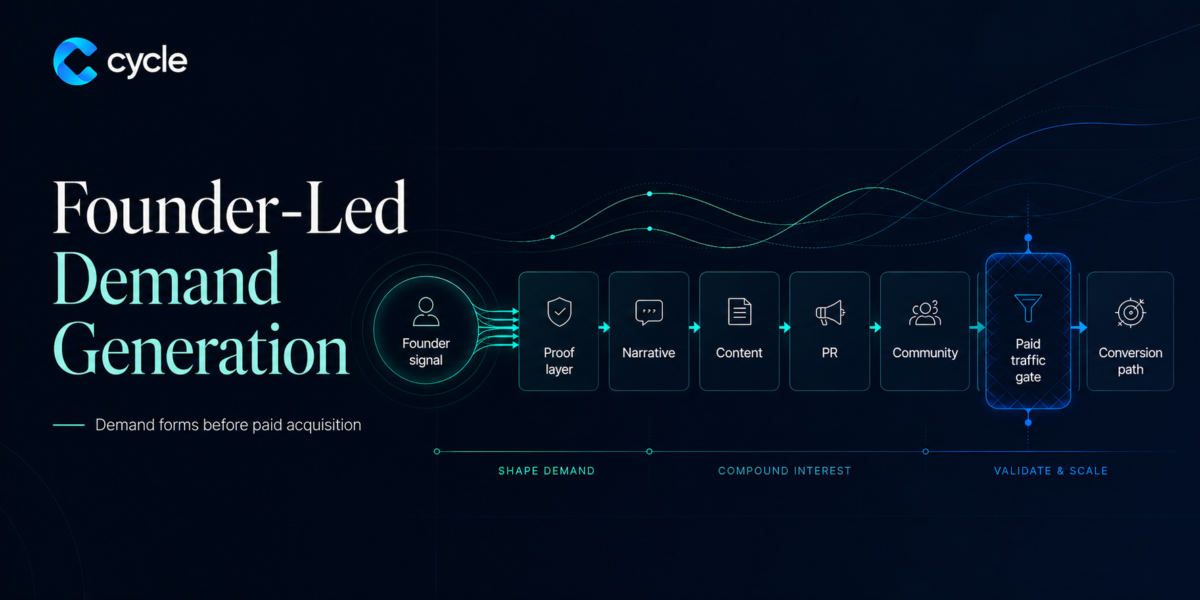
Short answer: founder-led demand generation is the work of creating market belief before scaling paid acquisition. It turns founder insight, proof, category narrative, content, PR, community, partnerships, and public trust into a demand system so paid traffic does not land on a market story that is still unclear.
Paid acquisition can be useful. But for many founder-led technical companies, paid is not the first demand problem.
The first problem is that the market does not yet understand what the company does, why it matters, who should care, and what proof makes the claim believable. If that is not solved, paid acquisition may only accelerate weak conversion.
Founder-led demand generation starts before the media budget.
Why paid acquisition is often too early
Paid traffic is a multiplier. It multiplies the quality of the message, the proof, the landing path, and the buyer's existing belief. If those pieces are weak, paid traffic makes the weakness visible faster.
Common signs that paid is too early:
- people click but do not understand the category;
- landing pages explain features but not urgency;
- proof points are missing or hard to verify;
- founder narrative is not connected to the offer;
- retargeting repeats weak claims;
- ads promise clarity that the website does not deliver;
- sales calls still have to rebuild the whole story from zero;
- the team optimizes campaigns before fixing market belief.
This does not mean a company should avoid paid forever. It means paid should enter after demand foundations exist.
What demand means in a founder-led company
Demand is not only search volume, clicks, or impressions.
For a founder-led startup, demand means the market is beginning to understand and repeat the company's logic:
- what problem matters;
- why the old way is insufficient;
- why this company is credible;
- why the timing matters now;
- what proof supports the claim;
- what next step makes sense.
The founder is central because the founder often holds the category insight before the market has language for it. The job is to turn that insight into public assets and distribution sequences.
The founder-led demand generation sequence
CYCLE uses a sequence that keeps demand generation connected to proof.
| Step | Question | Output |
|---|---|---|
| 1. Market belief | What does the market need to believe before it buys, funds, joins, or introduces us? | Belief map |
| 2. Proof layer | What evidence supports each belief? | Proof inventory and gap list |
| 3. Founder signal | What should the founder explain publicly? | POV themes and founder narrative |
| 4. Public surface | Where will new attention inspect us? | Website, deck, FAQ, cases, launch pages |
| 5. Organic signal | What can create demand before paid? | Content, PR, partnerships, community, founder posts |
| 6. Paid readiness | What should paid amplify once the story works? | Campaign angles, landing path, retargeting sequence |
| 7. Feedback loop | What does market response tell us? | Weekly GTM decisions |
The sequence matters. Paid acquisition should amplify a working belief system, not substitute for one.
Step 1: map the belief gap
Before creating demand, define the beliefs the market does not yet hold.
For a technical startup, the beliefs might be:
- this category problem is real;
- the current solution is insufficient;
- the team understands the problem deeply;
- the product has a credible advantage;
- the company is safe enough to evaluate;
- the timing is urgent;
- the next step is worth taking.
Demand generation should create those beliefs one by one.
Without a belief map, content becomes random education, PR becomes announcement chasing, and paid becomes traffic buying.
Step 2: connect belief to proof
Every belief needs proof.
If the company wants the market to believe the product is reliable, it needs product evidence. If it wants the market to believe the category is urgent, it needs founder POV, market context, or customer pain. If it wants the market to believe the company is trusted, it needs customer, partner, media, community, or founder credibility signals.
This is where demand generation connects to a Proof Layer Audit. The audit shows what demand can safely point to.
Step 3: turn founder insight into market assets
Founder-led demand generation works because the founder has non-generic context.
The founder knows:
- what customers misunderstand;
- why the category is changing;
- which objections matter;
- which use cases are strongest;
- why now is the right timing;
- which competitor assumptions are wrong;
- what proof should matter more than hype.
Those insights should become market assets:
- founder POV posts;
- category narrative;
- sales narrative;
- PR angles;
- launch story;
- content themes;
- FAQ answers;
- partner briefing language.
The founder does not need to personally execute every asset. But the demand system should carry founder judgment.
Step 4: build demand without paid first
Before paid acquisition, founder-led teams can create signal through controlled organic and trust-building channels.
Examples:
- publish a founder POV that frames the category problem;
- update the homepage around the clearest buyer trigger;
- create a proof-backed article or report;
- brief partners around one narrative;
- use PR only when the proof supports the story;
- run community conversations that answer real objections;
- publish use-case pages that match buying moments;
- turn customer or product proof into public assets.
This creates demand foundations. Paid can then accelerate what the market already has a reason to believe.
Step 5: decide when paid is ready
Paid acquisition becomes more useful when these conditions are met:
- The landing page explains the category and buyer problem quickly.
- The claim is supported by visible proof.
- The offer path matches the visitor's stage.
- Retargeting has something specific to repeat.
- The team knows which segment and belief gap it is testing.
- Sales or follow-up can continue the same narrative.
- Weekly review can distinguish channel issues from positioning issues.
If those conditions are not met, paid may produce data, but the data may not be useful. Low conversion could mean poor targeting, weak creative, unclear positioning, missing proof, wrong offer, or premature channel choice.
A GTM Control Room helps separate those issues.
Operational example
A founder-led B2B SaaS company wants to start paid acquisition.
The product solves a real workflow problem, but the website describes the product broadly. The founder explains the pain clearly in calls, but that narrative is not visible. Case evidence exists, but it is buried in sales materials. Content educates broadly but does not build urgency. Paid would send traffic to a page that requires too much interpretation.
The demand generation sequence would be:
- define the belief gap around the workflow problem;
- turn the founder's explanation into a category POV;
- create one proof-backed use case page;
- update the landing path and FAQ;
- publish founder-led content around the pain and timing;
- run a small paid test only after the proof path is visible;
- use conversion and sales feedback to adjust the narrative.
The company did not avoid paid. It made paid less wasteful.
What to measure before and after paid
Founder-led demand generation should not measure only impressions.
Before paid, track:
- direct and branded search movement;
- founder post saves, replies, and qualified comments;
- partner or investor introductions;
- PR response quality;
- content-assisted conversations;
- demo or audit requests from specific narratives;
- sales-call clarity improvements;
- objections that become easier to answer.
After paid, track:
- landing-page engagement by segment;
- proof asset clicks;
- retargeting response;
- conversion by narrative angle;
- qualified pipeline, not just lead volume;
- which objections remain unresolved.
The point is to learn which market beliefs are forming.
How this connects to CYCLE
CYCLE does not treat demand generation as “more content plus ads.”
For founder-led technical companies, demand generation is the connection between founder signal, proof, public surface, content, PR, partnerships, paid, community, and weekly execution. That is why it belongs inside the same operating layer as founder-led GTM and the external GTM control room.
The goal is to make the market ready to respond before the company pays to reach more of it.
FAQ
What is founder-led demand generation?
Founder-led demand generation is the process of turning founder insight, category narrative, proof, content, PR, partnerships, and market feedback into demand before scaling paid acquisition.
Should startups run paid acquisition before demand generation?
Sometimes small paid tests are useful. But broad paid acquisition works better when positioning, proof, landing path, founder narrative, and follow-up are ready enough to convert attention into belief and action.
How is founder-led demand generation different from content marketing?
Content marketing often focuses on publishing. Founder-led demand generation focuses on creating market belief. Content is one asset inside a larger system that includes proof, founder signal, public surface, PR, community, partnerships, and paid readiness.
What should be fixed before paid acquisition?
Fix the category story, buyer problem, proof layer, landing path, founder narrative, and follow-up sequence. Otherwise paid traffic may expose the same confusion to more people.
How can CYCLE help?
CYCLE can diagnose the proof and positioning gaps, create the market-facing assets, coordinate vendors and channels, and run the weekly GTM rhythm that turns demand generation into an operating system.