


GTM Operator Scope: What Should Be Centralized Before Launch
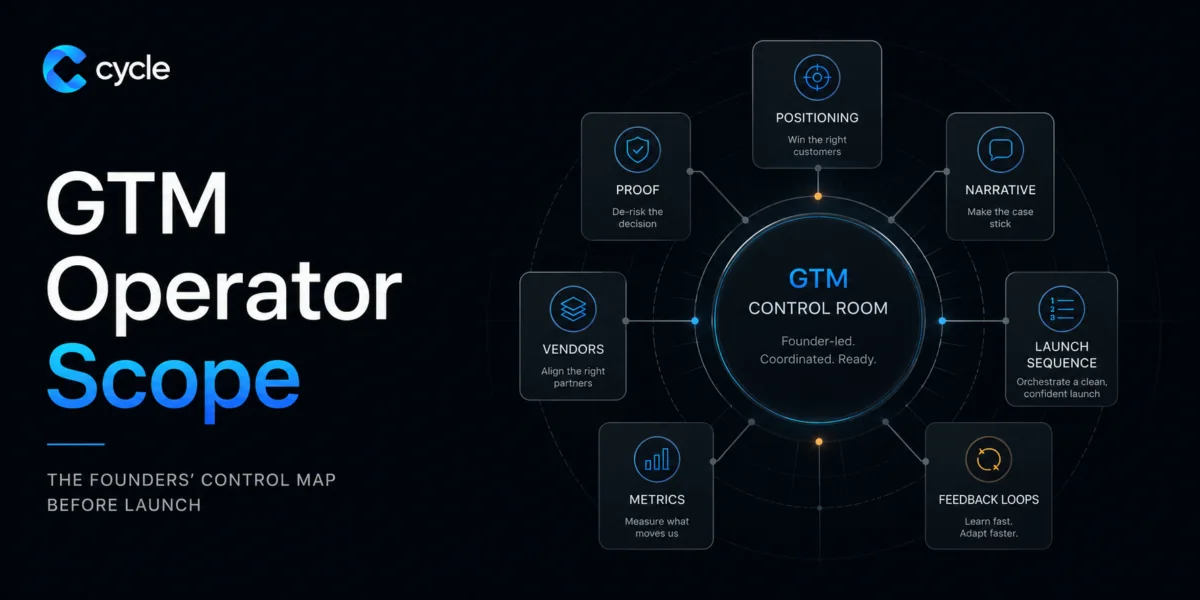
Short answer: GTM operator scope should centralize the decisions that determine whether launch activity compounds: positioning, proof, founder narrative, public surface, channel sequence, vendor briefs, metrics, and weekly decision cadence. The operator does not need to execute every task. The operator needs to own the GTM agenda so agencies, freelancers, PR partners, content teams, KOLs, paid media, and community operators are not all pulling the launch in different directions.
A founder-led launch usually fails in one of two ways. Either the company waits too long and stays invisible, or it starts buying activity before the market can understand and trust the story. The second failure mode is common in technical companies. The team has real product depth, but the launch system turns into disconnected motion: a deck, a website, a PR angle, founder posts, content, vendor proposals, and reporting that measures everything except whether the market is becoming more convinced.
That is why scope matters. A founder-led company does not need to centralize every task. It needs to centralize the judgment layer. CYCLE calls this the GTM Control Room: the operating layer that connects founder context, proof, narrative, distribution, vendors, and weekly execution.
Why scope matters before launch
Before launch, many teams ask the wrong question: “Which channels should we activate?”
The better question is: “Which GTM decisions must be owned centrally before channels create more noise?”
If those decisions are not centralized, each vendor starts solving from its own incentive. PR wants a media angle. Content wants a publishing calendar. Paid media wants landing pages and creatives. Community wants announcements and engagement hooks. KOLs want a simple story to repeat. Sales wants sharper proof. Founders want the market to understand the product without flattening it.
None of those needs are wrong. The problem is that they are not automatically aligned.
A GTM operator centralizes the operating logic before launch so the company does not outsource its sequence to the loudest vendor in the room.
What should be centralized vs delegated
The scope is not “do all marketing.” It is “own the system that makes marketing coherent.”
| GTM area | Centralize under the operator | Delegate to specialists |
|---|---|---|
| Positioning | Category, ICP, claim hierarchy, timing | Copy edits, design variants, page production |
| Proof | What must be shown, where, and in what order | Case writing, visuals, screenshots, research support |
| Founder narrative | POV, credibility, public angles | Ghostwriting, editing, repurposing |
| Public surface | What the market must understand and trust | Development, design, CMS implementation |
| PR and media | Timing, angle, proof readiness, spokesperson logic | Outreach, journalist research, press operations |
| Content | Strategic themes, internal links, commercial bridges | Drafting, editing, formatting, posting |
| Vendors | Briefs, priorities, sequencing, review criteria | Channel execution |
| Metrics | Weekly signal, decision rules, stuck points | Dashboard build, reporting exports |
The operator should not become a bottleneck for every asset. But the operator should be the person who can answer: why are we doing this now, what must it prove, and how does it connect to the rest of the launch?
Ten things to centralize before launch
- The market claim. The company needs one strongest honest claim, not ten claims and not a feature list. That claim should drive the homepage, deck, founder posts, PR angle, KOL brief, community FAQ, and sales follow-up.
- The proof hierarchy. Proof includes product evidence, customers, partners, founder track record, metrics, community behavior, technical substance, and media references. Decide which proof leads, which proof supports, and which proof is missing.
- The founder narrative. In founder-led companies, the founder is often the strongest trust signal. The operator turns founder context into public narrative: why the problem matters, what the market misunderstands, what the team has learned, and why the timing matters.
- The public surface. Inspect the homepage, product pages, social profiles, founder profile, case studies, FAQ, deck, media kit, and community entry points. If the founder explains the company better than the public surface does, launch spend will leak.
- The launch sequence. A launch is not one announcement. It is a sequence of belief-building moments: clarify, prove, warm the market, activate partners, route interest, and review signal.
- Vendor briefs. A strong brief tells every vendor the market claim, audience, proof assets, forbidden claims, timing, CTA, and review criteria. Without that, vendors produce activity. With it, vendor work can compound.
- The response path. Launch attention needs somewhere to go: demo request, investor conversation, waitlist, community, sales call, partnership intro, PR follow-up, or founder DM.
- Weekly metrics. Track whether the market is understanding the claim, which proof assets are being inspected, which objections repeat, and what should change next week.
- Internal-link and content architecture. SEO-led launch work needs canonical ownership: which page owns which keyword, which support posts link to which hub, and which internal links help buyers and Google understand the system.
- Decision cadence. The operator owns the weekly rhythm: what shipped, what changed, what is blocked, what evidence appeared, and what gets prioritized next.
What should not be centralized
Do not centralize every design variation, every social post formatting decision, every paid media optimization, every PR contact list, every community reply, every reporting export, or every CMS edit. Those should be owned by specialists, contractors, or internal team members when possible.
The operator centralizes judgment, sequence, and feedback. Execution can be distributed as long as the operating logic stays coherent.
A practical 30-day operator scope
A focused pre-launch scope can look like this:
Week 1: GTM diagnosis. Audit positioning, proof, public surface, and active vendors. Define the launch claim and audience. Identify missing proof assets.
Week 2: Message and proof system. Rewrite the claim hierarchy, build founder narrative angles, prepare proof assets, FAQ, and launch page logic.
Week 3: Channel and vendor sequence. Brief PR, content, community, paid, or creator vendors. Decide what should publish before the main announcement. Build response paths and internal links.
Week 4: Launch operating rhythm. Run weekly review, track objections, adjust messaging, and prepare the next wave after launch.
This is not a theoretical strategy sprint. The output should be visible: clearer pages, stronger proof, better briefs, sharper founder POV, and fewer disconnected vendor motions.
How CYCLE uses this scope
CYCLE’s role is not to make the founder less involved. It is to make the founder’s context usable by the market and by the execution system.
The GTM Control Room centralizes the operating layer: what should be said, proven, built, sequenced, distributed, measured, and reviewed. CYCLE then acts as the execution engine behind that agenda.
This connects to the broader founder-led GTM operator model and the GTM Readiness Scorecard: before more marketing enters the room, the company needs to know which decisions are ready and which are not.
FAQ
What is included in GTM operator scope?
GTM operator scope usually includes positioning, proof, narrative, public surface, channel sequence, vendor briefs, metrics, and weekly operating cadence. It does not mean the operator personally executes every channel task.
Is this the same as hiring a marketing agency?
No. A marketing agency usually owns a channel or service scope. A GTM operator owns the operating layer that decides how channels, vendors, proof, and founder context should work together.
When should scope be defined?
Before major launch, fundraising, PR, paid acquisition, creator outreach, or category education work. Once multiple vendors are active, scope becomes harder to reset.
What is the first thing to centralize?
Centralize the market claim and proof hierarchy first. If the company cannot clearly say what the market should believe and why it is believable, channel execution will be fragmented.
How does CYCLE help?
CYCLE works as an external GTM control room for founder-led technical companies. It connects founder signal, proof, narrative, vendors, and execution cadence before launch activity scales.
Bottom line
GTM operator scope is not a job description for a marketing generalist. It is the control layer that keeps founder-led launch work coherent.
Before launch, centralize the decisions that determine market readability. Then let specialists execute against a stronger system.