


Startup GTM Roadmap: 90 Days Before Public Launch
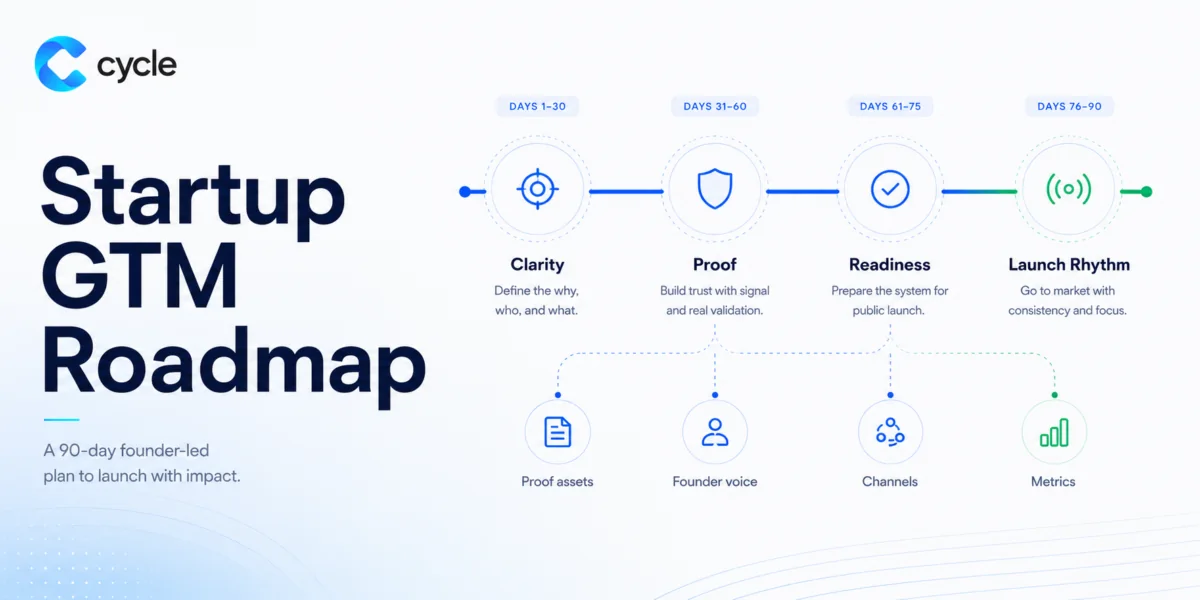
Short answer: a startup GTM roadmap should start 90 days before public launch by sequencing market clarity, proof assets, founder narrative, public surface, channel readiness, vendor briefs, and weekly decisions. The goal is not to create a huge marketing calendar. The goal is to make the company easier to understand, trust, introduce, discuss, and buy from before distribution scales.
Many startup launches are planned backwards. The team picks a launch date, then fills the calendar with announcements, posts, PR outreach, creators, emails, ads, community activity, and maybe a waitlist push. That looks like a roadmap, but it is often just a channel schedule.
A real GTM roadmap answers a harder question: what must the market believe before launch day, and what proof must exist for that belief to feel reasonable?
For founder-led technical companies, this matters because the product is rarely simple enough to sell through noise alone. AI, FinTech, Web3, infrastructure, DevTools, cybersecurity, and B2B SaaS companies usually need a clearer sequence: explain the category, prove the claim, make the founder signal visible, prepare the public surface, then activate distribution.
The 90-day roadmap principle
The best launch work happens before the announcement. By the time the company goes public with a major release, fundraising push, token event, product launch, partnership campaign, or category story, the market should already have enough context to understand the moment.
That context usually comes from four layers:
- Clarity — what the company does, for whom, and why now.
- Proof — what makes the claim believable.
- Readiness — whether the public surface can convert attention into trust.
- Rhythm — how founder voice, content, PR, community, partners, and vendors move together.
CYCLE frames this as founder-led GTM, not as a generic campaign calendar. The founder stays close to the story. The operator turns founder context into an execution system.
Days 90-61: clarify the market story
The first 30 days should not start with ads, PR blasts, or a content sprint. They should start with the story the market needs in order to care.
This phase answers:
- What category are we asking the market to understand?
- Which buyer or stakeholder should care first?
- What old way are we replacing?
- What proof do we already have?
- What claim can we make honestly?
- What should the founder be known for?
- Which objections will appear immediately?
The output is not a brand manifesto. It is a launch claim hierarchy.
| Layer | Question | Output |
|---|---|---|
| Category | Where does the company fit? | Simple category language |
| Buyer pain | What problem is expensive or urgent? | Buyer-facing problem statement |
| New way | What changes? | Clear product narrative |
| Proof | Why believe it? | Evidence map |
| Timing | Why now? | Market timing argument |
| Founder POV | Why this team? | Public founder narrative |
If the team cannot explain the company clearly at day 90, it will not become clearer because more people are posting on launch week. For teams unsure where to start, CYCLE’s Founder-Led Positioning Audit is the right first diagnostic.
Days 60-31: build the proof layer
The second 30 days should make the company more believable.
A proof layer can include product screenshots, customer or user signals, partner logos, founder track record, technical explanations, case studies, data points, security notes, community activity, investor references, public roadmap evidence, or media-ready facts.
The question is not “how much proof do we have?” The question is “what proof will the market inspect when attention arrives?”
This phase should produce:
- A proof map: what evidence exists and where it should live.
- A public FAQ: answers to predictable objections.
- A founder proof narrative: why this team can credibly build the product.
- A launch page or homepage section: visible evidence, not just claims.
- A media or partner brief: facts that others can repeat.
The Proof Layer Audit exists for this reason. It checks whether the company’s public surface gives the market enough evidence before PR, paid acquisition, creators, or community growth are scaled.
Days 30-15: prepare distribution without outsourcing the agenda
The third phase turns the story and proof into channel-ready execution. This is when teams usually start briefing PR, content, paid media, creators, community, partners, sales, founder social, and internal team members.
The operator’s job is to keep these motions connected. Each channel needs the same inputs: market claim, proof points, audience priority, forbidden claims, launch sequence, CTA, response path, and review criteria.
Without those inputs, each channel writes its own version of the company.
A 90-day roadmap should also decide which channels should wait. Sometimes the right move is to publish founder POV, proof assets, and category education before buying attention. This is the logic behind Founder-Led Demand Generation: demand generation should clarify the market story and proof layer before paid acquisition scales traffic.
Days 14-0: run launch rhythm, not launch chaos
The final two weeks should be about coordination. The team should know what publishes first, who amplifies, what founder post leads, what proof asset supports, what PR angle is used, what the website says, what community moderators answer, where interested people go, and what gets measured daily.
A launch rhythm can look like this:
| Timeframe | Focus | Example output |
|---|---|---|
| 14-10 days | Warm market context | Founder POV, category post, proof asset |
| 9-5 days | Build confidence | Case, demo, FAQ, partner proof, waitlist push |
| 4-1 days | Prepare announcement | Briefs, media kit, community answers, launch page |
| Launch day | Coordinate attention | Founder post, announcement, PR, social, community, partner posts |
| 1-7 days after | Convert and learn | Follow-up content, objection answers, retargeting, sales routing |
This is where an external GTM control room becomes useful. Someone needs to connect the founder, product, proof, and distribution system while the launch is moving.
The startup GTM roadmap checklist
Before public launch, a founder-led team should be able to answer yes to these questions.
Clarity
- Can a buyer understand the category in one minute?
- Is the main claim specific enough to be believable?
- Is the old way / new way distinction clear?
- Does the homepage match the deck and founder explanation?
Proof
- Does the public surface show why the claim is credible?
- Are the strongest proof points easy to find?
- Are weak or unsupported claims removed?
- Are predictable objections answered?
Founder signal
- Does the founder have a clear public POV?
- Are founder posts connected to launch goals?
- Is the founder’s credibility visible without overclaiming?
Distribution and learning
- Are PR, content, paid, community, and partner teams using the same narrative?
- Does each channel have a role in the sequence?
- Is there a response path for interested buyers, partners, investors, or users?
- Is there a weekly decision rhythm?
If too many answers are unclear, the company may still launch, but it should not pretend the launch is a complete GTM system.
How CYCLE helps with the roadmap
CYCLE does not treat the roadmap as a static document. The roadmap becomes the weekly GTM operating system.
The GTM Control Room helps founder-led companies decide what should be clarified, proven, published, sequenced, briefed, and measured before launch. CYCLE then turns that into public assets, internal briefs, channel coordination, and execution cadence.
FAQ
What is a startup GTM roadmap?
A startup GTM roadmap is the sequence of positioning, proof, public surface, channel readiness, launch activity, and post-launch learning that helps a company go to market coherently.
Is 90 days always necessary?
No. Some launches move faster. But the 90-day model is useful because it forces the team to build clarity and proof before the final distribution push.
What should happen first in a GTM roadmap?
Start with positioning and proof. If the market claim is unclear or unsupported, channel execution will amplify ambiguity.
Is this different from a marketing plan?
Yes. A marketing plan often lists channels and deliverables. A GTM roadmap connects market story, proof, founder signal, distribution, response path, and weekly decisions.
How does CYCLE use this roadmap?
CYCLE uses it as the operating layer for founder-led GTM: clarify the story, build the proof layer, brief vendors, sequence channels, and run the weekly control room around launch.
Bottom line
A startup GTM roadmap is not a launch calendar. It is the operating sequence that makes launch attention more likely to convert into trust, conversations, and demand.