


External GTM Control Room for Founder-Led Companies
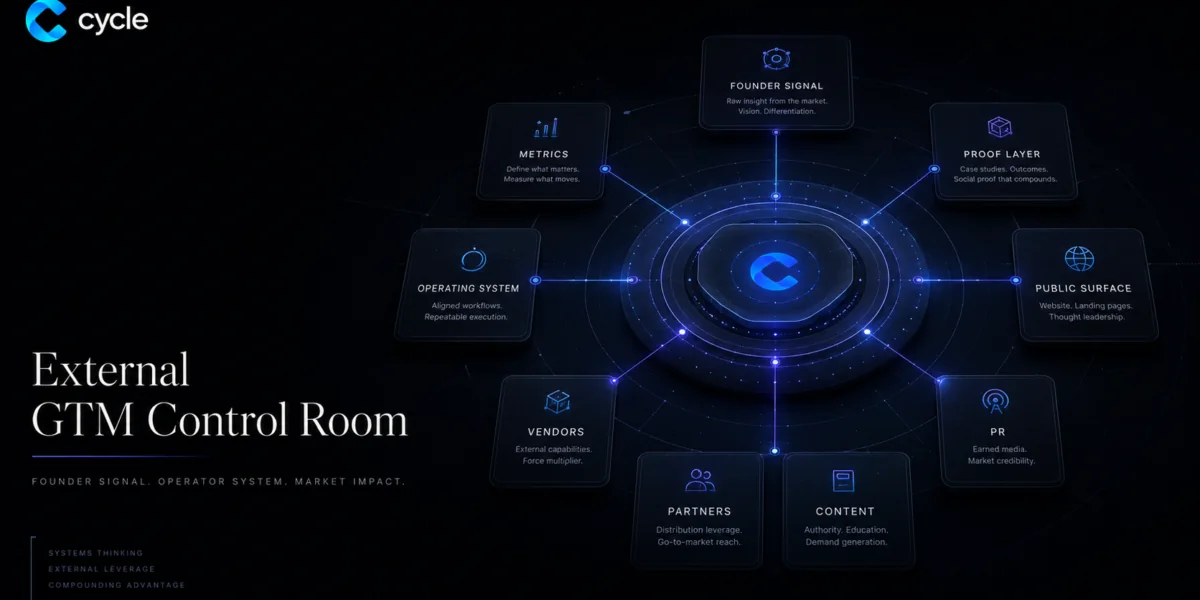
Short answer: an external GTM control room is the operating layer that keeps positioning, proof, narrative, launch readiness, PR, content, partnerships, vendors, and execution moving in one direction. For founder-led technical companies, it prevents GTM from becoming a pile of disconnected channel work.
CYCLE originally described this as founder-led GTM because the founder is still the strongest source of strategic signal. But the more precise role is a control room: a place where the market story, proof system, channel priorities, and weekly execution rhythm are coordinated together.
That matters because many technical companies already have pieces of GTM. They have a website, a deck, product updates, investor materials, PR ideas, maybe community channels, founder posts, design assets, agencies, freelancers, or internal marketers. What they often lack is one operating system that makes those pieces compound.
Why technical companies need a control room
In technical markets, the product is rarely simple. AI, FinTech, Web3, infrastructure, DevTools, cybersecurity, and B2B SaaS products often require explanation before demand can form.
That creates a common failure pattern.
The founder can explain the company clearly on a call. The product has real substance. The team has proof, roadmap, customers, technical depth, or category insight. But the market sees a weaker version:
- a homepage that sounds too broad;
- a deck that does not match the website;
- PR angles without enough evidence;
- content that educates but does not build urgency;
- paid or creator traffic landing on a thin proof layer;
- vendor work that looks busy but does not sharpen the story;
- launch assets that are produced too late or in the wrong order.
The company does not need more random marketing. It needs control.
What the external GTM control room owns
The control room owns the connection between strategy and execution.
It does not mean one person does every task. It means one operating layer decides what needs to happen, in what order, with what proof, and how each output supports the same market objective.
| Control room layer | What it coordinates | Output |
|---|---|---|
| Positioning | Category, audience, claim hierarchy, timing | Clear market narrative |
| Proof | Customers, partners, traction, product evidence, founder credibility | Stronger public trust layer |
| Public surface | Website, deck, case studies, FAQs, launch pages | Easier buyer/investor inspection |
| Distribution | PR, content, partnerships, community, paid, creators | Channels pointing to the same story |
| Vendor system | Briefs, priorities, feedback, quality bar | Less fragmented execution |
| Cadence | Weekly roadmap, owners, deadlines, metrics | GTM that keeps moving |
This is the practical reason CYCLE offers a GTM Control Room instead of only selling channel deliverables.
The difference between a control room and an agency
A traditional agency usually starts with a scope: content, PR, paid media, design, social, community, SEO, or campaign execution.
An external GTM control room starts with the system:
- What does the market need to believe?
- What proof can we show now?
- What claims are unsupported?
- Which audience matters first?
- Which channels are premature?
- Which assets should be fixed before more distribution?
- What should the founder say publicly?
- Which vendors need clearer briefs?
- What should change this week?
An agency can still be valuable. But without the control room, agencies often receive unclear briefs and produce disconnected work.
The control room makes channel execution easier to brief, easier to coordinate, and easier to judge.
The CYCLE control room model
CYCLE's model has five operating loops.
1. Founder signal loop
The founder holds context that the market needs: why the product exists, why now, what tradeoffs matter, what customers misunderstand, and what the category is becoming.
The control room turns that signal into market assets: homepage language, founder POV, launch narrative, investor story, PR angles, content themes, and sales proof.
2. Proof layer loop
Before distribution scales, the company needs proof that can carry attention. That can include customer evidence, partner signals, traction metrics, product screenshots, use cases, founder credibility, technical validation, community activity, or case studies.
A Proof Layer Audit identifies what is visible, what is missing, and what should be fixed before campaigns send more people to the public surface.
3. Public surface loop
The website, deck, blog, case studies, social channels, product pages, launch pages, and FAQ need to tell one story. If they contradict each other, buyers and investors feel the friction even when they cannot name it.
The control room keeps those surfaces consistent.
4. Distribution loop
PR, content, partnerships, community, paid media, and creator work should not be independent campaigns. They should be distribution paths into the same proof and narrative system.
If PR says one thing, content says another, and the website says a third, the market slows down.
5. Weekly operating loop
GTM needs cadence. Each week should clarify what is being shipped, what is being learned, what proof was added, what channels are active, and what needs to be fixed before the next push.
The control room keeps that rhythm visible.
When a company should use one
An external GTM control room is useful when:
- The founder is still central to sales, fundraising, partnerships, or market trust.
- The product is technical or difficult to explain quickly.
- The team is preparing for a launch, fundraising push, listing, PR moment, market expansion, or category education sprint.
- Multiple vendors or contributors are involved.
- The public surface does not reflect the strength of the product.
- More distribution would expose weak proof.
- The founder knows what should be true but needs help turning it into assets and execution.
The control room is less useful when the company only needs a narrow production vendor and already has strong internal GTM leadership.
A simple control room checklist
Before scaling a campaign, ask:
- Is the main claim clear?
- Is the claim supported by visible proof?
- Does the homepage match the pitch deck?
- Does the founder narrative match the product narrative?
- Are PR, content, and partner messages using the same language?
- Do vendors have one shared brief?
- Are we sending attention to pages that can convert trust?
- Do we know what changed this week?
- Do we know what to fix before the next push?
If the answer is no, the company does not have a channel problem yet. It has a control room problem.
What should come out of a control room sprint
A control room sprint should not end with vague strategic alignment. It should produce assets and decisions that make the company easier to operate.
Useful outputs include:
- a positioning hierarchy that explains the strongest claim and supporting proof;
- a public-surface audit of the website, deck, blog, social channels, and proof assets;
- a founder narrative that can be reused across posts, PR, investor updates, and sales;
- a campaign sequence for launch, fundraising, expansion, or category education;
- a vendor brief system that prevents every specialist from inventing their own interpretation;
- a proof backlog: what evidence needs to be created, improved, or made visible;
- a weekly GTM dashboard that shows what shipped, what changed, and what is next.
The point is not to create a heavier process. The point is to remove ambiguity from the work that already needs to happen.
How this connects to the founder-led GTM cluster
This page is the hub for CYCLE's control-room model. For the broader role definition, read Founder-Led GTM Operator: What It Is and When You Need One. If the question is whether to hire an agency or keep GTM closer to the founder, read Founder-Led GTM vs Marketing Agency.
For founder-led teams comparing senior GTM roles, Fractional CMO vs GTM Operator for Technical Founders explains the decision. For deeply technical products, Technical Founder GTM shows how product depth becomes market demand.
The existing live page already explains why CYCLE works as an external control room. This refresh broadens the positioning so it is not read as Web3-only. The refreshed angle is clearer for founder-led technical companies across AI, FinTech, Web3, B2B SaaS, DevTools, infrastructure, cybersecurity, and other trust-sensitive markets.
It should also link more deliberately to CYCLE's proof-layer language. The live explainer What Is a Proof Layer Audit? gives readers the diagnostic layer behind the control room model, while PR & Media Readiness shows how one channel becomes stronger when the proof and narrative are ready.
FAQ
Is an external GTM control room a replacement for an internal team?
No. It can support an internal team, coordinate specialists, or help before the company is ready to hire a full GTM function. The value is operating ownership and market clarity.
How is this different from consulting?
Consulting often stops at recommendations. A control room should stay close to execution: briefs, assets, reviews, priorities, launch sequence, and weekly decisions.
When should a founder use one?
Use one when the product is real but the market story, proof layer, public surface, and channel execution are not yet connected.
Bottom line
An external GTM control room helps founder-led companies stop treating GTM as scattered channel work.
It creates the operating layer between founder judgment and market execution: positioning, proof, narrative, public surface, distribution, vendors, and cadence.
For CYCLE, that is the core role. Not louder marketing. Clearer market trust, sharper proof, and a GTM system that can actually carry attention.