


Founder-Led GTM vs Marketing Agency: What to Build, Buy, or Orchestrate
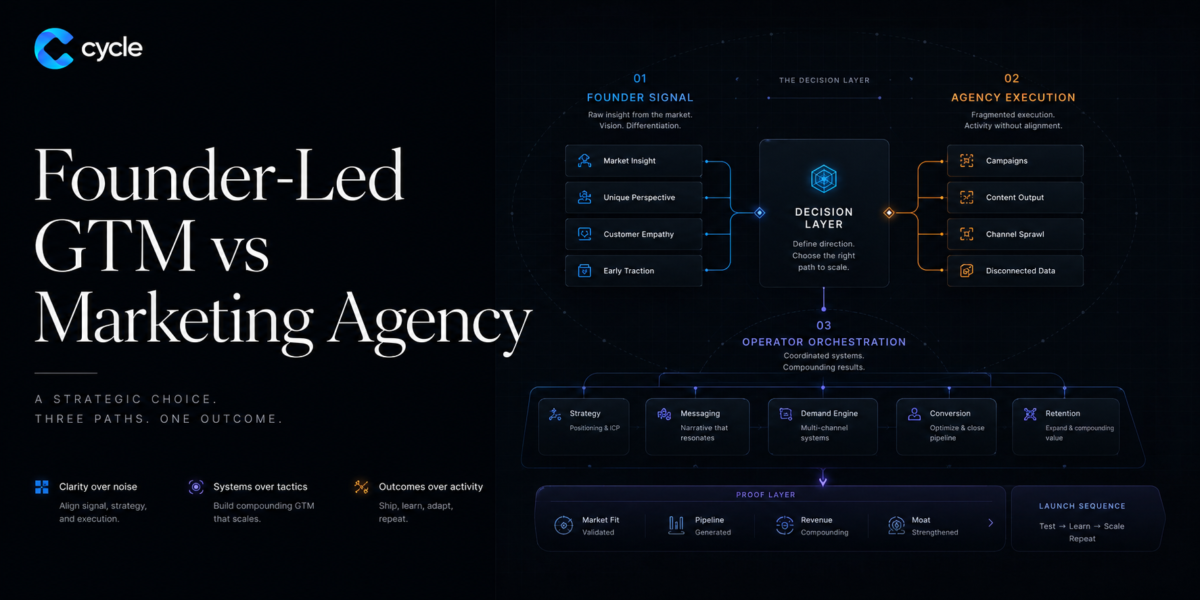
Short answer: founder-led GTM vs marketing agency is not a choice between doing everything yourself and outsourcing everything. The real question is what the founder must own, what an operator should orchestrate, and what specialist vendors should execute.
A marketing agency can help with channels. A founder-led GTM system decides what those channels should say, what proof they should point to, and how each motion supports the same market objective.
That distinction matters for technical companies. AI, FinTech, Web3, DevTools, cybersecurity, infrastructure, and B2B SaaS teams often fail not because nobody is “doing marketing,” but because too many people are doing disconnected marketing.
The wrong question: should we hire an agency?
The better question is: what part of GTM is actually broken?
If the problem is production capacity, a specialist agency may help. If the team needs more design output, paid media management, PR pitching, SEO writing, community moderation, or short-form content production, a vendor can be useful.
But if the problem is unclear positioning, weak proof, inconsistent founder narrative, disconnected launch assets, or vendor chaos, an agency alone will not fix it.
That is why many founder-led companies end up with activity but not momentum:
- content is published, but it does not sharpen demand;
- PR outreach happens, but the story is not proof-ready;
- paid campaigns run, but the landing page cannot carry trust;
- founder posts get attention, but they are not connected to pipeline;
- agencies ask for briefs, but the founder has not yet clarified the market story;
- every vendor reports progress, but the company does not feel clearer from the outside.
The issue is not effort. It is missing operating ownership.
What founder-led GTM should own
Founder-led GTM means the founder remains the source of strategic signal. The founder understands the product, the customer pain, the tradeoffs, the category, and the reason the market should care now.
That does not mean the founder should write every post, manage every channel, or brief every vendor manually.
It means the GTM system should be built around the founder's judgment.
Founder-led GTM should own:
- The strongest honest market claim.
- The category narrative.
- The buyer or investor urgency.
- The proof that makes the claim believable.
- The public voice of the company.
- The launch or expansion sequence.
- The standard for what good execution looks like.
If those decisions are outsourced too early, the company can become easier to market but harder to believe.
What a marketing agency is good for
A marketing agency is useful when the company has enough strategic clarity to brief execution.
An agency can help with:
- content production;
- SEO operations;
- paid media;
- PR outreach;
- design and creative;
- campaign management;
- community activation;
- social calendars;
- analytics and reporting;
- specific launch assets.
The agency model works best when the company already knows what it wants to say, who it needs to reach, what proof it can show, and how success will be measured.
If those inputs are weak, the agency is forced to guess. Good agencies may push back. Average agencies will simply produce.
That is where founder-led companies often waste budget.
What a GTM operator does differently
For the complete role definition, see what a GTM operator does and owns.
A GTM operator sits between founder strategy and channel execution.
The operator does not just ask, “What deliverables do you need?” The operator asks:
- What does the market need to believe first?
- What proof is missing?
- Which claims are too early?
- Which audience should be prioritized now?
- Which vendor work is useful, and which is premature?
- What should the founder say publicly?
- Which assets should exist before more distribution spend?
- What should the next two weeks change?
For CYCLE, that operating layer is the GTM Control Room: positioning, proof, narrative, distribution readiness, vendor coordination, and execution rhythm connected in one system.
Decision table: build, buy, or orchestrate
| Situation | Best move | Why |
|---|---|---|
| Founder has clear positioning but no content capacity | Buy specialist execution | The brief is clear enough for production |
| Founder has a strong product but weak market story | Build founder-led GTM system | The problem is narrative, not output volume |
| Multiple vendors are active but disconnected | Add GTM operator | Someone must own orchestration |
| Launch is approaching and proof assets are weak | Fix proof layer before distribution | Attention will expose gaps |
| Paid or PR is underperforming | Audit message and proof before scaling spend | Channels may not be the root cause |
| Founder is still the best salesperson | Operationalize founder signal | Turn calls and judgment into assets |
| Team needs category education | Build content/narrative architecture | Random posts will not create market understanding |
| Existing agency asks for better briefs | Add operator layer | Better briefs require strategic ownership |
This is not anti-agency. It is anti-fragmentation.
When a marketing agency is the wrong first hire
A marketing agency is usually the wrong first move when the company cannot yet answer these questions:
- What exactly should the market believe after visiting the website?
- Which proof makes that belief credible?
- Which customer, investor, partner, or ecosystem segment matters first?
- What should the founder be known for?
- Which channels are premature until the public surface improves?
- What does the next launch or campaign need to prove?
- Which assets should every vendor reuse?
If those answers are missing, an agency may increase execution surface area while spreading the confusion wider.
When an agency is the right move
An agency becomes much more useful when the operating layer is in place.
Once positioning, proof, narrative, and priorities are clear, specialist vendors can accelerate specific parts of the system:
- PR can pitch a sharper story;
- content can build topical authority;
- designers can turn proof into better public assets;
- paid media can test messages instead of guessing;
- community teams can activate around a clear launch motion;
- partner campaigns can point to consistent proof.
The founder-led GTM operator does not replace specialists. It makes them easier to brief and easier to judge.
The CYCLE view
For the Web3-specific execution model, see how a Web3 marketing agency should connect proof, launch readiness, KOLs, PR, and community.
For technical companies, the market often needs orchestration before amplification.
That is especially true when the company sells something complex, trust-sensitive, or category-shaping. The work is not only “marketing.” It is making the company readable to the people who matter.
CYCLE's role is to help founders decide what to build, what to buy, and what to orchestrate:
- build the narrative and proof layer;
- buy specialist execution where it has clear leverage;
- orchestrate the system so channels compound instead of competing.
That is the practical difference between founder-led GTM and a traditional agency engagement.
How to avoid the common hybrid mistake
Many founder-led companies try to combine founder input and agency execution, but they skip the operating layer between them.
The founder gives scattered context. The agency turns that context into deliverables. The team reacts to deliverables one by one. Eventually everyone is busy, but nobody is sure whether the market is becoming clearer.
A better hybrid model has three layers:
- Founder signal — product truth, market insight, customer pain, category judgment, and timing.
- Operator layer — positioning, proof hierarchy, campaign sequence, vendor briefs, internal priorities, and weekly decision-making.
- Specialist execution — PR, content, paid media, design, community, analytics, SEO, partnerships, or creative production.
When those layers are separated, the company can buy execution without outsourcing judgment.
What to fix before hiring more vendors
Before hiring another agency, freelancer, or specialist, founders should check whether the operating inputs are strong enough.
A vendor brief should include:
- the primary audience;
- the main market claim;
- the proof points that support the claim;
- the founder POV;
- the campaign objective;
- the assets that already exist;
- the assets that should not be used;
- the internal owner for feedback;
- the definition of quality;
- the metric that matters after launch.
If those inputs are missing, the vendor will either ask strategic questions or produce generic work.
CYCLE's live article on Web3 Marketing Agency vs In-House Team covers the Web3-specific version of this decision. This page is broader: it applies to technical founder-led companies across AI, FinTech, Web3, B2B SaaS, DevTools, and DeepTech.
FAQ
Should early-stage founders avoid agencies completely?
No. Agencies can be useful when the work is clear. The mistake is asking an agency to solve an undefined GTM system through channel deliverables alone.
What should stay founder-led?
The founder should stay close to category narrative, product truth, proof standards, customer pain, and market timing. Those decisions can be supported by an operator, but they should not be fully outsourced too early.
Where does CYCLE fit?
CYCLE fits between founder signal and specialist execution. The GTM Control Room helps define the market story, proof layer, priorities, and briefs so execution can compound instead of fragmenting. If the proof system itself is weak, the live explainer What Is a Proof Layer Audit? shows how to diagnose what the market can actually verify before more channel spend.
Bottom line
If the problem is output, hire production help.
If the problem is market clarity, proof, narrative, launch readiness, or vendor coordination, start with a GTM operator.
The best system is rarely founder-only or agency-only. It is founder-led, operator-orchestrated, and specialist-supported.