


Web3 Marketing Agency vs In-House Team: What to Build, Buy, or Orchestrate
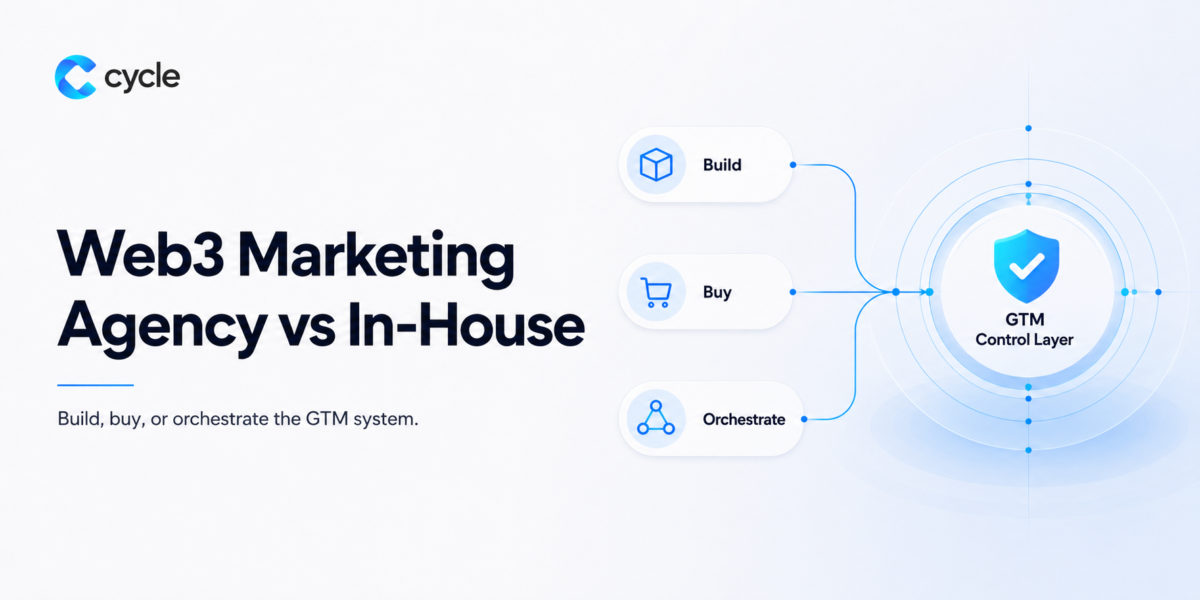
Short answer: the Web3 marketing agency vs in-house question is usually framed too narrowly. The real decision is what the team must own internally, what can be outsourced safely, and what needs senior orchestration so vendors, channels, founder voice, proof, community, PR, KOLs, and execution move in one sequence.
Most Web3 teams do not fail because they picked an agency instead of an in-house marketer.
They fail because nobody owns the GTM sequence.
A founder hires a KOL agency before the proof layer is ready. A community manager posts without a narrative. PR pitches a story the website cannot support. A designer ships assets before the claim hierarchy is clear. An in-house marketer tries to manage eight vendors while also waiting for founder approvals.
The question is not: agency or in-house?
The better question is:
What should we build, what should we buy, and what must be orchestrated by someone who owns the GTM agenda?
Why the Agency vs In-House Debate Breaks
The classic argument says agencies bring speed, networks, and specialist execution, while in-house teams bring context, ownership, and long-term learning.
That is true, but incomplete.
Web3 adds extra pressure:
- claims get inspected publicly;
- communities ask questions in real time;
- KOLs can amplify both clarity and confusion;
- token, listing, fundraising, and partner language can create risk;
- public proof matters before distribution scales;
- founder credibility often becomes part of the GTM asset.
In this environment, an agency can create more output without creating more trust. An in-house team can protect context but still move too slowly for launch windows. Freelancers can ship assets but rarely own the system. A fractional operator can help, but only if execution capacity exists behind the strategy.
That is why CYCLE uses a simple decision model:
Build the ownership layer. Buy specialist capacity. Orchestrate the market-facing system.
What Should Stay Internal
Some work should not be outsourced casually because it depends on product truth, founder judgment, and fast decisions.
Keep these inside the company or close to the founder:
- Positioning decisions. What the project is, what it is not, who it is for, and why the market should care now.
- Proof governance. Which claims have evidence, which claims need softer wording, and which claims should not be made publicly.
- Founder voice. The founder does not need to become a full-time creator, but the market should be able to see judgment, priorities, and context.
- Approval authority. During launch, listing, funding, PR, or community pressure, someone must approve fast without rewriting the strategy every day.
- Business priorities. Marketing should know what matters this month: users, partners, investors, ecosystem support, listing readiness, product education, or reputation repair.
If those decisions are weak, the agency will not fix the root problem. It will package uncertainty into campaigns.
What Can Be Outsourced
Outsourcing works when the brief is clear and the surface is ready.
Good candidates for external execution:
- creative production;
- landing page design and build;
- short-form content adaptation;
- KOL sourcing and scheduling;
- PR outreach once the angle is real;
- community operations and moderation;
- AMA coordination;
- paid media operations;
- reporting production;
- technical SEO and publishing support.
These tasks can move faster outside the company because they require specialist execution and repeatable process.
But outsourcing becomes expensive when the vendor is forced to guess the story.
A KOL vendor should not decide the token narrative. A PR team should not invent the founder position. A community contractor should not determine what the project means. Paid media should not compensate for a public surface that cannot convert attention into trust.
What Needs Orchestration
Between ownership and execution sits the layer most teams miss.
This is the orchestration layer.
It connects:
- positioning;
- proof assets;
- founder voice;
- service/vendor briefs;
- KOL and PR timing;
- community readiness;
- campaign sequencing;
- reporting and next decisions.
Without orchestration, every vendor optimizes for their own lane. The PR team wants a press angle. The KOL team wants creator posts. The community team wants activity. The paid team wants landing pages. The founder wants traction. The market wants clarity.
Those goals are not automatically aligned.
The job of a GTM Control Room is to keep them aligned.
The CYCLE Build / Buy / Orchestrate Framework
Use this framework before hiring anyone.
Build
Build internally when the work requires founder context or product truth.
Examples:
- positioning and category choices;
- claim boundaries;
- founder POV;
- product explanation;
- partner/investor priorities;
- final approval logic.
The internal team does not need to do all the work. But it must own the truth.
Buy
Buy externally when the work is execution-heavy and can be briefed clearly.
Examples:
- design;
- motion;
- PR outreach;
- KOL management;
- community operations;
- content adaptation;
- paid media;
- production systems.
External capacity is powerful when it receives a strong brief. It is dangerous when it receives a vague wish.
Orchestrate
Orchestrate when multiple channels need one sequence.
Examples:
- pre-TGE launch readiness;
- founder-led fundraising narrative;
- KOL + PR + community campaign;
- social proof cleanup before paid traffic;
- listing readiness;
- reputation or trust repair;
- market expansion.
This is where CYCLE fits best: not as a disconnected vendor, but as the operator layer that connects strategy, proof, founder signal, vendor coordination, and market-facing execution.
Comparison Table
| Model | Best for | Risk | What must be true | | — | — | — | — | | In-house team | Long-term ownership and context | Slow learning curve, narrow skill set | Founder can hire and manage well | | Agency | Specialist execution and speed | Output without ownership | Narrative and proof are already clear | | Freelancers | Specific production tasks | Fragmentation | Strong internal briefs exist | | Fractional CMO | Senior judgment without full-time hire | Strategy without capacity | Execution engine is available | | External GTM control room | Complex launch / trust / vendor sequence | Requires founder access | Founder wants one operating rhythm |
No model is automatically better.
The wrong model is the one that leaves the GTM agenda unowned.
When to Choose In-House
Choose in-house first when:
- the category is extremely technical;
- founder approvals are constant;
- product knowledge changes weekly;
- marketing is tied closely to sales, BD, or investor conversations;
- the company can afford senior talent and give them authority.
In-house wins when compounding knowledge matters more than speed.
But do not mistake hiring for ownership. A junior marketer cannot own founder-level positioning if the founder is not participating.
When to Choose an Agency
Choose an agency when:
- the story is already clear;
- the proof layer exists;
- the approval loop is fast;
- the team needs multi-skill capacity quickly;
- the campaign has a defined window.
A Social Proof Package can work well here because it is not just “more marketing.” It fixes the public surface that distribution depends on: proof assets, founder signal, community readiness, narrative clarity, and trusted activity.
When to Choose an External GTM Control Room
Choose an external GTM control room when the company has too many moving parts for a normal vendor relationship.
This usually happens before:
- TGE;
- listing;
- fundraising;
- major partnership announcement;
- new market entry;
- reputation-sensitive PR;
- KOL/community campaign;
- founder-led visibility push.
The team does not only need execution. It needs sequence.
That is the role CYCLE plays around founder-led teams: make the company easier to understand, trust, introduce, discuss, and buy from before more vendors enter the room.
Mistakes to Avoid
Mistake 1: Hiring vendors before the narrative is stable
If vendors receive different versions of the story, the market will see different versions too.
Mistake 2: Buying KOLs before the proof surface is ready
KOLs create inspection. They do not create proof. If the public surface is thin, KOL attention exposes the gap.
Mistake 3: Building in-house too early
A full-time hire can be the right move, but not if the company still needs senior sequencing, proof cleanup, and channel architecture first.
Mistake 4: Treating community as a separate function
Community is part of the public proof surface. It should connect to founder voice, narrative, proof, and response ownership.
Mistake 5: Letting channels set the agenda
If the PR agency, KOL manager, paid ads team, or community vendor defines the next priority, the company has already outsourced too much of its GTM judgment.
The Operator Question
Before choosing a model, ask:
Who owns the sequence from positioning to proof to distribution to follow-through?
If the answer is “nobody,” the team is not choosing between agency and in-house.
It is choosing between controlled execution and vendor drift.
When CYCLE Fits
CYCLE fits when a founder-led technical or trust-sensitive team has something real to sell, launch, explain, or prove, but the market surface is not yet strong enough to carry bigger attention.
The work can include:
- GTM sequence;
- proof layer cleanup;
- founder voice;
- KOL/PR/community coordination;
- launch readiness;
- partner and investor-facing assets;
- weekly execution rhythm.
Start with GTM Control Room when the issue is sequence and ownership.
Start with Social Proof Package when the issue is credibility and public surface.
Use Trusted Distribution System when the story, proof, creators, media, and community need to move together.
FAQ
Is it better to hire a Web3 marketing agency or build in-house?
It depends on ownership and capacity. Keep positioning, proof governance, founder voice, and approvals close to the company. Outsource specialist execution when briefs are clear. Use an operator model when multiple vendors and channels need one GTM sequence.
What should a Web3 team never fully outsource?
The team should not fully outsource product truth, claim boundaries, founder judgment, positioning, or final approval authority. Those decisions shape the public trust layer.
When is an agency the right choice?
An agency is useful when the public narrative is clear, proof assets exist, approvals are fast, and the team needs execution capacity around content, community, KOLs, PR, creative, or paid distribution.
When does a fractional CMO make sense?
A fractional CMO or external GTM operator makes sense when the company needs senior sequence ownership before it is ready to hire a full internal GTM leader.
What is the biggest risk of hiring Web3 marketing vendors?
The biggest risk is vendor drift: each specialist optimizes their own channel before the company owns the story, proof layer, and execution rhythm.