


Marketing Vendor Audit for Founder-Led Startups
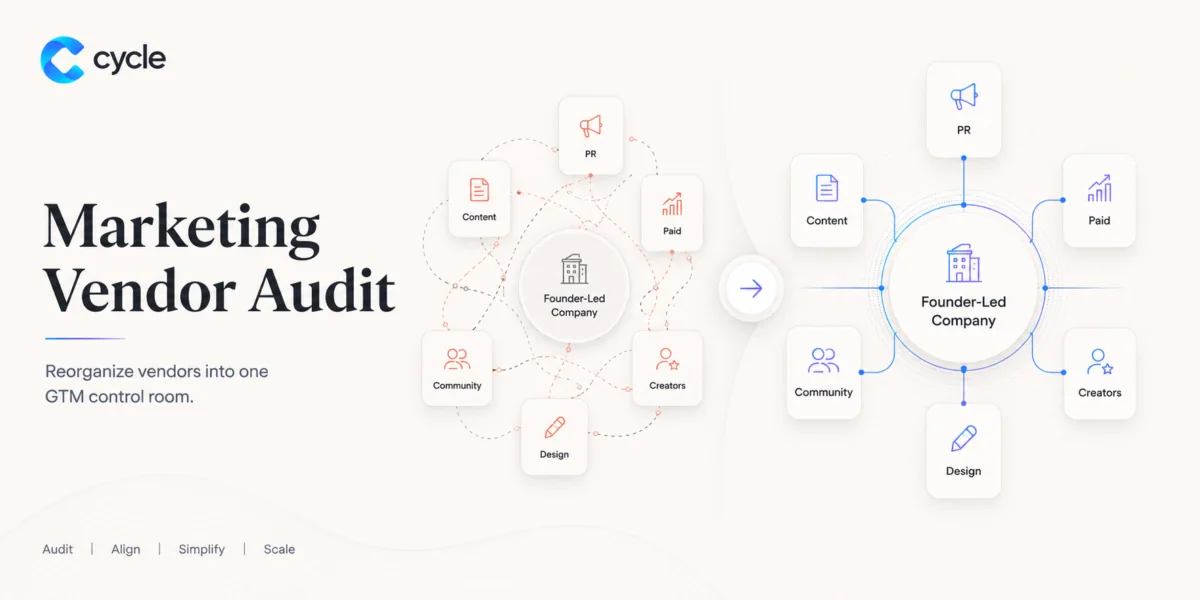
Short answer: a marketing vendor audit for a startup shows whether agencies, freelancers, PR partners, content teams, paid media, creators, community operators, and internal contributors are helping one GTM system or creating fragmented activity. The goal is not to blame vendors. The goal is to see what should be centralized, what should be delegated, where briefs are weak, where proof is missing, and where the founder-led company has lost control of its own GTM agenda.
Most founder-led startups do not start with a vendor problem. They start with a sequencing problem.
The founder knows the product. The team has some proof. The company needs visibility. Then vendors enter: PR, content, paid media, community, design, social, KOLs, SEO, website work.
Each vendor may be competent. But if nobody owns the GTM operating layer, vendor work can create motion without coherence.
A marketing vendor audit helps the founder see whether the system is compounding or fragmenting.
The real problem: vendor capture
Vendor capture happens when external vendors start setting GTM priorities before the company has defined its own sequence.
It does not usually happen maliciously. It happens because every vendor sees the company through its own scope. PR sees a media angle. Paid media sees landing pages and creatives. Content sees publishing volume. Community sees engagement. KOLs see attention. SEO sees keyword gaps. Design sees visual consistency. Website teams see conversion sections. Freelancers see deliverables.
All of those can be useful. But without a central operating layer, the founder starts managing vendor opinions instead of leading the GTM agenda.
The audit asks: are vendors executing a shared market logic, or are they installing separate priorities?
What a marketing vendor audit should inspect
A useful vendor audit looks at seven areas.
| Audit area | What to check | Risk if ignored |
|---|---|---|
| Scope | What each vendor owns and does not own | overlap, gaps, duplicate work |
| Brief quality | Whether vendors share claim, proof, audience, timing, CTA | inconsistent market language |
| Proof dependency | Whether vendors need proof that does not exist yet | premature distribution |
| Channel sequence | Whether work is happening in the right order | paid/PR/KOLs before trust layer |
| Founder input | Whether founder context reaches execution | generic outputs |
| Measurement | Whether metrics connect to GTM decisions | reporting without learning |
| Ownership | Who decides priorities across vendors | founder attention drain |
This is an operating audit, not a procurement exercise.
The audit should also connect back to the broader founder-led GTM system. If the company has not defined the role of the founder-led GTM operator, the vendor map will still depend on the founder manually translating context. If the team has not checked its GTM readiness scorecard, vendors may be asked to scale channels before the proof layer is ready. And when the founder is deciding between senior marketing leadership and channel execution, the fractional CMO vs GTM operator distinction helps clarify what should be owned centrally.
Signs your vendor system needs an audit
1. Vendors are busy, but the company is not easier to understand
Activity is increasing, but the public story is still unclear. Posts are going out, PR is being discussed, ads are being planned, but prospects still ask basic questions. That means the work may be happening downstream of a positioning problem.
2. Every vendor uses different language
The website says one thing, PR says another, paid ads simplify the offer, community repeats features, and the founder explains it differently on calls. This is a messaging system failure, not just a copy problem.
3. Distribution starts before proof is ready
Vendors can bring attention. They cannot make weak proof stronger after attention arrives. If the company is planning PR, KOLs, paid campaigns, or launch announcements while the public proof layer is thin, the sequence may be wrong.
4. The founder is stuck translating context
The founder keeps explaining the product, market, narrative, objections, and proof to different vendors. The same context is repeated in every call because no shared operating brief exists.
5. Reports do not change decisions
Each vendor reports metrics, but the company does not know what to do next. Impressions, clicks, posts, coverage, and engagement are visible, but GTM priorities remain unclear.
6. The team cannot tell which vendor owns a gap
A proof gap looks like a content issue. A content issue looks like a positioning issue. A positioning issue looks like a website issue. A website issue looks like a conversion issue. A conversion issue looks like a paid media issue.
If nobody owns the system, every gap is passed sideways.
The vendor audit checklist
Scope and overlap
- What does each vendor own?
- Where do scopes overlap?
- Which work is duplicated?
- Which critical work has no owner?
- Which vendor is being asked to solve a problem outside its scope?
Strategic brief
- Does every vendor know the primary market claim?
- Does every vendor know the target audience?
- Does every vendor know the proof hierarchy?
- Does every vendor know the current launch or GTM sequence?
- Does every vendor know what claims are forbidden or unsupported?
Proof readiness
- Are vendors driving attention to proof that exists?
- Are vendors waiting on missing proof assets?
- Is the website strong enough for new attention?
- Are case studies, demos, metrics, founder proof, or customer signals easy to find?
- Are weak claims being amplified?
Execution sequence
- What should happen before PR?
- What should happen before paid acquisition?
- What should happen before creator or KOL distribution?
- What should happen before community growth pushes?
- Which channel is being activated too early?
Measurement and founder load
- Does each vendor report metrics that matter to the company?
- Do reports connect to the same GTM objective?
- What changed because of last week’s reporting?
- How many vendor calls does the founder attend weekly?
- What context should be turned into a shared brief?
What to centralize after the audit
Do not centralize everything. Centralize the pieces that determine coherence: market claim, proof hierarchy, founder narrative, launch sequence, vendor briefs, channel priority, weekly metrics, decision cadence, internal-link and content architecture, and public-surface requirements.
Delegate design production, PR outreach operations, paid media optimization, community moderation, content formatting, social scheduling, analytics exports, CMS implementation, and creator coordination.
This is the same distinction CYCLE makes in Founder-Led GTM vs Marketing Agency: the problem is not that agencies are bad. The problem is that agencies often operate inside narrow scopes unless someone owns the broader GTM system.
A practical example
A startup preparing for launch has a PR freelancer, paid contractor, content writer, designer, community manager, part-time growth advisor, and founder approving everything.
The PR freelancer wants an announcement. The paid contractor wants to test ads. The writer wants a content calendar. The designer wants new landing visuals. The community manager wants more posts. The founder wants the market to understand why the product matters.
A vendor audit finds that the main claim is unclear, no proof page exists, the deck is stronger than the website, the founder’s best narrative is not public, vendors have separate briefs, no one owns the launch sequence, paid traffic would land on a weak proof surface, and PR would pitch before the strongest proof asset is ready.
The fix is not firing everyone. The fix is creating a GTM control layer: define the market claim, publish proof assets, update the website narrative, create a shared vendor brief, sequence founder content before PR, delay paid spend until proof improves, and install weekly decision rhythm.
Now vendors can execute against one system.
How CYCLE uses vendor audits
CYCLE does not treat vendor audits as vendor scorecards only. The audit is a way to find where the founder-led GTM system is missing ownership.
Sometimes the answer is better briefs. Sometimes it is fewer vendors. Sometimes it is a new proof asset. Sometimes it is a stronger positioning layer. Sometimes it is an external GTM control room that keeps all moving parts aligned.
The audit should help the founder stop asking, “Which vendor should I hire next?” and start asking, “What GTM decision must be owned before more execution enters the room?”
FAQ
What is a marketing vendor audit for startups?
A marketing vendor audit reviews whether the startup’s agencies, freelancers, internal contributors, and channel partners are aligned around one GTM strategy, proof layer, message, sequence, and measurement system.
When should a startup run a vendor audit?
Run one before a major launch, fundraising push, PR campaign, paid acquisition scale-up, or when several vendors are active but the company still feels unclear from the outside.
Is the goal to cut vendors?
Not always. The goal is to see which vendors are useful, which scopes overlap, which gaps are unowned, and what must be centralized so vendor work compounds.
Who should own the audit?
The founder should provide strategic context, but a GTM operator should run the audit and translate it into briefs, sequence, ownership, and weekly decisions.
How does CYCLE help?
CYCLE helps founder-led technical companies audit vendor scopes, centralize GTM decisions, strengthen proof, and run the operating cadence through the GTM Control Room.
Bottom line
A marketing vendor audit is not about blaming vendors. It is about restoring GTM agenda ownership.
If vendors are active but the market still does not understand or trust the company faster, the problem is probably not activity. The problem is the missing operating layer between founder signal and execution.