


Token Launch Marketing Checklist: The Trust Layer Before TGE
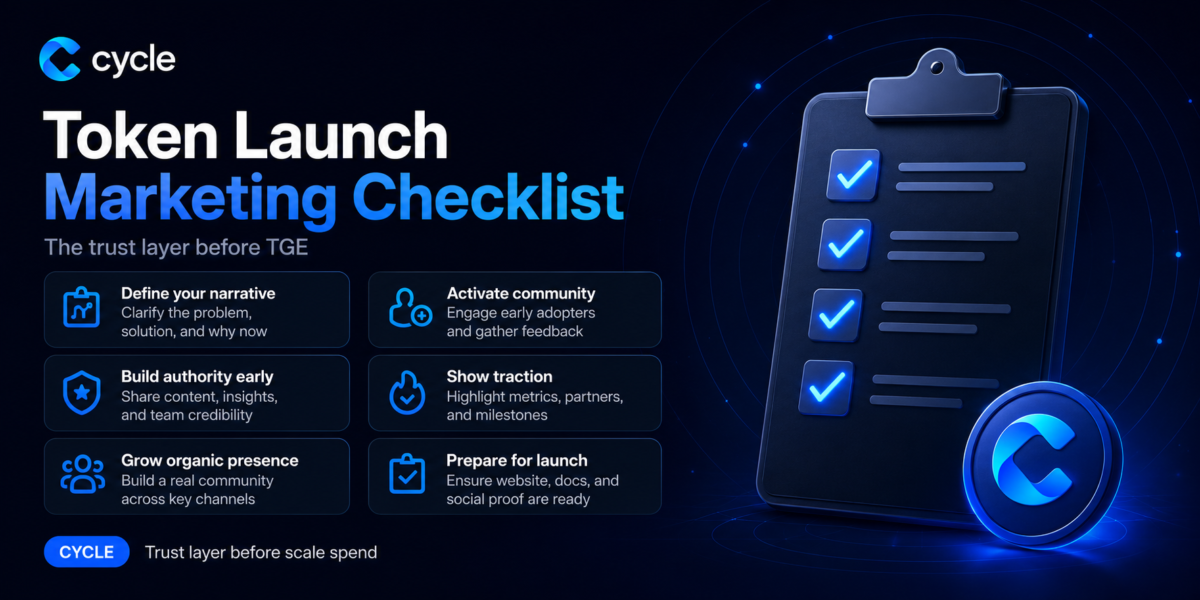
Short answer: token launch marketing should prepare the trust layer before a TGE, listing conversation, fundraising push, or major launch campaign. Before buying KOLs, PR, ads, or exchange attention, a Web3 team needs clear claims, approved token language, a credible website, active X and Telegram surfaces, proof assets, community onboarding, launch-week operations, and a conversion path that does not promise price, ROI, listings, or fundraising outcomes.
A token launch creates attention. It does not automatically create trust.
That is the mistake many Web3 teams make before TGE. They treat launch marketing as a distribution problem: find KOLs, announce the date, push Telegram, pitch media, line up AMAs, and hope the market pays attention.
Distribution matters. But when people arrive, they inspect the project.
They check the website, X, Telegram, docs, token utility, vesting story, founder signal, partners, audits, product proof, and whether the campaign sounds real or desperate. If those surfaces are weak, more attention only makes the weakness visible.
This checklist is for teams preparing a token launch, TGE, listing readiness push, or pre-launch fundraising moment. It is not legal, tax, or investment advice. It is a practical marketing readiness checklist for building enough public confidence before the campaign starts.
For a tighter operating view of the final month, use the TGE marketing plan before launch traffic starts compounding every weak claim.
What Token Launch Marketing Is Not
Token launch marketing is not price promotion.
It is not a promise that the token will list, pump, return capital, or create guaranteed upside for buyers. Those claims are risky, often non-compliant, and bad for long-term trust.
Good token launch marketing does a different job:
- explains what the project is;
- shows why the token exists;
- makes the public surface credible;
- gives communities a clear way to understand and participate;
- prepares partners, KOLs, media, and users to tell the same story;
- reduces confusion during the launch window.
The launch is a pressure test. If the story, proof, and operations are not ready, the pressure shows.
The CYCLE TGE Readiness Question
Before launch spend, ask one blunt question:
If a serious user, partner, KOL, investor, or exchange reviewer checks the project today, will they find proof or doubt?
The answer is rarely hidden inside the media plan. It is visible in the basics:
- the homepage and docs;
- the token utility explanation;
- the roadmap and status of the product;
- the X profile and pinned posts;
- Telegram onboarding and moderation;
- founder or team credibility;
- audits, partners, backers, demos, or traction signals;
- approved wording for token claims;
- launch FAQ and support flow.
If those elements are not aligned, the team is not ready to scale attention.
1. Lock The Claim Boundary First
Before writing a single KOL brief or PR pitch, decide what the team is allowed to say.
For token launches, the claim boundary matters because small wording differences can change how the campaign is perceived. Avoid language that implies:
- guaranteed token price movement;
- guaranteed ROI;
- guaranteed exchange listing;
- guaranteed fundraising;
- guaranteed user acquisition;
- investment advice;
- official endorsement where none exists.
The SEC investor bulletin on ICOs warns that token sales can involve securities depending on the facts and circumstances, and it specifically points investors toward questions about rights, use of funds, registration, business plan, code, and cybersecurity audits. A marketing team should not improvise around those topics on launch week.
Make a shared claim sheet:
- approved one-sentence project description;
- approved token utility language;
- approved roadmap language;
- approved risk disclaimers;
- banned phrases;
- approved founder/team bio;
- approved partner and investor references;
- approved FAQ answers.
This prevents the launch from becoming a chaotic mix of hype, contradictions, and accidental promises.
2. Make The Token Story Understandable
A token launch needs a story that a new person can understand quickly.
Not:
- "next-generation decentralized ecosystem";
- "AI-powered Web3 revolution";
- "massive opportunity before listing."
Better:
- who the product is for;
- what the token does inside the system;
- why now matters;
- what is already live;
- what the user can do next;
- what proof supports the story.
If the token is mainly a future promise, say less and prove more. If the product is live, show the user flow. If the ecosystem is early, explain the sequence honestly: what exists now, what comes later, and what must be verified.
3. Prepare The Website And Docs For Inspection
A TGE sends people to the project surface. The website and docs should not feel like a placeholder.
Minimum launch-ready surface:
- clear homepage headline;
- short product explanation;
- token utility page or section;
- roadmap with realistic milestones;
- team or founder visibility where possible;
- links to X, Telegram, Discord, docs, and product;
- audit or security status if relevant;
- partner/backer proof only when approved;
- FAQ for common launch questions;
- one primary CTA.
The CTA should match the stage. For example:
- join the community;
- read the token docs;
- try the product;
- join an AMA;
- subscribe for updates;
- review the launch FAQ.
Avoid sending visitors into five different actions at once. Confusion lowers trust.
4. Build Visible Social Proof Before Paid Attention
Before KOLs or PR, make sure the project accounts look alive.
For X:
- current pinned post;
- recent useful posts;
- replies from real accounts;
- founder or team comments;
- launch thread;
- proof assets;
- clear link to the launch page or docs.
For Telegram or Discord:
- pinned onboarding message;
- launch FAQ;
- moderator coverage;
- clear anti-scam notice;
- links to official channels only;
- response plan for repeated questions;
- community prompts that do not feel fake.
This is where Social Proof Package matters. Paid traffic and KOL traffic convert better when the public surface already looks credible.
5. Align Tokenomics, Utility, And Narrative
Tokenomics should not live separately from marketing.
People will ask:
- why does the token exist;
- who needs it;
- what unlocks or vesting events matter;
- what utility is live now versus planned;
- how incentives avoid looking extractive;
- how the token connects to the product or community.
Marketing does not need to turn into financial engineering. But the public explanation should be understandable. If the token model is confusing, users will fill the gap with suspicion.
For teams still refining this layer, launch and listing readiness should be handled before the campaign narrative is pushed externally.
6. Prepare The KOL Brief Before Buying Reach
KOL marketing can help a launch only when the project gives creators a real story and clear guardrails.
A useful KOL brief includes:
- campaign objective;
- approved project description;
- approved token language;
- key proof points;
- forbidden claims;
- disclosure requirements;
- CTA;
- launch timing;
- links to official assets;
- contact for questions;
- examples of angles that fit the creator's audience.
Do not ask KOLs to invent the launch narrative. That creates inconsistent, hype-heavy content and makes the project look less serious.
Creator readiness should include a basic screen for how to vet crypto KOLs before a token launch, especially when paid posts will send new users into Telegram, X, or docs.
If KOLs are part of the launch plan, connect the brief to Trusted Distribution System so KOL, PR, community, and launch messaging move from one proof-led brief.
7. Treat Paid Ads As Restricted, Not Automatic
Many token teams assume paid ads can simply fill the top of the funnel. Crypto campaigns are not that simple.
Google's crypto advertising policy says ads promoting ICOs, DeFi trading protocols, or the purchase, sale, or trade of cryptocurrencies or related products are not allowed. It also treats some crypto products and services as restricted categories that require approval, local compliance, and eligible targeted locations.
That means token launch marketing should not depend on paid ads unless the team has already checked:
- jurisdiction;
- product category;
- platform policy;
- certification requirements;
- landing page claims;
- compliance review;
- backup channels.
For many launch-stage projects, the safer near-term path is organic proof, community activation, founder visibility, PR angles, AMAs, partner distribution, and carefully vetted KOLs.
8. Prepare For Listing Conversations Without Promising Listings
Exchange listing readiness is partly marketing and partly operational credibility.
Coinbase's public listing materials describe legal, compliance, technical security, business, and ongoing monitoring considerations. Their listing process page says assets are evaluated through rigorous vetting and additional business assessments. Their listing FAQ also makes clear that missing information, technical integration work, unsupported token standards, regional regulatory requirements, and failure to meet listing standards can affect whether an asset is supported.
For launch marketing, the lesson is simple: do not talk about listings as if they are guaranteed.
Instead, prepare the project surface so a reviewer, partner, or exchange contact can understand the project quickly:
- product status;
- token standard;
- security posture;
- key people;
- business model;
- community and usage signals;
- legal/compliance contacts;
- public documentation;
- brand assets;
- clean announcement language.
Launch & Listing Readiness exists for this exact layer: the project should look coherent before listing or launch attention arrives.
9. Build A Launch Week Operating System
A TGE is not just a date. It is a live operating window.
Prepare:
- launch room owner;
- announcement schedule;
- official links document;
- anti-scam messaging;
- Telegram and Discord moderator shifts;
- X response owner;
- KOL post tracker;
- PR and partner tracker;
- FAQ update owner;
- issue escalation path;
- daily reporting format;
- post-launch follow-up content.
The point is to avoid silence. During launch week, unanswered questions and broken links become public trust problems fast.
10. Decide What Success Means Before The Campaign
A token launch marketing plan should track more than impressions.
Useful metrics:
- qualified website visits;
- docs visits;
- Telegram joins and retention;
- X profile visits;
- replies and comments from relevant accounts;
- AMA attendance;
- KOL post quality and audience relevance;
- partner mentions;
- media pickups;
- community question themes;
- conversion into the next desired action.
Impressions are useful, but they are not the outcome. The outcome is whether the launch creates a more credible project surface and a stronger path into the next stage.
30-Day Token Launch Marketing Checklist
30 Days Before TGE
- Lock approved claims and banned phrases.
- Finalize core narrative.
- Review website, docs, token page, and FAQ.
- Prepare social proof assets.
- Build KOL and PR target lists.
- Prepare community onboarding.
- Confirm paid media restrictions.
- Confirm listing-readiness materials.
- Create launch reporting sheet.
14 Days Before TGE
- Publish launch explanation content.
- Pin official X and Telegram messages.
- Brief KOLs and partners.
- Schedule AMAs or Spaces.
- Prepare moderator scripts.
- Test links and tracking.
- Prepare anti-scam notices.
- Review founder/team visibility.
7 Days Before TGE
- Freeze public claims unless approved.
- Confirm announcement sequence.
- Confirm support coverage.
- Confirm KOL posting windows.
- Confirm PR embargo or publish plan.
- Confirm official links and docs.
- Prepare post-launch follow-up content.
Launch Week
- Monitor official channels.
- Answer repeated questions fast.
- Update FAQ as needed.
- Track KOL and partner posts.
- Repost credible community activity.
- Watch for scam links or impersonation.
- Report daily.
- Keep the next CTA clear.
Common Token Launch Marketing Mistakes
The most common mistakes are predictable:
- launching before the public surface is credible;
- using price or ROI language;
- implying guaranteed exchange listings;
- buying KOLs before the story is clear;
- sending traffic to an unclear landing page;
- letting Telegram look unmanaged;
- hiding the team without replacing it with other proof;
- overloading the launch with too many CTAs;
- ignoring platform ad policies;
- treating launch day as the end of the campaign.
Most of these are fixable before TGE. They are expensive to fix after the public narrative is already messy.
For the broader trust infrastructure behind this checklist, see Trust Before TGE: Why Token Launches Fail Before the Token Exists.
How CYCLE Helps
CYCLE helps Web3 teams prepare the trust layer before launch, listing, fundraising, KOL, PR, or paid distribution moments.
For token launches, that usually means:
- sharpening the campaign narrative;
- cleaning the public surface;
- building proof assets;
- preparing KOL, PR, and community briefs;
- improving X and Telegram trust signals;
- setting launch-week operating rhythm;
- connecting the launch to the next conversion path.
The goal is not to manufacture hype. The goal is to make the project easier to understand, easier to trust, and harder to dismiss when attention arrives.
Start with Launch & Listing Readiness if a TGE, listing, or major campaign is close, or if the token story itself is still unclear. Use Social Proof Package if the public surface looks too quiet before distribution.
Related Proof
- Web3 Epic Challenge / Bybit Partnership shows partner activation, quests, and community participation around a campaign moment.
- OKX CIS Brand Awareness shows how PR and media readiness support market trust.
- CYBERBASE Telegram Mini App shows how community activation can support product traction.
FAQ
What should a token launch marketing plan include?
A token launch marketing plan should include approved claims, project narrative, token utility explanation, website/docs readiness, X and Telegram activation, KOL and PR briefs, community onboarding, paid media restrictions, launch-week operations, and post-launch follow-up.
When should marketing start before a TGE?
Start at least 30 days before the TGE if possible. The project needs time to fix narrative, website, docs, community onboarding, proof assets, KOL briefs, and operational gaps before launch attention arrives.
Can KOLs make a token launch successful?
KOLs can amplify attention, but they cannot replace trust. A KOL campaign works best when the project already has a credible public surface, clear narrative, active community path, and approved claims.
Should token launch campaigns use paid ads?
Only after checking platform policy, local regulations, product category, certification requirements, and landing page claims. Many crypto token sale and trading-related ads are prohibited or restricted on major platforms.
What is the biggest token launch marketing risk?
The biggest risk is scaling attention before the project is ready for inspection. If the public surface looks weak, unclear, or overpromotional, launch traffic can create more skepticism instead of more trust.