


Fractional CMO for Web3 vs Marketing Agency
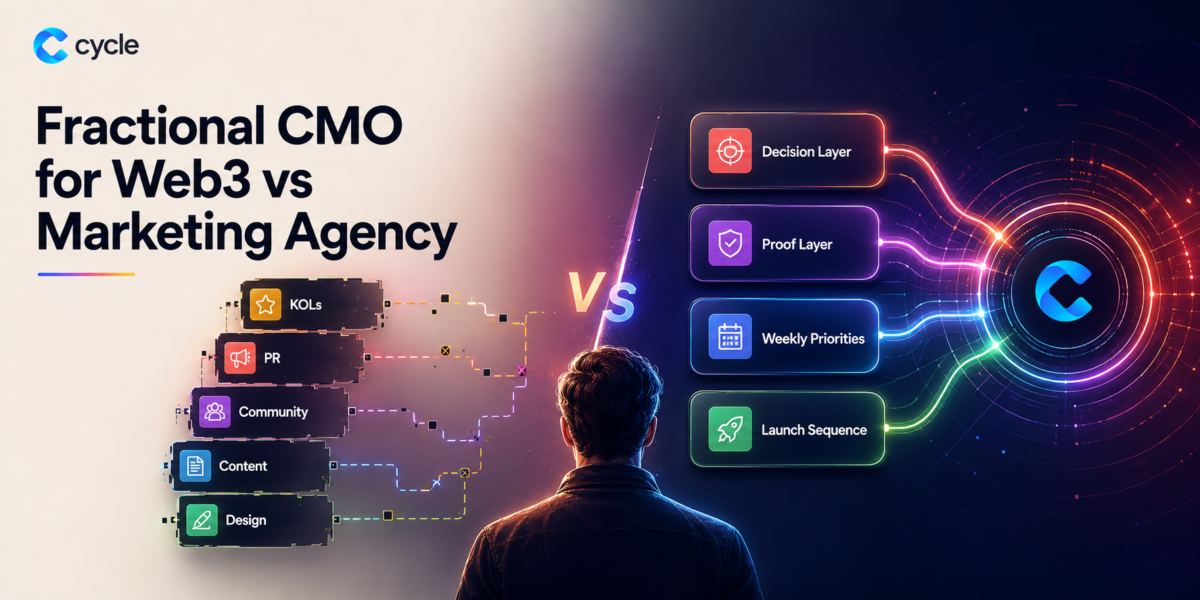
Short answer: a fractional CMO for Web3 is the right first move when the founder needs senior GTM ownership: what to say, what to fix, what to pause, which vendors to use, and how proof, community, KOLs, PR, launch readiness, and weekly execution connect. A marketing agency is the right move when the strategy, proof layer, and approval loop are already clear, and the team mainly needs execution capacity.
For the broader cross-market version of this decision, read Fractional CMO vs GTM Operator for Technical Founders. If the question is whether to orchestrate GTM through a founder-led operating model or a conventional agency, see Founder-Led GTM vs Marketing Agency.
Many Web3 teams do not have a vendor shortage.
They have a decision-layer shortage.
One vendor handles KOLs. Another pitches media. A community manager keeps Telegram active. A designer makes campaign assets. The founder writes when there is time. A partner needs copy. A listing or launch window is coming. Everyone is moving, but the public surface still feels thin.
That is not always an agency problem.
It is often a missing CMO problem.
The sharp POV
A fractional CMO is not “a strategist who joins calls.”
A useful Web3 fractional CMO owns the operating question:
What should the market understand, verify, and trust this week — and who is responsible for shipping it?
That is different from buying a marketing agency.
An agency usually sells execution capacity: content, PR, KOL coordination, community operations, creative production, paid media, SEO, or campaign delivery.
A fractional CMO owns the decision layer above those functions:
- what the project should be known for;
- what proof the market needs before distribution;
- what claims can and cannot be made;
- which channels matter now;
- which vendors should be briefed or paused;
- what the founder must approve;
- what needs to ship this week;
- what should happen after attention arrives.
When that layer is missing, agencies start setting the agenda by default.
That is vendor capture.
Fractional CMO vs marketing agency: the real difference
The decision is not “senior person vs team.”
The decision is ownership vs capacity.
| Question | Fractional CMO | Marketing agency |
|---|---|---|
| Core job | Own the GTM decision layer | Execute a defined scope |
| Starts with | Diagnosis, sequence, priorities, proof gaps | Deliverables, campaign plan, channel work |
| Best when | Founder needs senior marketing ownership before building a department | Strategy is clear and the team needs execution speed |
| Owns vendors? | Yes, briefs and coordinates them | Sometimes, if included in scope |
| Owns positioning? | Should own or sharpen it with the founder | May execute it if already clear |
| Owns proof layer? | Should define what proof must exist | May produce assets if briefed |
| Owns weekly priorities? | Yes | Usually only inside the agency scope |
| Failure mode | Becomes advisory theater if not close to execution | Ships output that does not solve the real GTM problem |
A good Web3 setup often needs both.
The fractional CMO owns the sequence. The agency or execution team ships the work.
When a Web3 founder needs a fractional CMO first
Choose a fractional CMO before a marketing agency when the team lacks GTM ownership.
Common signs:
- The founder is still the only person who can explain the project clearly.
- The website, X profile, Telegram, docs, and deck say slightly different things.
- Vendors are active, but nobody owns the campaign sequence.
- KOLs, PR, and community are being planned as separate tracks.
- The project has a launch, TGE, listing, fundraising, or ecosystem push in the next 30–90 days.
- The public surface does not support the claims the team wants to distribute.
- The founder is approving tiny tasks instead of making high-leverage decisions.
- Reporting shows activity, but not enough market clarity or pipeline signal.
- The team keeps buying attention before fixing what people see after the click.
- There is not enough need for a full-time CMO, but the project needs senior judgment now.
The pattern is simple: there is motion, but not enough control.
When a Web3 marketing agency is enough
A marketing agency can be the right move when the project already has a solid operating base.
Agency-first can work when:
- the one-sentence narrative is clear;
- the founder and team agree on claim boundaries;
- the public proof surface is credible;
- the team can approve work quickly;
- the target audience and campaign objective are specific;
- the landing path and CTA are ready;
- the agency receives strong briefs;
- one internal owner can evaluate output and make decisions.
In that situation, the project may not need a fractional CMO first.
It needs execution capacity.
The danger is hiring an agency to solve a decision problem it was not hired or structured to own.
The CYCLE operator framework: Decision Layer, Proof Layer, Distribution Layer
A Web3 fractional CMO should make three layers work together.
| Layer | The question | What the operator fixes | What happens if ignored |
|---|---|---|---|
| Decision layer | What matters now? | Positioning, priorities, channel sequence, founder approvals, vendor scope | Vendors create motion without direction |
| Proof layer | What can the market verify? | Website, founder signal, proof assets, channel surfaces, claim boundaries | Attention lands on doubt |
| Distribution layer | Who should see it, and how? | KOLs, PR, community, AMAs, partner posts, launch rhythm, follow-up | Channels compete instead of compounding |
Most Web3 marketing underperforms because teams scale the distribution layer before the decision and proof layers are ready.
A useful fractional CMO does not slow the team down.
They prevent the team from moving fast in the wrong order.
The first 30 days of a useful fractional CMO engagement
The first month should create visible changes, not only strategy notes.
| Week | Operator focus | Concrete output |
|---|---|---|
| Week 1 | Diagnose the GTM system | Surface audit, vendor map, priority list, decision loop, risk list |
| Week 2 | Fix narrative and proof gaps | One-sentence story, claim boundaries, proof asset plan, channel cleanup priorities |
| Week 3 | Build the campaign sequence | KOL/PR/community briefs, launch or content rhythm, founder POV topics, response path |
| Week 4 | Ship and measure | Public updates, proof assets, community prompts, partner/KOL coordination, reporting loop |
If the first month produces only decks, the role is too far from execution.
If the first month produces only tasks, the role is too far from strategy.
The useful version does both: set the frame, then make the public surface change.
Operational example: too many vendors, no owner
A Web3 gaming project is preparing a token campaign. The team has a KOL vendor, a PR freelancer, a community manager, a designer, and a founder who approves everything late at night.
Each person is doing something reasonable.
The total system is still weak.
The KOL brief says the game is for Web3-native players. The PR angle says it is onboarding mainstream gamers. Telegram answers focus on token rewards. The website explains the game mechanics but not the launch sequence. The founder’s X account has strong thoughts, but they are not connected to the campaign. The community manager does not know which claims are approved.
A marketing agency can produce more assets here.
But the project first needs an operating layer.
A fractional CMO would usually:
- choose the primary campaign audience;
- lock the narrative and claim boundaries;
- decide what proof must exist before paid reach;
- align the website, X, Telegram, PR angle, and KOL brief;
- brief each vendor from one source of truth;
- assign response owners for launch-week questions;
- define what success means beyond impressions;
- decide what to pause until the proof layer is ready.
After that, an agency or vendor network can execute faster and with less waste.
The point is not to replace every vendor.
The point is to stop vendors from setting the strategy by accident.
What to ask before hiring a fractional CMO for Web3
Use this checklist before signing a retainer.
- Can they explain the difference between attention and trust?
- Have they worked across KOL, PR, community, launch, and founder-led execution as one system?
- Will they own weekly priorities, or only advise?
- Can they make the founder’s thinking market-readable?
- Can they identify weak proof before distribution exposes it?
- Can they brief and manage vendors without becoming another meeting layer?
- Do they understand claim control around tokens, listings, fundraising, and roadmap language?
- Can they produce visible public-surface improvements in the first month?
- Do they have access to execution capacity when the diagnosis is clear?
- Will they tell the founder what not to do?
The last point matters.
A fractional CMO who cannot say “not yet” will let the team buy noise.
When a fractional CMO is not enough
A fractional CMO cannot fix every situation.
The role will not work if:
- the founder is unavailable for real decisions;
- there is no product, proof, or credible roadmap;
- the team wants guaranteed token performance;
- there is no budget for execution;
- the project refuses to clarify claims;
- approvals are political and slow;
- the team wants a senior title without giving the operator authority.
Marketing ownership requires access, trust, and speed.
Without those, the role becomes a meeting layer.
How CYCLE fits
CYCLE does not frame this as “hire a lone fractional CMO and hope the work ships.”
The CYCLE model is an external GTM control room:
- senior operator thinking close to the founder;
- proof-layer diagnosis before distribution;
- weekly priorities across narrative, proof, community, PR, KOLs, and launch work;
- execution capacity behind the operating decisions;
- commercial focus on making the project easier to understand, verify, trust, introduce, discuss, and buy from.
That is why the best starting point is often GTM Control Room, especially when the team has vendors already but no one owning the sequence.
If the trust layer is unclear, start with Proof Layer Audit before scaling spend.
If the project needs visible credibility before a campaign, use Social Proof Package.
If KOLs, PR, community, and founder channels need to move together, use Trusted Distribution System.
If the moment is a TGE, listing, product launch, or ecosystem push, use Launch & Listing Readiness.
Commercial bridge: choose the right operating path
Use the decision below.
| Your situation | Better next step |
|---|---|
| We have vendors, but no one owns the weekly GTM sequence | GTM Control Room |
| We are not sure whether the public surface can survive attention | Proof Layer Audit |
| We need the project to look credible before PR, KOLs, or fundraising conversations | Social Proof Package |
| We already plan KOLs, PR, AMAs, community, or partner distribution | Trusted Distribution System |
| We are close to TGE, listing, launch, or ecosystem campaign | Launch & Listing Readiness |
| Telegram or Discord exists, but does not convert attention into confidence | Community Growth |
| We need media outreach, but the story and proof base are not ready | PR & Media Readiness |
FAQ
What is a fractional CMO for Web3?
A fractional CMO for Web3 is a senior marketing operator who works with a project part-time or on retainer to own GTM decisions, narrative, proof layer, vendors, launch readiness, community, KOLs, PR, and weekly execution rhythm.
How is a fractional CMO different from a Web3 marketing agency?
A fractional CMO owns the decision layer. A marketing agency usually sells execution capacity. The CMO decides what should be amplified, what proof is missing, what vendors should do, and what the founder must approve. The agency helps ship the work once the scope is clear.
Should a Web3 project hire a fractional CMO or an agency first?
Hire a fractional CMO first if the team lacks GTM ownership, positioning, proof readiness, vendor coordination, or weekly priorities. Hire an agency first if the strategy is clear and the main gap is production or distribution capacity.
Can a fractional CMO manage agencies and vendors?
Yes. In many Web3 teams, vendor coordination is one of the highest-leverage parts of the role. The fractional CMO should brief vendors from one source of truth, align execution with the campaign sequence, and stop disconnected work from becoming the strategy.
What should happen in the first 30 days?
The first 30 days should produce a GTM diagnosis, clearer narrative, proof-layer priorities, vendor briefs, public surface fixes, campaign sequence, response path, and reporting loop. The public surface should visibly improve.
What if we already have an agency?
If the agency is executing well but the system still feels fragmented, add a GTM operating layer above the work. The goal is not to replace execution. The goal is to make execution compound.