


Web3 Community Growth Is a Proof System, Not a Chat Room
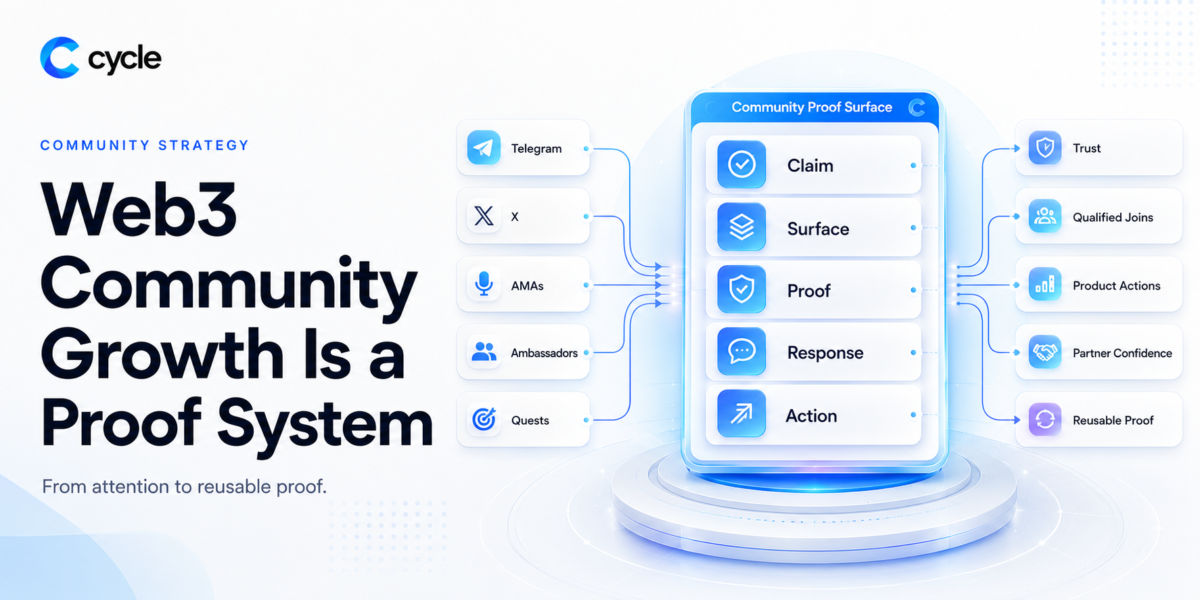
Most Web3 teams do not have a community problem.
They have a proof and coordination problem.
Web3 community growth is not making a channel look busy. It is building a public proof system that can survive inspection when attention arrives.
The failure usually happens after distribution, not before it. A KOL post, partner announcement, quest campaign, AMA, or paid push can create attention. The community surface decides whether that attention becomes trust, confusion, or churn.
If the community surface cannot carry inspection, paid attention becomes paid confusion.
Teams can buy KOL posts, run ads, announce partner campaigns, schedule AMAs, launch quests, recruit ambassadors, or push Telegram growth. But when new people arrive, the surface often feels fragmented:
- X says one thing.
- Telegram says another.
- The website is too broad.
- Pinned posts are outdated.
- Founders are invisible.
- Nobody owns what a new visitor should do next.
That is not community growth.
That is traffic entering an unprepared room.
The Broken Model: Community As Activity
The old community model is simple:
- Grow Telegram.
- Post more on X.
- Run an AMA.
- Add ambassadors.
- Show activity as traction.
The problem is that activity is easy to fake and hard to trust.
Member count can be bought. Replies can be rented. Quests can attract farmers. AMAs can become one-off events that leave no useful trail. Ambassadors can produce noise instead of signal.
The better model is:
Community growth should make the project easier to inspect.
When a user, investor, partner, KOL, exchange team, or ecosystem lead checks the project, the community surface should answer the basic questions:
- What is this project?
- Why does it matter now?
- Is anything real happening?
- Who is behind it?
- Where is the proof?
- What should I do next?
If the community cannot answer those questions, more attention will not fix the problem.
KOL spend turns into repetitive Telegram questions. PR turns into shallow impressions. Quests attract farmers. Partner posts create spikes without qualified follow-through.
Where Crypto Attention Gets Inspected
Web3 community growth is multi-channel by default because crypto attention does not live in one place.
CoinGecko's crypto community media research cites its Post-Halving Sentiment Survey of 2,558 crypto participants from June 25 to July 8, 2024. It found that X, Telegram, and YouTube represented 84.0% of respondents' main social platforms for crypto. CoinGecko notes that the survey is indicative rather than universal.
The channel mix changes.
The inspection problem does not.
X creates the public narrative. Telegram handles onboarding, questions, and daily interpretation. YouTube, podcasts, newsletters, media, and AMAs create deeper context. Discord can matter for gaming, builders, governance, or structured communities.
The user does not experience these as separate channels.
They experience them as one credibility check.
Telegram is too large and too crypto-native to treat as a back-office moderation channel. In March 2025, TechCrunch reported Pavel Durov's statement that Telegram had more than 1B active users.
For Web3 teams, that means community is not a back-office moderation task.
It is part of the public proof surface.
Community Management vs Community Growth
Community management keeps channels usable: moderation, spam control, pinned posts, answer flow, announcements, support routing, and daily rhythm.
Community growth makes those channels turn trust into action: narrative clarity, proof assets, onboarding paths, founder visibility, campaign coordination, partner amplification, AMA reuse, ambassador design, quest design, and reporting on signal quality.
Moderation keeps the room clean.
Growth makes the room convert.
The CYCLE Community Proof Surface Framework
CYCLE audits the Community Proof Surface through five controls before scaling attention:
Claim → Surface → Proof → Response → Action.
Every community growth push should answer five questions: what are we asking the market to believe, where will people inspect it, what evidence supports it, who handles doubt in the first 72 hours, and what should belief turn into?
When that sequence works, activity becomes reusable proof for the next distribution loop.
1. Narrative
What should people understand and repeat?
The community should not rely on random admin explanations. The project needs a simple external story:
- what it is;
- who it is for;
- why now;
- what proof already exists;
- what is happening this week;
- what a new visitor should do next.
If Telegram, X, the website, and founder posts each tell a different story, the market reads that as confusion.
Failure mode: admins, founder posts, X bio, website copy, and KOL briefs describe the project differently.
Operator question: can a serious visitor explain the project correctly after 60 seconds of inspection?
2. Entry Surface
Where does a new person land first?
For many crypto projects, the first inspection path is:
- X profile.
- Website.
- Telegram.
- Founder profile.
- Product or campaign page.
- Search results.
Each surface should support the same story.
A pinned Telegram message should act like a lightweight landing page:
- short project explanation;
- current milestone or campaign;
- official links;
- product or app link;
- proof links;
- FAQ or docs link;
- next step.
If the pinned message is an old announcement, the community is already leaking trust.
Failure mode: traffic lands in Telegram and sees stale pins, broken links, unclear campaign context, and no first action.
Operator question: does the first landing surface behave like a lightweight landing page?
3. Proof Assets
Community growth becomes stronger when the team can point to proof without improvising.
A useful proof library can include:
- product demo or screenshots;
- traction recap;
- founder or team credibility signal;
- partner or ecosystem proof;
- AMA recap;
- community FAQ;
- customer, user, or campaign evidence;
- case study;
- public roadmap update;
- media or KOL recap;
- post-campaign learning.
This connects directly to Web3 social proof: new visitors need evidence before they take the next step.
Failure mode: proof exists, but it is scattered across private decks, old posts, unlinked partner announcements, and admin memory.
Operator question: can the team point visitors, KOLs, partners, and media to the same current proof without improvising?
4. Activation Path
What does a visitor do after they believe enough to act?
The activation path should match the visitor's level of belief.
- A cold visitor may need a founder note, explainer, campaign page, or product walkthrough.
- A warmer visitor may join Telegram, attend an AMA, follow the founder, read the launch page, or compare proof.
- A high-intent visitor may use the product, join a quest, apply as a partner, submit interest, invite a friend, or ask a qualified question.
Without an activation path, community growth becomes passive attention.
Passive attention decays fast.
Failure mode: the visitor believes enough to continue, but the next step is vague, buried, or disconnected from the campaign.
Operator question: what action counts as success for this traffic source?
5. Distribution Loop
Where does new attention come from, and what happens after it arrives?
Distribution can come from KOLs, PR, partners, ecosystem accounts, quests, paid ads, founder posts, AMAs, or media.
Distribution fails when every channel sends visitors to a different version of the truth.
Distribution should not start with the KOL brief. It should start with the landing surface.
Before any market-facing push goes live, the team should know where traffic lands, what proof it sees, what question it asks next, who answers, and what action counts as success.
Distribution channels should carry the same story and point to the same proof. This is why crypto KOL marketing works better when the public surface is already prepared.
Community growth is not isolated channel management.
It is the trust layer that makes distribution believable.
Operational Example: Why a KOL Spike Dies in Telegram
A common Web3 gaming failure pattern looks like this.
A team runs a six-KOL push before a partner quest. In 24 hours, Telegram adds 1,800 members, X gets 240,000 impressions, and the quest page sees 6,000 visits.
The traffic is real.
The surface is not ready.
They ask the obvious questions:
- Is the game live?
- What is the reward mechanic?
- Is the partner confirmed?
- Where do I join?
- Is this token-related?
- What should I do before the campaign starts?
Then the gaps show up.
The Telegram pinned message is outdated. The X bio does not explain the campaign. The website sends people to a generic homepage. Admins answer with "soon" instead of links. There is no FAQ. The founder is silent. The quest page exists, but nobody explains why it matters.
The first 72 hours after distribution decide whether the campaign becomes proof or support debt.
The project gets attention, but the surface cannot turn attention into trust.
That is not a KOL problem.
It is a community proof surface problem.
Now reverse the same campaign.
Before distribution, the team ships five assets: updated Telegram pin, campaign FAQ, founder note, partner proof link, and quest explainer.
Then it assigns a 72-hour response map: Telegram admin owns FAQs, founder owns X replies, growth lead owns KOL corrections, and partner manager owns co-marketing updates.
The same KOL traffic now lands on a surface that can carry it.
That is what web3 community growth should do.
Case Signals: What Real Community Proof Looks Like
CYCLE has already applied this pattern in Telegram-native growth and quest-led partner campaigns.
CYBERBASE Telegram Mini App shows the Telegram-native version. In mini-app growth, product and community are not separate surfaces. The public case frames the result as seven-figure user scale and visible daily activity during the campaign. A user may enter from a post, inspect the Telegram channel, open the mini app, ask a reward question, and decide whether to continue within minutes. The operational lesson is simple: the product may be one tap away, but trust still has to be earned before the tap happens.
Web3 Epic Challenge / Bybit Partnership shows the campaign version. The public case records 280,000+ participants, a 50,000 USDT prize pool, 10+ participating projects per cycle, and headliner partner examples including The Sandbox and Bybit. Quest activity becomes stronger when partner context, public participation, leaderboard mechanics, social channels, Zealy, and recap assets all point to the same moment. The campaign was not just "activity." It became a visible proof engine around a specific market event.
Community growth is stronger when the activity creates proof that can be reused.
CYCLE Pre-Distribution Community Proof Audit
Use this audit before spending another dollar on KOLs, PR, paid traffic, quests, exchange campaigns, AMAs, or partner announcements.
Score each area from 0 to 2:
- Narrative alignment: 0 = website, X, Telegram, and founder posts tell different stories; 1 = story is partly aligned; 2 = the same clear story appears across the public surface.
- Telegram entry point: 0 = pinned message is stale or confusing; 1 = pinned message is current but incomplete; 2 = pinned message explains the project, current moment, proof, links, and next step.
- X proof trail: 0 = X is generic or inactive; 1 = some useful posts exist; 2 = X explains the narrative, proof, milestones, founder POV, and campaign context.
- Proof asset library: 0 = proof is scattered or private; 1 = a few assets exist; 2 = proof assets are public, current, and easy for admins, founders, KOLs, and partners to reuse.
- Founder/team visibility: 0 = no credible human surface; 1 = founder or team presence exists but is inconsistent; 2 = founder/team profiles, posts, notes, or AMAs reinforce the same narrative and proof.
- Activation path: 0 = visitors do not know what to do next; 1 = there is a CTA but it is weak or disconnected; 2 = the first action is clear and matched to the campaign.
- Response ownership: 0 = nobody owns questions after traffic arrives; 1 = owners exist but no scripts or assets are ready; 2 = first 72-hour response path is assigned across Telegram, X, founder, KOL, and partner channels.
- Qualified signal reporting: 0 = only member count, followers, and impressions are tracked; 1 = some quality metrics exist; 2 = reporting tracks qualified joins, useful questions, retention, product actions, proof assets created, and conversion.
- Unanswered doubt rate: 0 = repeated questions require improvisation because no public proof asset exists; 1 = some repeated doubts have prepared answers; 2 = recurring doubts are handled with public proof links, scripts, or owner escalation.
Hard rule: if Telegram entry point, proof asset library, activation path, or unanswered doubt rate scores 0, do not scale distribution regardless of the total score.
Interpretation:
- 0-7: do not scale distribution yet. The community surface will likely leak trust.
- 8-13: run only controlled distribution while fixing narrative, proof, activation, response, and reporting gaps.
- 14-18: ready for KOL, PR, AMA, partner, quest, or paid amplification with clear owners and reporting.
The score is not a vanity audit.
It tells the team whether community attention will become trust or disappear as noise.
Good reporting should not only say "Telegram grew by 3,000 members."
It should show which questions appeared, which proof was missing, which links converted, which KOLs sent qualified users, which objections repeated, which FAQ gaps appeared, and what the team changed before the next distribution push.
The 10-Day Community Proof Sprint
If the audit shows gaps, run a short trust and coordination sprint before the next distribution push.
Days 1-2: Map the current surface
Review website, X, Telegram, Discord, founder profiles, docs, campaign pages, product links, search results, and available proof.
Output: surface audit, broken links, stale messages, narrative conflicts, missing proof, and unanswered visitor questions.
Days 3-4: Align the narrative
Write the one-sentence story, pinned Telegram copy, X bio/pinned post, founder note, and campaign explanation.
Output: one story across the surfaces people check first.
Days 5-6: Build proof assets
Create or refresh the proof library: explainer, demo, screenshots, traction recap, partner context, FAQ, AMA recap, or campaign proof.
Output: 5-8 public assets the team can reuse.
Days 7-8: Design activation and response
Define the first action, expected questions, answer scripts, escalation rules, and owners.
Output: CTA, onboarding path, FAQ, and 72-hour response map.
Days 9-10: Start controlled distribution
At this point, scale KOLs, PR, AMAs, ambassadors, quests, partner posts, or paid traffic into a surface that can absorb and convert attention.
Output: distribution that lands on a surface ready to convert attention into trust.
When to Bring CYCLE In
CYCLE works at the layer where narrative, proof, community response, and distribution meet.
The work is not "keep Telegram active."
The work is to make the project easier to understand, trust, join, use, discuss, and buy from across the surfaces the market actually checks.
Bring in Web3 Community Growth when the channels are active but the market still cannot read the story, trust the answers, or find the next step.
Bring in Social Proof Package when the project is stronger than it looks publicly and needs credibility assets before bigger distribution.
Bring in KOL, PR & Community Growth System when creators, media, community, launch assets, and response paths need to move together around one campaign motion.
CYCLE helps teams prepare the surface before they scale attention: story, entry points, proof assets, response ownership, distribution coordination, and signal reporting.
The goal is not to fill a room.
The goal is to make every new arrival find enough proof to take the next step.
FAQ
What is web3 community growth?
Web3 community growth is the process of turning public community surfaces into trust, participation, product action, and reusable proof. It is not only member count, moderation, or daily posting.
Why do KOL campaigns fail after bringing real traffic?
KOL campaigns fail when traffic lands on an unprepared public surface: stale Telegram pins, unclear X narrative, missing proof assets, weak CTA, and no assigned response path for the first 72 hours.
What should a Web3 project fix before scaling KOLs or PR?
Fix the public trust layer first: website narrative, X profile, Telegram entry point, proof assets, founder visibility, campaign CTA, and response ownership. KOL and PR traffic works better when the inspection surface is ready before posts or coverage go live.