


TGE Marketing Plan: What to Fix 30 Days Before the Token Goes Live
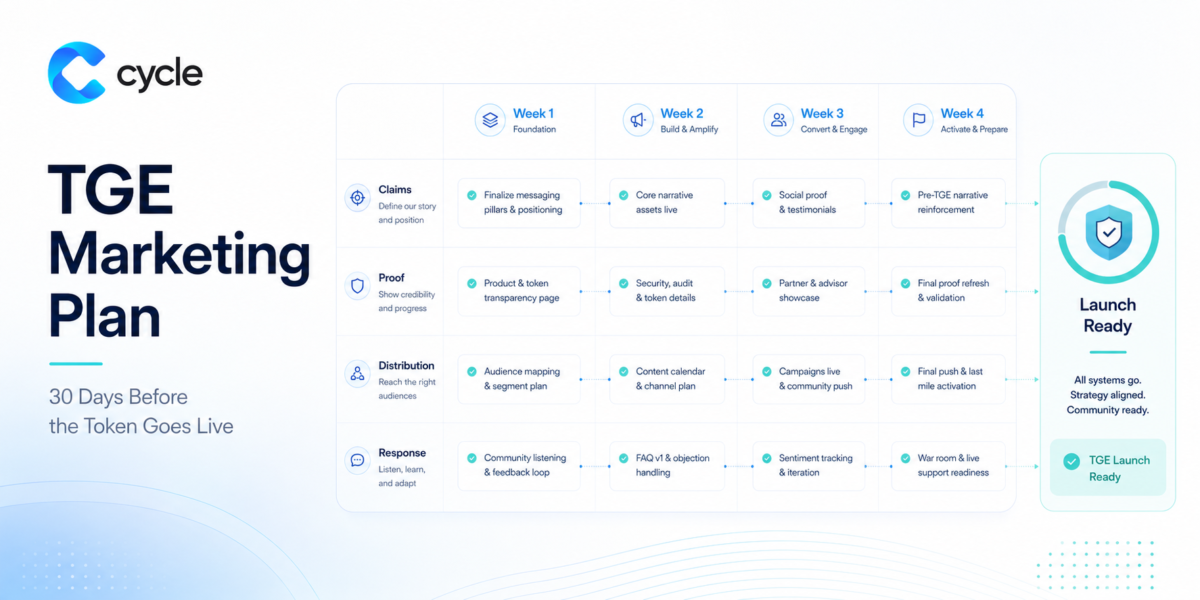
Short answer: a TGE marketing plan should use the final 30 days before token launch to make the project easier to understand, verify, and trust. The work is not only KOLs, PR, AMAs, or announcements. It is claim control, token story, proof assets, public channel readiness, community response, creator briefs, media readiness, and launch-week operating rhythm.
A TGE is not just a marketing date.
It is an inspection event.
The market checks the project more aggressively because the token moment gives people a reason to ask harder questions:
- What does the token do?
- Why does it need to exist?
- Who is behind the project?
- What is live now?
- What proof supports the claims?
- Are the community and public channels real?
- Are KOLs explaining something useful or just pushing attention?
- Is the team making promises it should not make?
This is why pre TGE marketing should not begin with a creator list.
It should begin with readiness.
The 30 days before TGE should be used to make the public surface strong enough for the launch to survive inspection.
What this plan is not
This is not a price-promotion plan.
It is not a plan for promising ROI, guaranteed exchange listings, guaranteed fundraising, or guaranteed token performance.
Good TGE marketing does a different job:
- makes the project understandable;
- explains the token’s role;
- gives the market proof to inspect;
- prepares public channels for attention;
- aligns founder, community, KOL, PR, and partner language;
- reduces confusion during launch week;
- turns the TGE into a trust-building moment instead of only a traffic spike.
If the token launch creates attention but the project looks unclear, quiet, or reckless, the campaign has not solved the real problem.
The 30-day TGE readiness principle
Use the token launch marketing checklist for the broader claims, proof, KOL, PR, community, and launch-week operating sequence.
The final month before TGE should answer one question:
If serious people inspect the project today, will they find proof or doubt?
Those serious people may be users, KOL audiences, partners, investors, exchange reviewers, ecosystem teams, community members, or journalists.
They will not all read the full docs.
They will scan the surface:
- homepage;
- token page or docs;
- X profile;
- Telegram or Discord;
- founder profile;
- pinned posts;
- product screenshots;
- partner references;
- public roadmap;
- community questions;
- search results;
- PR and KOL wording.
The 30-day plan is about making that surface coherent.
Week 1: Lock the claim boundary
The first week should control language before external distribution starts.
Token launch campaigns become risky when every vendor, KOL, community manager, founder, and partner improvises wording.
Before the campaign scales, define:
- approved project one-liner;
- approved token utility description;
- approved roadmap language;
- approved founder/team description;
- approved partner/backer language;
- approved community CTA;
- numbers that need sources;
- claims that need qualification;
- banned price language;
- banned ROI language;
- banned guaranteed listing language;
- banned fundraising promises;
- questions that should be escalated.
The goal is not to make the campaign timid.
The goal is to make it disciplined.
A clear claim boundary lets KOLs, PR, community, and founder posts stay aligned without creating avoidable trust risk.
Week 1 output: the launch claims sheet
By the end of week one, the team should have a launch claims sheet.
It should include:
- Project one-liner.
- Token utility explanation.
- What is live now.
- What is planned later.
- What the team will not promise.
- Approved links.
- Approved founder quote or POV.
- Short FAQ answers.
- Escalation path for hard questions.
This sheet becomes the base for KOL briefs, PR pitches, Telegram answers, founder posts, launch page copy, and partner messages.
Without it, launch week turns into a wording fight.
Week 2: Build the proof layer
After claims are controlled, build the proof assets that support them.
Useful proof depends on the project, but often includes:
- product demo;
- screenshots;
- docs;
- token utility explainer;
- roadmap proof;
- partner or ecosystem proof;
- founder note;
- launch FAQ;
- community recap;
- audit or security status where relevant;
- traction recap where verifiable;
- media kit;
- AMA topic list.
The point is not to create a pile of content.
The point is to remove doubt from the exact places where people will inspect the project.
If the launch says the token powers product usage, show the product path.
If the launch says the community is active, make the community surface understandable.
If the launch says partners matter, make the partner context verifiable.
If the launch says the founder has a clear view of the market, make the founder voice visible.
Week 2 output: the proof library
By the end of week two, the team should have a proof library that can be used by PR, KOLs, partners, community, and founder channels.
Minimum version:
- one launch page or updated product page;
- one token utility explainer;
- one founder POV post or note;
- one FAQ;
- one proof asset for product/traction/partner/community;
- one media/KOL brief;
- one official link list.
This is where Social Proof Package work becomes practical. It makes the project look alive, specific, and credible before larger distribution arrives.
Week 3: Prepare distribution without letting vendors set the agenda
Week three is when many teams jump directly into KOLs, PR, AMAs, and partner posts.
That work matters.
But it should now follow the proof layer, not replace it.
Plan distribution by role:
| Channel | Job before TGE | What it should point to |
|---|---|---|
| KOLs | Introduce and explain the project to relevant audiences | Launch page, proof asset, founder POV, community CTA |
| PR | Create credible announcement context | Media angle, proof assets, claims sheet, founder quote |
| AMAs / Spaces | Let the team answer public questions | FAQ, token utility, roadmap, official links |
| Telegram / Discord | Convert interest into clarity | Pinned onboarding, response scripts, moderator owners |
| X / founder posts | Make the story repeatable | Thread, proof asset, launch sequence |
| Partners | Add validation where real | Partner context, approved co-messaging |
The team should avoid a vendor-capture pattern where every external channel installs its own priority.
KOLs ask for hype.
PR asks for a sharp announcement.
Community asks for activity.
Ads ask for landing pages.
Partners ask for their own angle.
The founder-led company still needs one sequence.
Week 3 output: the launch distribution map
By the end of week three, the team should know:
- which KOLs matter and why;
- which PR angle is being pitched;
- which AMAs or Spaces support the story;
- which community questions will appear first;
- which founder posts explain the launch;
- which links every channel should use;
- which claims every channel must avoid;
- who approves changes;
- who monitors response.
This is the operating layer behind Trusted Distribution System.
Week 4: Own the response path
Launch week is not only publishing.
It is response management.
The team needs owners for:
- X replies;
- Telegram questions;
- Discord moderation;
- KOL follow-up;
- PR questions;
- partner amplification;
- founder responses;
- support issues;
- scam warnings;
- official link verification;
- daily recap and adjustment.
Many launches lose trust because the first hard questions are answered slowly, inconsistently, or defensively.
A prepared response path turns attention into clarity.
The team should know what happens when people ask:
- What does the token do?
- Is there a listing?
- Is there an airdrop?
- Where is the official link?
- What is the product status?
- What is the roadmap?
- What can and cannot be promised?
- Where can I verify this announcement?
Do not wait until launch day to write these answers.
Week 4 output: the 72-hour launch room
By launch week, the team should operate a simple control room.
It does not need to be complicated.
It needs:
- daily channel check;
- active issue list;
- response owners;
- approved answers;
- link safety check;
- KOL/PR/community publishing calendar;
- sentiment notes;
- escalation path;
- end-of-day recap;
- next-day adjustment.
A TGE campaign is not a set of disconnected posts.
It is a live operating window.
The 30-day TGE checklist
Use this checklist before scaling token launch attention.
Claim control
- Approved one-liner exists.
- Token utility wording is clear.
- Banned price/ROI/listing claims are defined.
- Partner and traction claims have sources.
- KOL and PR briefs use the same claim boundary.
Proof layer
- Website explains the project clearly.
- Token page or docs explain utility.
- Product, roadmap, partner, or traction proof exists.
- Founder or team signal is visible.
- FAQ answers predictable objections.
Public surface
- X bio and pinned posts match the launch.
- Telegram or Discord onboarding is current.
- Official links are consistent.
- Community moderators have scripts.
- Scam and impersonation warnings are ready.
Distribution
- KOLs are segmented by role.
- PR angle is specific and evidence-backed.
- AMAs or Spaces support real questions.
- Partner posts are aligned.
- Founder posts explain the launch in plain language.
Response path
- Owners are assigned.
- First 72-hour questions are mapped.
- Hard questions have approved answers.
- Sentiment and issue tracking are active.
- Daily recap and adjustment loop exists.
If this feels like too much work for the final 30 days, that is the signal.
The launch is not ready for more attention yet.
Operational example: the 30-day save
A Web3 project is 30 days from TGE. The token page is half-written. KOLs are being negotiated. Telegram is active but confused. The founder has strong explanations in calls but little public writing. PR wants a launch announcement, but the proof assets are thin.
The weak move is to push harder on distribution.
The stronger move is to use the final month as a readiness sprint.
Week one locks claims and the one-sentence story.
Week two creates the token explainer, founder note, FAQ, and proof assets.
Week three briefs KOLs, PR, AMAs, and partners around one sequence.
Week four runs the response room.
The TGE still creates pressure.
But now the pressure lands on a system that can answer.
Where CYCLE fits
CYCLE helps founder-led Web3 teams prepare the trust layer before TGE, listing, fundraising, or launch attention scales.
Use Launch & Listing Readiness when the token story, claims, proof assets, launch page, KOL/PR briefs, and response path need to be aligned before the public moment.
Use Social Proof Package when the project is stronger than it looks publicly and needs visible credibility before KOLs, PR, listings, or fundraising attention.
Use Trusted Distribution System when KOLs, PR, community, AMAs, founder posts, and partner channels need to move around one launch sequence.
The goal is not to make the TGE louder.
The goal is to make the project easier to understand, trust, introduce, discuss, and act on before the token gives the market a reason to look harder.
FAQ
What is TGE marketing?
TGE marketing is the work of preparing and coordinating the public story, proof layer, launch channels, KOLs, PR, community, founder voice, and response path around a token generation event. It should not promise token price, guaranteed listings, ROI, or fundraising outcomes.
What should a project do 30 days before TGE?
Thirty days before TGE, a project should lock claim boundaries, clarify token utility, prepare proof assets, update public channels, brief KOLs and PR, prepare Telegram or Discord responses, assign launch-week owners, and build a 72-hour response plan.
Is TGE marketing the same as token launch marketing?
TGE marketing is a specific part of token launch marketing focused on the final pre-launch and launch window. Token launch marketing can include broader positioning, community, PR, KOL, listing readiness, fundraising, and post-launch proof work.
Should KOLs start before or after TGE?
KOLs can start before TGE if the project has a clear story, proof assets, approved claims, public channel readiness, and a response path. If those pieces are weak, KOLs should wait until the project is ready for inspection.
What is the biggest mistake before TGE?
The biggest mistake is treating TGE as the moment that will create trust. A TGE does not create trust by itself. It pressure-tests whether the project already has enough narrative, proof, public surface, community readiness, and claim discipline.