


Proof Layer Audit for Founder-Led Startups
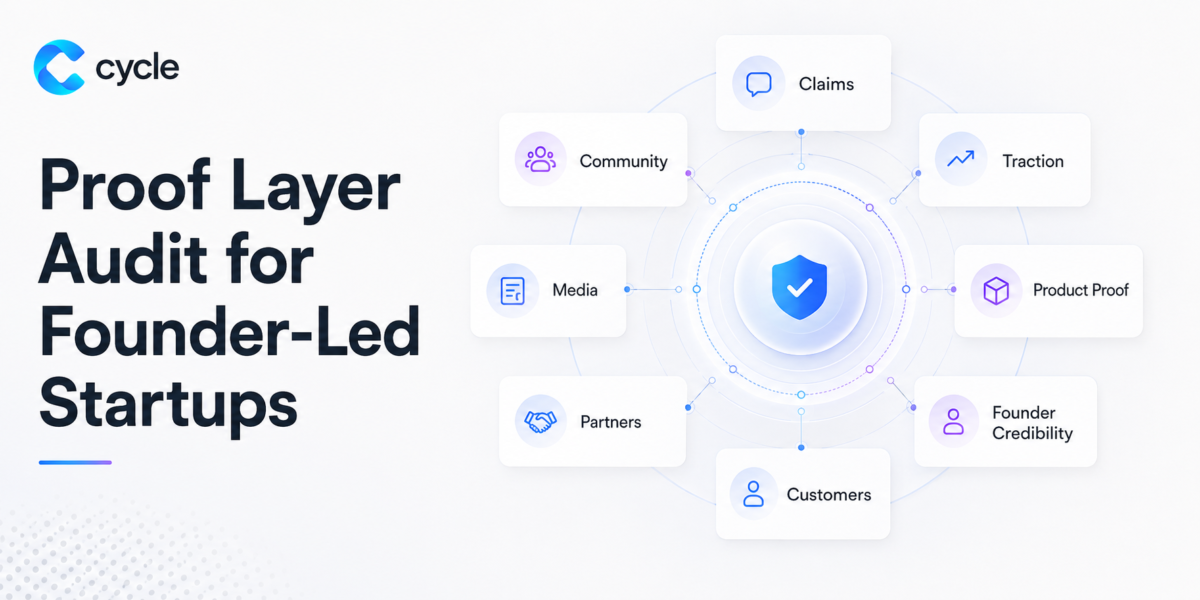
Short answer: a proof layer audit for startups checks whether the company has enough visible evidence to support its market claims before more attention arrives. It reviews the gap between what the startup says and what buyers, investors, partners, media, creators, and users can verify from the outside.
For founder-led startups, this matters because the founder often knows more proof than the market can see.
The founder knows why the product matters. The team knows what has been built, what customers say, what traction exists, what partners are engaged, and what technical choices make the company credible. But if that proof is not visible, distribution has to carry too much weight.
More PR, more content, more paid acquisition, more KOLs, more partnerships, or more founder posts will not fully solve a weak proof layer. They may only send more people to inspect the gap.
What the proof layer does
The proof layer is the evidence system around the company.
It answers the market's quiet questions:
- Is this real?
- Who trusts it?
- Why should I care now?
- What has already worked?
- Can the team execute?
- Is the founder credible?
- Is the product more than a claim?
- What would make this safer to introduce, fund, buy, publish, or join?
A Proof Layer Audit is the diagnostic that shows which of those questions have public answers and which still rely on private explanation.
How this is different from a general proof layer explainer
A definition article can explain what a proof layer is. A startup proof layer audit is more specific. It asks what proof a founder-led company needs at its current stage.
A pre-launch startup does not need the same proof as a scaled company. A technical infrastructure startup does not need the same proof as a consumer community. A fundraising-stage company does not need the same proof as a product-led SaaS company moving into paid acquisition.
The audit should match the moment.
| Startup moment | Proof the market expects |
|---|---|
| Pre-launch | founder credibility, category insight, product clarity, roadmap, waitlist or design partner signal |
| Early users | usage evidence, customer quotes, product screenshots, use cases, onboarding clarity |
| Fundraising | traction narrative, market timing, team credibility, proof of demand, investor-facing story |
| Public launch | launch assets, media angles, FAQ, demo proof, founder narrative, social proof |
| Distribution scale | case studies, retention or engagement signals, partner proof, channel-specific proof assets |
The audit does not ask, “Do we have enough proof forever?” It asks, “Do we have enough proof for the next GTM move?”
The proof gap most startups miss
Many founder-led startups have proof, but it is not organized around market belief.
Proof may be scattered across:
- pitch decks;
- private investor updates;
- product demos;
- customer conversations;
- founder posts;
- internal metrics;
- partner calls;
- community screenshots;
- PR notes;
- roadmap documents.
The market does not see that internal pile. It sees the website, founder profile, social channels, public deck fragments, community surface, press mentions, product pages, and search results.
A proof layer audit turns internal evidence into public trust assets.
The CYCLE proof layer audit framework
CYCLE checks six proof layers.
1. Claim proof
Every major claim should have visible support.
If the startup says it is faster, safer, more trusted, more efficient, easier to use, category-defining, enterprise-ready, community-led, or investor-backed, the audit asks what evidence supports that claim.
Unsupported claims are not always false. They are just expensive to distribute.
2. Product proof
Product proof shows that the product is not only an idea.
Depending on the company, this can include demos, screenshots, architecture explainers, docs, usage flows, integrations, product updates, changelogs, technical breakdowns, or use-case pages.
Technical startups often underuse product proof because the team assumes the product is self-evident. It rarely is.
3. Customer or user proof
Customer proof can be public logos, quotes, use cases, case studies, retention examples, waitlist quality, community activity, or adoption signals.
The key is specificity. “Users love us” is not proof. A concrete use case, result, behavior, or market segment is more useful.
4. Founder proof
For founder-led companies, founder credibility is part of the proof layer.
This can include founder POV, track record, technical depth, public explanation, investor trust, prior execution, or category insight. The founder does not need to become a personality brand. But the market should understand why this founder is credible enough to lead the company through the category problem.
5. Ecosystem proof
Ecosystem proof includes partners, integrations, advisors, media mentions, community participation, grants, ecosystem support, and credible relationships.
The mistake is treating these signals as logo decoration. The audit should connect each signal to a market belief: trust, distribution, credibility, technical validation, category access, or adoption.
6. GTM proof
GTM proof shows that the company can create and convert market attention.
That can include content performance, PR pickup, community engagement, founder response quality, events, demos, pipeline signal, partner conversations, or qualified inbound. It is the proof that the company is not only building, but learning how the market responds.
Proof layer scorecard
Score each area from 0 to 2.
| Proof area | 0 | 1 | 2 |
|---|---|---|---|
| Claim proof | Claims are broad or unsupported | Some claims have evidence | Main claims map clearly to proof |
| Product proof | Product is hard to inspect | Product is partly visible | Product value is easy to understand and verify |
| Customer/user proof | No visible demand signal | Early signal exists but is scattered | Use cases, quotes, behavior, or metrics are visible |
| Founder proof | Founder context is private | Some founder signal exists | Founder credibility supports the category story |
| Ecosystem proof | Relationships are invisible | Signals exist but lack context | Partners/media/community signals build trust |
| GTM proof | No market response visible | Activity exists but lacks interpretation | Market signal is visible and tied to next actions |
A startup does not need a perfect score before launching. It needs to know where attention will create doubt.
Operational example
A founder-led fintech startup is preparing a PR push.
The story is strong in private: the founder has deep domain experience, the product solves a clear workflow problem, and early design partners are engaged. But the public website has broad claims, no product screenshots, no founder POV, no use-case detail, and no proof of demand.
A PR campaign may still get coverage. But after readers click through, they may not find enough evidence to believe the company.
The proof layer audit would recommend:
- tighten the main claim;
- show one concrete workflow use case;
- publish founder POV on the category problem;
- add design partner or early-user proof if approved;
- create a short FAQ for risk and trust questions;
- align the PR angle with evidence the public can inspect.
Then PR has something to point to.
What to fix before attention scales
Before scaling attention, fix the proof that supports the next market move.
For fundraising, the proof may be traction, market timing, founder credibility, and investor narrative. For paid acquisition, it may be landing-page proof, customer use cases, and offer clarity. For PR, it may be founder POV, category timing, and evidence that the story is more than an announcement. For creator or KOL distribution, it may be social proof, product explanation, and public credibility.
The mistake is trying to build every proof asset at once. The right move is sequencing.
How this connects to CYCLE
CYCLE uses proof layer work to make distribution safer and more effective.
A proof layer audit can feed into:
- a Social Proof Package when the public surface needs visible trust signals;
- a GTM Control Room when proof, positioning, PR, content, vendors, and launch execution need ongoing coordination;
- founder-led content when founder credibility needs to become visible;
- PR and creator briefs when external channels need proof-backed angles.
The goal is not to decorate the company with credibility signals. The goal is to make the company easier to understand, trust, introduce, discuss, and buy from.
FAQ
What is a proof layer audit for startups?
It is a diagnostic that checks whether a startup's claims are supported by visible evidence: product proof, customer or user proof, founder credibility, ecosystem signals, and market response.
When should a founder-led startup run a proof layer audit?
Run it before PR, fundraising, paid acquisition, creator campaigns, launch announcements, partnerships, or a website rewrite. It is especially useful when the team has real proof internally but the public surface looks thin.
Is a proof layer the same as social proof?
No. Social proof is one part of the proof layer. A full proof layer also includes product evidence, founder credibility, customer proof, ecosystem proof, and GTM signal.
What if the startup has limited traction?
The audit should not invent proof. It should identify the strongest available evidence and adjust claims to match reality. Early-stage proof can include founder credibility, problem insight, product demos, design partners, waitlist quality, or category timing.
How does CYCLE use proof layer work?
CYCLE uses proof layer work to prepare companies for distribution. Once the proof is visible and coherent, PR, content, paid, partnerships, KOLs, and community activity have a stronger public surface to support.