


Founder-Led Category Narrative: How to Make the Market Understand You
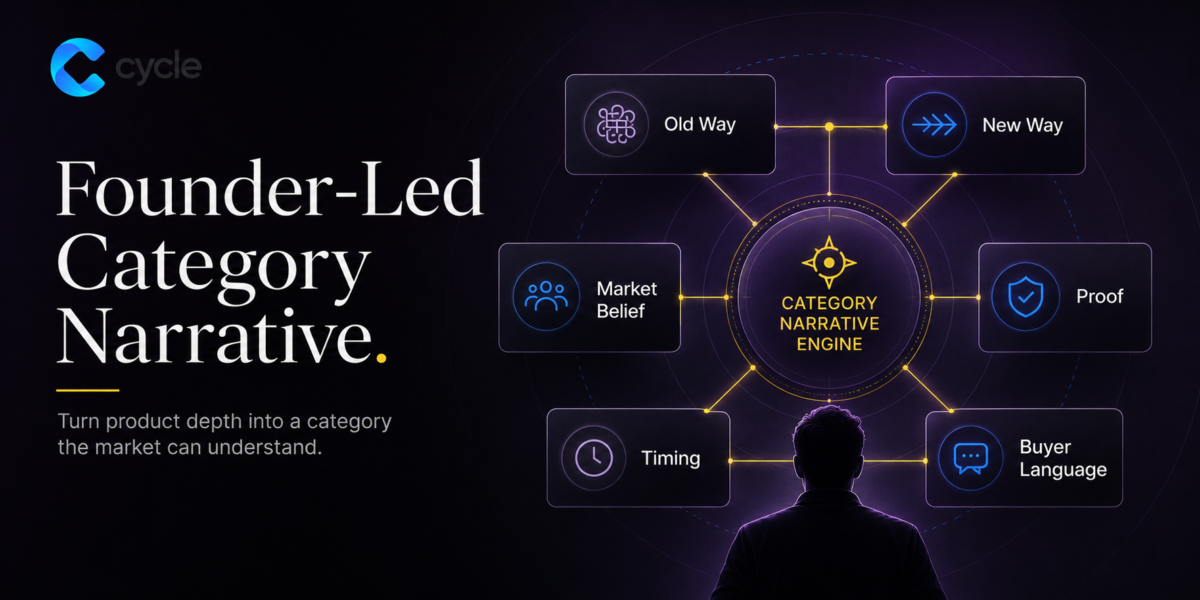
Short answer: a founder-led category narrative is the market story that explains what category the company belongs to, what old way is breaking, what new way is emerging, why the timing matters, and why the founder's company is credible in that shift. It helps technical companies become easier to understand before more channels try to distribute the story.
Many founder-led companies do not lose the market because the product is weak. They lose the market because the category is hard to read.
The founder understands the shift. The team understands the product. Early users or investors may understand the opportunity. But the broader market sees a product page, a few claims, a deck, a founder post, or a launch announcement and tries to place the company in an existing mental box.
If the box is wrong, the company sounds smaller than it is.
A category narrative helps the market build the right box.
Why category narrative matters
Technical companies often enter markets where the buyer does not yet have perfect language for the problem.
AI products can look like wrappers. FinTech products can look risky before the trust layer is clear. Web3 infrastructure can look speculative even when the system is serious. DevTools can look like features instead of workflow change. Cybersecurity products can sound important but hard to evaluate quickly.
The founder can usually explain the deeper category shift in conversation. The public market needs a compressed version.
Without that narrative, channels struggle:
- PR pitches sound like announcements instead of market insight;
- content explains features but not why the category matters;
- paid campaigns test claims without belief;
- creator or partner briefs simplify the company incorrectly;
- sales calls repeat category education from the beginning;
- investors compare the company to the wrong alternatives.
The company may have a GTM problem, but the root is category readability.
What a category narrative should do
A category narrative should not invent a fake category. It should make the real market shift easier to understand.
It should answer six questions.
| Question | Purpose |
|---|---|
| What is the old way? | Gives the market a familiar starting point |
| What is breaking? | Creates urgency and timing |
| What is the new way? | Explains the category shift |
| Who feels the pain first? | Defines the buyer or audience |
| What proof makes this believable? | Connects narrative to evidence |
| Why is this founder credible? | Turns founder insight into trust |
If the narrative cannot answer those questions, the market will create its own simpler version.
The founder's role in category narrative
Founder-led category narrative works because founders often see the category before the market has clean language for it.
They know:
- which customer behavior changed;
- what legacy assumptions are failing;
- what new workflow is forming;
- which objections are real;
- why existing solutions are insufficient;
- where the product has to be precise;
- why now is the right moment.
That insight should not stay trapped in private calls. It should shape the homepage, deck, founder content, PR angles, sales narrative, partner briefs, launch pages, FAQ, and proof assets.
This is part of technical founder GTM: turning product and category depth into market demand.
The CYCLE category narrative framework
CYCLE uses a practical five-part framework.
1. Name the market tension
Start with what is changing in the market.
Weak category narratives start with the company. Strong ones start with the tension the market already feels or is about to feel.
Examples:
- teams are adding more AI tools but losing control of workflow quality;
- financial products need trust signals before users share data or money;
- technical buyers need proof before they evaluate another infrastructure claim;
- Web3 communities need credibility before token or listing attention scales.
The tension makes the narrative relevant before the company introduces itself.
2. Define the old way
The old way gives the market something to compare against.
It might be manual work, fragmented vendors, generic agencies, unclear dashboards, trustless distribution, founder-only sales, shallow content, disconnected PR, or feature-led product pages.
The old way should be fair. Do not attack a straw man. The goal is to show why an existing approach no longer fits the market moment.
3. Describe the new way
The new way is the category shift.
For CYCLE's own positioning, the shift is simple: founder-led technical companies do not only need more marketing vendors. They need an operating layer that connects positioning, proof, founder signal, trusted distribution, and execution rhythm.
That is why CYCLE uses the language of a founder-led GTM operator and an external GTM control room.
For a client, the new way should be equally concrete. It should describe the change in how the market should think, buy, evaluate, or act.
4. Anchor the proof
A category narrative without proof becomes thought leadership theater.
The narrative should point to evidence:
- product behavior;
- customer pain;
- user adoption;
- founder experience;
- partner signal;
- market timing;
- case examples;
- community response;
- technical validation;
- investor or ecosystem activity.
Proof turns the narrative from opinion into a market argument.
5. Turn it into a GTM system
A category narrative should not live only in a manifesto.
It should guide:
- homepage language;
- founder POV;
- PR angles;
- sales deck structure;
- FAQ answers;
- launch campaign themes;
- creator and partner briefs;
- content architecture;
- proof assets;
- paid and retargeting messages.
If every channel tells a different category story, the narrative is not operational yet.
Category narrative diagnostic
Use this diagnostic before launch, fundraising, PR, or major content production.
| Diagnostic question | If the answer is weak, fix this |
|---|---|
| Can a buyer describe the category after reading the homepage? | Category entry point |
| Can the founder explain the old way/new way in two minutes? | Narrative compression |
| Does the deck match the website and founder posts? | Public surface consistency |
| Is the proof connected to the category claim? | Proof layer |
| Do PR, content, and sales use the same core language? | Channel alignment |
| Does the narrative create urgency, not just clarity? | Timing and stakes |
The best category narrative makes the company easier to introduce. If a partner, investor, buyer, journalist, or community member can repeat the story accurately, the narrative is working.
Operational example
A DevTools startup says it helps engineering teams “ship faster with AI.” The product is real, but the category narrative is too broad. The market places it in the same bucket as dozens of AI productivity tools.
The founder's actual insight is sharper: engineering teams are not short on code generation. They are short on review, context, and workflow control as AI-generated output increases.
The category narrative could become:
- old way: AI coding tools increase output;
- breaking point: more output creates review and context debt;
- new way: engineering teams need control layers for AI-assisted development;
- buyer: technical leaders managing quality and velocity;
- proof: product demos, workflow examples, early customer behavior;
- founder credibility: deep engineering workflow insight.
That narrative changes the homepage, sales deck, founder content, PR angle, and paid tests. The company stops competing as another AI wrapper and starts educating the market around a specific category shift.
What founders should avoid
Avoid these category narrative mistakes:
- Naming a category before proving the market tension.
- Using a tagline as a substitute for a narrative.
- Explaining every feature before explaining the change in the market.
- Making the old way sound stupid instead of insufficient for the new context.
- Creating a category so broad that no buyer feels addressed.
- Publishing thought leadership that does not connect to proof or offer path.
- Letting every vendor rewrite the category in their own channel language.
The category narrative should give vendors, channels, partners, and the founder one shared map.
How this connects to CYCLE
CYCLE helps founder-led companies turn category insight into a GTM system.
That usually means connecting:
- founder narrative;
- positioning;
- proof layer;
- public surface;
- content architecture;
- PR and partner angles;
- vendor briefs;
- weekly execution.
The category narrative is not the final deliverable. It is the operating logic that makes the rest of GTM more coherent.
For companies that need ongoing coordination, the work belongs inside a GTM Control Room, where the narrative, proof, channels, vendors, and execution rhythm can be managed together.
FAQ
What is a founder-led category narrative?
It is the category story led by the founder's market insight. It explains the old way, what is changing, the new way, who should care, what proof supports the claim, and why the founder's company is credible.
Is category narrative the same as positioning?
No. Positioning defines where the company fits and why it matters to a buyer. Category narrative explains the broader market shift that makes the company's position meaningful now.
When does a startup need a category narrative?
A startup needs one when the product is complex, the market does not understand the problem yet, existing comparisons are misleading, or the founder repeatedly has to explain the company before buyers see the value.
Should every startup create a new category?
No. Many startups should use an existing category and sharpen the narrative inside it. The goal is not to invent terminology. The goal is to make the market understand the change and the company's role in it.
How does CYCLE turn category narrative into GTM?
CYCLE connects the narrative to proof, founder voice, website language, PR angles, content, partner briefs, vendor coordination, and weekly execution so the category story becomes usable across the market-facing system.