


Crypto KOL Marketing: Meaning, Strategy & Measurement
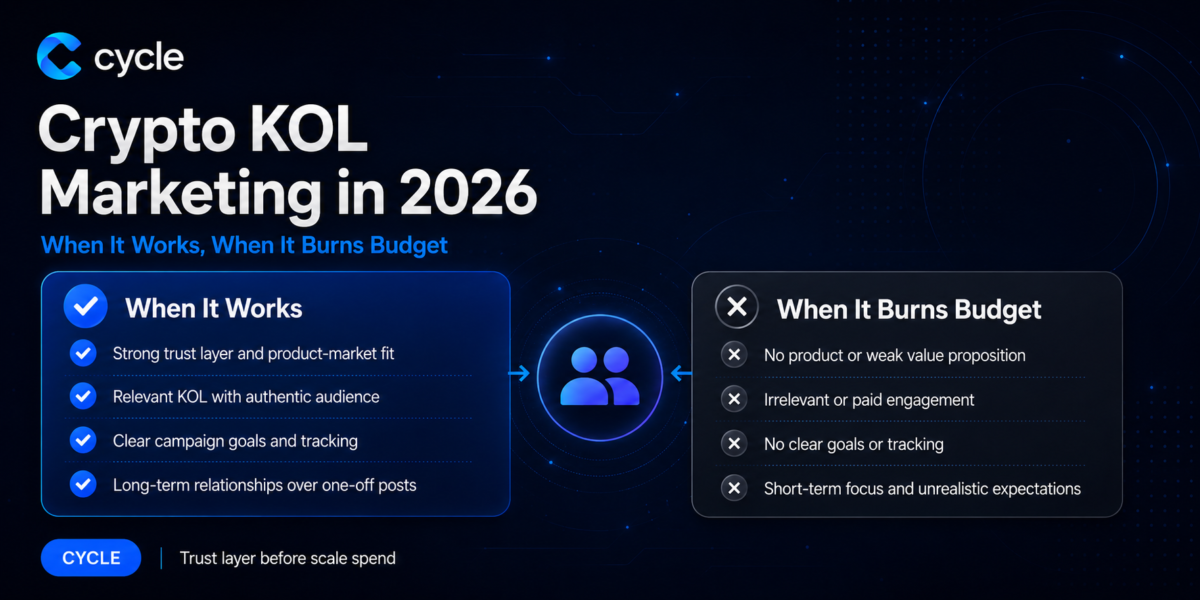
Short answer: Crypto KOL marketing works when a Web3 project has something credible for the influencer to amplify: a clear narrative, active public channels, proof assets, a real community entry point, disclosure rules, and a landing path that turns attention into trust. It burns budget when teams buy reach before the project is ready for visitors to inspect X, Telegram, founder profiles, website claims, and proof.
KOLs can still move attention fast. That is why founders keep paying for them.
But in 2026, attention is not the scarce resource. Trust is.
A KOL post can send thousands of people to a project in a few hours. The problem starts when those people click through and see a weak public surface:
- the pinned post is old;
- Telegram looks quiet or staged;
- the website explains the category but not the project;
- the founder profile gives no confidence;
- proof points are scattered;
- the campaign CTA is vague;
- the KOL content sounds disconnected from the actual product.
That is not a KOL problem. That is a readiness problem.
What Does KOL Mean in Crypto?
In crypto, KOL means key opinion leader: a creator, analyst, founder, educator, or community voice whose audience trusts their judgment in a specific Web3 niche.
Crypto KOL marketing coordinates those trusted voices around a clear audience, campaign angle, proof layer, disclosure rules, conversion path, and measurement plan.
The useful version is not "pay a big account to shill."
The useful version is coordinated distribution:
- Choose the right audience.
- Give the creator a real angle.
- Make the project surface ready for traffic.
- Track what happens after attention arrives.
- Use the campaign to create durable public proof.
If a team skips steps 2 through 5, the campaign becomes a rented spike.
Why KOL Campaigns Fail
Most failed KOL campaigns fail before the first post goes live.
The project assumes the influencer is the strategy. It buys a list, negotiates rates, sends a shallow brief, gets posts, watches impressions rise, and then wonders why community quality, signups, investor interest, or token demand did not change.
The hidden issue is usually one of these:
- weak narrative;
- wrong KOL category;
- inflated or irrelevant audience;
- unclear landing path;
- no social proof under the project's own posts;
- no community onboarding;
- no follow-up content;
- no disclosure or compliance discipline;
- no measurement beyond views and likes.
KOL marketing is not magic. It is a distribution channel. Distribution only helps when the destination is ready.
The CYCLE Readiness Rule
Before paying for KOLs, a Web3 project should be able to pass one simple test:
If 1,000 serious people visit the project today, will the public surface make them more confident or more skeptical?
Use the Web3 social proof before KOL ads checklist to inspect that surface before paid creator reach begins.
That surface includes:
- homepage;
- X/Twitter profile;
- pinned posts;
- Telegram or Discord;
- founder or team profiles;
- docs or product demo;
- media mentions;
- community replies;
- proof assets;
- campaign CTA.
If the answer is "more skeptical," the first budget should go into social proof and readiness work before the KOL push.
When Crypto KOL Marketing Works
KOL campaigns work best when they amplify something that already has substance.
1. The project has a specific story
Weak story:
- "We are building the future of Web3."
- "A revolutionary ecosystem."
- "The next big AI crypto platform."
Stronger story:
- who it is for;
- what problem it solves;
- why the current moment matters;
- what proof already exists;
- what action the audience should take.
A KOL cannot fix a vague category narrative. They can only repeat it louder.
2. The KOL audience matches the project
Follower count is a crude filter.
A DeFi yield product, gaming quest, Telegram mini-app, infrastructure tool, exchange listing campaign, NFT brand, and RWA protocol need different creator maps. The overlap between audience and intent matters more than raw reach.
Better questions:
- Does this audience already care about the category?
- Does the KOL drive comments from real people or only low-quality engagement?
- Has the KOL promoted too many unrelated projects?
- Does the creator have credibility with founders, traders, builders, retail users, or a niche community?
- What happened after their previous campaigns?
The right small KOL can outperform a large account with the wrong audience.
This is the operator question behind crypto KOL agency vs GTM operator: the issue is not who can buy influencer reach, but who owns the sequence before attention arrives.
3. The content angle is real
Good KOL content needs a reason to exist.
Possible angles:
- a launch moment;
- a product update;
- a campaign or quest;
- a founder story;
- a useful explainer;
- a partner announcement;
- a traction milestone;
- a public AMA or Space;
- a comparison against a known problem.
Bad KOL content sounds like an ad pasted into a thread.
If the post could promote any project by changing the name, the angle is too weak.
4. The project has visible social proof
The KOL creates a door. The project still has to look credible when people walk through it.
Before the campaign, prepare:
- active X posts;
- relevant replies under important posts;
- Telegram pinned message and onboarding;
- FAQ or explainer page;
- proof assets;
- founder or team visibility;
- AMA or community event plan;
- clear CTA;
- moderation coverage during the campaign window.
This is where many campaigns leak.
The KOL post performs, but the project account looks quiet. People click, scan, and leave.
That is why Web3 community growth should be treated as a proof surface before paid creator traffic scales.
5. The campaign has a conversion path
Every KOL campaign should answer:
- What should a new person do first?
- Where do they land?
- What proof do they see?
- What happens after they join Telegram or visit the site?
- Who handles questions?
- How do we retarget, follow up, or continue the conversation?
Without this path, the campaign becomes a screenshot of impressions.
When Crypto KOL Marketing Burns Budget
KOL marketing burns budget when the project is using paid credibility to hide an unfixed trust gap.
Warning signs:
- The team cannot explain the project in one sentence.
- The website and X profile say different things.
- Telegram has no useful pinned onboarding.
- The founder or team has no public credibility signal.
- The project is asking for token attention before product or proof is clear.
- The KOL list is built only from follower count.
- The brief is generic.
- The campaign has no moderation or community response plan.
- The only KPI is impressions.
- The project expects KOLs to create trust from nothing.
In this situation, the smarter move is a readiness sprint.
Fix the narrative. Build proof assets. Make the community surface active. Prepare the CTA. Then activate KOLs.
A High-Level KOL Screen Before Paying
Use a practical screen before committing budget.
For a deeper checklist, use how to vet crypto KOLs before a token launch before budget moves into creator posts.
Audience Quality
Check:
- follower growth pattern;
- average replies from real accounts;
- repeat commenters;
- geography and language fit;
- audience category;
- signs of bot engagement;
- quality of previous sponsored posts.
Do not only check likes. In crypto, low-quality engagement is easy to buy.
Category Fit
Ask what the KOL is known for.
Some creators are good for:
- DeFi users;
- memecoin traders;
- gaming communities;
- NFT collectors;
- builders and developers;
- founders and investors;
- a regional language market;
- exchange users;
- airdrop hunters.
An airdrop audience may inflate campaign activity but produce weak long-term trust. A founder/investor audience may be smaller but better for credibility.
Reputation Risk
Review:
- past paid promotions;
- public callouts;
- deleted campaigns;
- scam association risk;
- whether the creator discloses paid work;
- whether they overpromise price movement.
The KOL's reputation becomes part of the project's reputation during the campaign.
Content Quality
A good creator can explain why the project matters in their own voice.
If they only copy-paste a brief, the campaign may look paid, lazy, and low-conviction.
Ask for:
- examples of previous campaign content;
- angle options;
- format fit;
- whether they will use original wording;
- whether they can join an AMA, Space, or follow-up thread.
Compliance and Disclosure
Paid promotion should be handled carefully.
The FTC's influencer guidance says material connections should be disclosed clearly and placed with the endorsement message. Their endorsement FAQ also emphasizes that responsibility for clear disclosure can sit with both the influencer and the brand.
This article is not legal advice, and disclosure rules vary by jurisdiction. But the operating principle is simple: do not build a campaign around hidden paid endorsements, false independence, or promises the project cannot support.
In crypto, that is not just a compliance issue. It is a trust issue.
What A Strong KOL Brief Should Include
A good brief is short, specific, and hard to misunderstand.
Include:
- project one-liner;
- target audience;
- campaign goal;
- key message;
- proof points;
- forbidden claims;
- required disclosure language;
- approved links;
- CTA;
- timing;
- content format;
- community or AMA follow-up;
- reporting expectations.
Also include what the creator should not say.
For crypto campaigns, this matters. Avoid:
- token price promises;
- guaranteed ROI;
- guaranteed listing or fundraising outcomes;
- unsupported user or revenue claims;
- fake urgency;
- language that makes paid promotion look independent.
How To Measure KOL Campaigns
Views are useful, but not enough.
Track the full path:
- impressions;
- clicks;
- profile visits;
- follower quality;
- Telegram joins;
- Discord joins;
- site sessions;
- waitlist signups;
- wallet connects, if relevant and appropriate;
- AMA attendance;
- questions asked;
- reply quality;
- sentiment;
- secondary mentions;
- conversion by creator;
- cost per meaningful action;
- post-campaign retention.
For some campaigns, the most useful result is not immediate conversion. It is durable proof:
- people discussing the project;
- founder clips;
- AMA recording;
- high-quality replies;
- search-visible threads;
- partner-facing proof assets;
- content that can be reused in fundraising or listing conversations.
That is why KOLs should be planned with PR, community, founder content, and social proof. The campaign should leave evidence behind.
A 10-Day KOL Readiness Sprint
Before a serious KOL push, run this sprint.
Days 1-2: Audit the public surface
Review website, X, Telegram, founder profiles, docs, proof assets, search results, and current community activity.
Output: one ranked list of trust gaps.
Days 3-4: Fix the narrative
Align homepage, X bio, pinned post, Telegram intro, short deck, and KOL brief around one explanation.
Output: a message that a new user can understand in under 30 seconds.
Days 5-6: Build proof assets
Create or update the assets that reduce doubt:
- explainer page;
- founder note;
- product demo;
- launch FAQ;
- traction recap;
- community proof;
- partner proof;
- AMA plan.
Days 7-8: Vet and sequence KOLs
Segment creators by audience and role:
- awareness;
- trust;
- education;
- community activation;
- regional reach;
- post-campaign follow-up.
Do not launch every KOL at once unless the campaign moment truly needs it.
Days 9-10: Prepare community and reporting
Set moderation coverage, pinned messages, FAQ answers, tracking links, UTM structure, and reporting format.
Then launch.
Where CYCLE Fits
CYCLE does not treat KOL marketing as isolated paid posts.
The stronger sequence is:
- Social proof audit.
- Narrative and proof asset cleanup.
- KOL readiness check.
- Creator selection and briefing.
- Community and PR coordination.
- Campaign execution.
- Reporting and proof capture.
That is the difference between buying attention and building a campaign system.
If a project is not ready for KOLs yet, the right answer is not "buy cheaper KOLs."
The right answer is: fix the trust layer first.
Related CYCLE Services
Use Trusted Distribution System for creator selection, campaign briefing, KOL/PR coordination, and distribution execution. If the public surface is still weak, start with Social Proof Package or Community Growth before sending paid attention into the funnel.
Related Proof
- Web3 Epic Challenge / Bybit Partnership shows a quest-driven campaign with partner activation and community participation.
- OKX CIS Brand Awareness shows how media visibility supports broader trust.
- CYBERBASE Telegram Mini App shows Telegram and community activation as part of a growth system.
FAQ
What is crypto KOL marketing?
Crypto KOL marketing is paid or partnered promotion through trusted Web3 creators, influencers, analysts, community owners, founders, or media personalities. It is used to create awareness, credibility, community activity, and campaign momentum.
Does crypto KOL marketing still work in 2026?
Yes, but it works best when the project has a clear story, credible proof, a strong public surface, and a conversion path. KOLs amplify trust that already exists. They rarely create it from nothing.
How do you choose the right crypto KOL?
Choose based on audience relevance, engagement quality, category fit, reputation risk, content quality, disclosure discipline, and past campaign outcomes. Do not choose based only on follower count.
What should a KOL campaign brief include?
A strong brief includes the project one-liner, target audience, goal, key message, proof points, forbidden claims, disclosure rules, approved links, CTA, timing, format, and reporting expectations.
What should a project fix before paying KOLs?
Fix the homepage, X profile, pinned posts, Telegram or Discord onboarding, founder/team signal, proof assets, campaign CTA, moderation coverage, and reporting setup before driving paid attention.
What metrics matter beyond impressions?
Track clicks, profile visits, community joins, site sessions, signup quality, wallet or product actions where relevant, AMA attendance, reply quality, sentiment, secondary mentions, conversion by creator, and post-campaign retention.