


Crypto PR Agency: How to Buy Media Support Without Paying for Noise
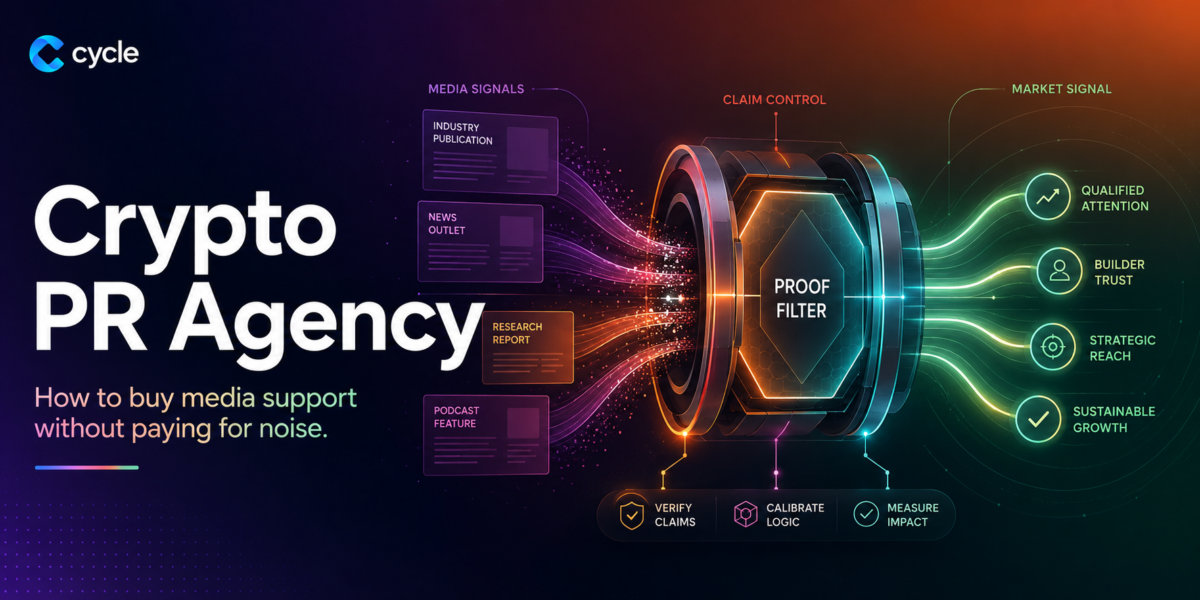
Short answer: a crypto PR agency is worth hiring when it can sharpen the story, prepare media-ready proof, manage crypto media relations, control risky claims, coordinate launch communication, and turn coverage into reusable market signal. If the agency only sells outlet names, press-release distribution, or vague “buzz,” you are probably buying noise.
Most Web3 teams start the PR search too late.
The announcement is close. The token launch is close. The partnership is signed. The product update needs attention. The founder wants Tier-1 coverage. The team searches for a crypto PR agency, a web3 PR agency, or someone with crypto media relations access.
That search usually starts with the wrong question:
Can this agency get us coverage?
A better first question is:
What exactly will this agency make ready before coverage sends people to inspect us?
Coverage is not the whole job. Coverage is the visible output.
The real job of crypto PR is to make the project easier for media, partners, KOLs, communities, investors, and users to understand, verify, repeat, and discuss without the story collapsing under inspection.
That changes how you should buy PR.
The sharp POV: a crypto PR agency should not sell attention before scope
A weak PR package sells attention first.
It starts with outlet names, package tiers, distribution promises, “guaranteed placements,” press-release syndication, and a list of logos the buyer wants to see.
A useful crypto PR agency starts with scope:
- What is the story?
- Why should anyone care now?
- What proof supports the claim?
- Which claims are safe to make?
- Which claims should not be made?
- What will journalists, KOLs, and communities find when they check the project?
- Who answers the first hard questions after the article goes live?
- How will the coverage be reused after launch week?
The difference matters because crypto PR creates inspection.
A media article, founder quote, interview, announcement, podcast mention, or token launch PR push does not end with the reader consuming the story. The reader usually checks the project: website, X, Telegram, founder profile, docs, product evidence, partner proof, search results, and community replies.
If that public surface is weak, PR does not fix it.
It exposes it.
This is why the buyer should not evaluate a crypto PR agency only by access. Access matters. But access without readiness can turn a visible moment into a trust gap.
What a crypto PR agency should actually do
A serious crypto PR agency should not be a press-release forwarding desk.
The work should cover five layers.
1. Narrative and angle
The agency should help compress the story into a media-readable angle.
Not:
- “revolutionary Web3 ecosystem”;
- “next-generation DeFi platform”;
- “AI-powered blockchain innovation.”
Those phrases do not help a journalist, partner, or user understand the company.
A stronger PR angle explains:
- what changed;
- why it matters now;
- who is affected;
- what proof exists;
- why this team is credible;
- what the market can verify.
If the agency cannot turn the project into a specific one-sentence story, the outreach will be weak even if the contact list is real.
2. Media readiness
Crypto media relations works better when the team prepares the evidence before outreach.
That can include:
- media kit;
- founder bio and quote;
- product screenshots or demo links;
- proof asset or traction recap;
- partner context;
- launch FAQ;
- claim sheet;
- official links;
- approved and banned language;
- community response scripts;
- technical explainer when relevant.
The goal is not to create a pile of assets.
The goal is to remove the next objection before media, KOLs, or the community ask it.
3. Outreach and relationship handling
This is the part most buyers think of first: crypto media relations.
A useful agency should know which outlets, editors, journalists, newsletters, podcasts, regional media, analysts, or ecosystem channels fit the story.
But the agency should also be honest about the difference between:
- earned coverage;
- paid or sponsored placements;
- press-release syndication;
- contributed articles;
- interviews;
- podcast appearances;
- newsletter mentions;
- partner channels;
- KOL amplification.
If those categories are blurred, reporting becomes misleading.
A syndication hit is not the same as a journalist-led article. A paid placement is not the same as earned editorial interest. A logo on a deck is not the same as durable trust.
4. Claims control
Crypto PR carries specific risk because token, listing, fundraising, yield, user, partnership, and roadmap claims can be misunderstood or overstated.
Before outreach, define:
- what can be said confidently;
- what needs a source;
- what needs qualification;
- what cannot be promised;
- which numbers require context;
- which partner language needs approval;
- which token or listing claims are banned;
- how to answer hard questions without improvising.
Good PR makes the story sharper.
It should not make the project reckless.
5. Amplification and follow-up
PR is not finished when coverage goes live.
The first 24 to 72 hours decide whether the coverage becomes useful proof or a one-day screenshot.
The agency or operating team should know:
- who posts from the founder account;
- how X, Telegram, Discord, and newsletter channels explain the coverage;
- which KOLs or partners should amplify it;
- which community questions will appear;
- what answer scripts are ready;
- how the coverage will be reused in sales, investor updates, partner follow-up, launch pages, and future campaigns.
A media hit should become a proof asset.
If it is shared once and forgotten, most of the value disappears.
The CYCLE crypto PR agency evaluation framework
Use this framework before hiring a crypto PR agency, web3 PR agency, or token launch PR partner.
The question is not only “can they pitch?”
The question is whether they can manage the full PR scope around a trust-sensitive Web3 project.
| Evaluation area | What a strong agency does | Red flag |
|---|---|---|
| Story | Turns the project into a specific, repeatable media angle | Uses broad category language and asks the client to “send the announcement” |
| Proof | Asks for evidence before promising coverage | Treats proof assets as optional or cosmetic |
| Surface | Checks website, X, Telegram, founder profiles, docs, and official links | Ignores where readers will land after coverage |
| Relations | Explains relevant media categories and realistic outreach paths | Leads with logo walls, vague “Tier-1 access,” or guaranteed editorial outcomes |
| Claims | Builds approved, qualified, and banned claim language | Encourages hype around token price, listings, ROI, or unsourced traction |
| Sequence | Connects PR with KOLs, community, founder posts, partners, and launch timing | Runs PR as an isolated press-release task |
| Follow-up | Turns coverage into reusable proof for the next campaign | Reports only URLs and screenshots |
This is the practical difference between buying PR activity and buying media readiness.
What to ask before you sign the PR scope
Before paying a crypto PR agency, ask questions that reveal how the agency thinks.
Strategy questions
- What is the strongest media angle here?
- What would make this story uninteresting to journalists?
- What proof is missing before outreach?
- Which audience should this PR moment influence: users, investors, partners, ecosystem teams, exchange reviewers, builders, or community members?
- What should happen after someone reads the article?
Media questions
- Which media categories fit this story and why?
- What is the difference between earned, sponsored, syndicated, contributed, and partner media in your plan?
- Which outlets are realistic for this announcement?
- What would need to change for stronger editorial interest?
- How will you report quality, not only quantity?
Claims questions
- Which claims need evidence?
- Which claims should we avoid?
- How should we describe token, listing, roadmap, or funding language safely?
- Who approves the final pitch, press release, quote, and FAQ?
Operations questions
- What should be ready on the website, X, Telegram, and founder profile before outreach?
- Who owns responses after the story goes live?
- How will PR coordinate with KOLs, AMAs, partners, and community?
- What is the 72-hour plan after publication?
- How will the coverage be reused?
If the agency cannot answer these questions clearly, the risk is not only weak coverage.
The risk is unmanaged attention.
What should be inside a crypto PR agency SOW
A good scope of work should be specific enough to prevent a bad surprise.
For a serious PR engagement, the SOW should clarify:
- Objective. What business moment is PR supporting: token launch PR, product launch, partnership, funding news, ecosystem announcement, reputation reset, founder authority, or general media readiness?
- Narrative work. Who owns the one-liner, angle, press release, founder quote, FAQ, and media kit?
- Proof assets. Which proof assets need to exist before outreach starts?
- Media approach. Which media categories are being targeted and which coverage types are included?
- Claims control. Who approves sensitive claims and which claims are not allowed?
- Timeline. What happens before outreach, during outreach, at publication, and after coverage?
- Community and founder coordination. How will Telegram, Discord, X, founder posts, KOLs, AMAs, or partners support the moment?
- Reporting. What will be reported beyond URLs: message pull-through, outlet relevance, referral signal, community questions, follow-up opportunities, and reusable proof?
- Exclusions. What is not promised: token price movement, guaranteed listings, guaranteed fundraising, guaranteed Tier-1 editorial coverage, or guaranteed ROI.
A clear SOW protects both sides.
It makes the agency useful and keeps the buyer from assuming PR will solve problems it was never scoped to fix.
Operational example: token launch PR bought too late
A Web3 infrastructure project is three weeks from a token launch.
The team hires a crypto PR agency because it wants coverage before launch week. The agency offers a package: press release, outlet distribution, two contributed placements, one founder interview attempt, and a coverage report.
The package sounds reasonable.
But the public surface is not ready.
The token utility page is vague. The founder profile does not explain the project. Telegram pinned posts still reference an old campaign. The partner claim in the announcement is not visible anywhere else. KOLs have not been briefed. No one has defined what moderators should say when users ask about listings, rewards, or token mechanics.
Coverage goes live.
People click.
Then the gaps become public.
The PR agency may have delivered the contracted outputs. The team still fails the inspection moment.
Now reverse the sequence.
Before outreach, the project runs a media readiness sprint:
- one-sentence token story;
- claim boundary sheet;
- token utility explainer;
- founder quote and founder post;
- updated X and Telegram pins;
- partner context link;
- media kit;
- launch FAQ;
- KOL and community brief;
- 72-hour response owner map.
Now the crypto PR agency has a real story to pitch and a credible surface to send attention into.
The article is no longer asked to create all the trust by itself.
It becomes one part of a launch system.
The crypto PR agency red-flag checklist
Use this before signing.
A crypto PR agency is risky if it:
- leads with guaranteed outlet names before understanding the story;
- cannot explain the difference between earned, paid, sponsored, contributed, and syndicated media;
- promises token price movement, exchange listings, fundraising outcomes, or investor demand;
- does not ask for proof assets;
- does not inspect the public surface;
- treats Telegram, X, founder posts, and community replies as someone else’s problem;
- has no claim-control process;
- reports only links and screenshots;
- pushes hype language that the team cannot defend;
- starts outreach before the team knows what happens after coverage goes live.
A stronger agency or operating partner will slow the process down in the right places.
Not to delay the campaign.
To prevent the campaign from sending attention into a surface that cannot carry it.
The PR readiness scorecard for buyers
Score each area from 0 to 2 before hiring or briefing a crypto PR agency.
| Area | 0 | 1 | 2 |
|---|---|---|---|
| Story | The announcement sounds generic | The story is clear internally but not media-ready | The story is specific, timely, and repeatable |
| Proof | Claims are unsupported or private | Some proof exists but is scattered | Proof assets are public, current, and easy to link |
| Public surface | Website, X, Telegram, docs, or founder profiles are stale | Main surfaces are usable but inconsistent | Public surfaces support the PR angle |
| Claims | Sensitive language is improvised | Some claims are reviewed | Approved, qualified, and banned claims are clear |
| Media fit | Target outlets are chosen by prestige only | Media categories are broadly defined | Outreach targets match the story and audience |
| Response path | Nobody owns the first 72 hours | Owners exist but assets are thin | Founder, community, PR, KOL, and partner responses are mapped |
| Follow-up | Coverage will be reposted once | Some reuse is planned | Coverage becomes proof for sales, partners, community, and future campaigns |
Interpretation:
- 0-5: do not buy PR yet. Fix readiness first.
- 6-10: limit outreach and close the weakest proof gaps before scaling media.
- 11-14: ready to brief a PR partner with a tighter scope and better odds of useful coverage.
This score does not guarantee media results.
It tells you whether media attention is likely to help or simply make the weak parts easier to see.
Where CYCLE fits
CYCLE works at the layer where story, proof, PR, KOLs, community, founder voice, and launch rhythm need to move together.
Use PR & Media Readiness when the project needs a sharper story, proof assets, media kit, claim control, and response path before outreach.
Use Trusted Distribution System when PR, KOLs, AMAs, community, partners, and founder channels need to support one market-facing motion.
Use Social Proof Package when the project has substance but does not yet look credible enough for media or KOL attention to convert.
Use Launch & Listing Readiness when token launch PR needs to connect with claim discipline, launch assets, community readiness, and listing-sensitive communication.
The goal is not to make the project louder.
The goal is to make the project easier to understand, trust, introduce, discuss, and buy from when media attention arrives.
FAQ
What does a crypto PR agency do?
A crypto PR agency helps Web3 projects prepare and distribute media stories. Useful work can include narrative development, media kit creation, press releases, founder quotes, crypto media relations, claim control, outreach, interview coordination, launch communication, and post-coverage amplification.
How is a web3 PR agency different from a traditional PR agency?
A web3 PR agency should understand token launches, crypto media, Telegram and X behavior, KOL coordination, community response, founder visibility, partner claims, exchange-sensitive language, and the way crypto audiences inspect projects in public. Traditional PR skills still matter, but Web3 requires stronger claim discipline and public-surface readiness.
Is token launch PR just a press release?
No. Token launch PR usually needs a broader readiness layer: token utility explanation, approved and banned claims, launch FAQ, community response scripts, founder quote, KOL and PR briefs, media kit, public proof assets, and a clear plan for the first 72 hours after attention arrives.
Should a crypto PR agency guarantee media coverage?
Be careful with guarantees. An agency can guarantee work, outreach, deliverables, sponsored placements, or syndication if those are clearly defined. It should not guarantee earned editorial coverage, token performance, fundraising outcomes, exchange listings, or investor demand.
What should I prepare before hiring a crypto PR agency?
Prepare the project story, proof assets, product or traction evidence, founder/team context, official links, media kit basics, claim boundaries, launch timeline, community FAQ, and response owners. If these are missing, start with PR readiness before outreach.
Can CYCLE act as a crypto PR agency?
CYCLE can support crypto PR through PR & Media Readiness and trusted distribution work, but the focus is not isolated press-release pushing. CYCLE connects PR with proof assets, social proof, founder-led GTM, KOL coordination, community readiness, launch rhythm, and follow-up so coverage has something credible to carry.