


How to Vet Crypto KOLs Before a Token Launch
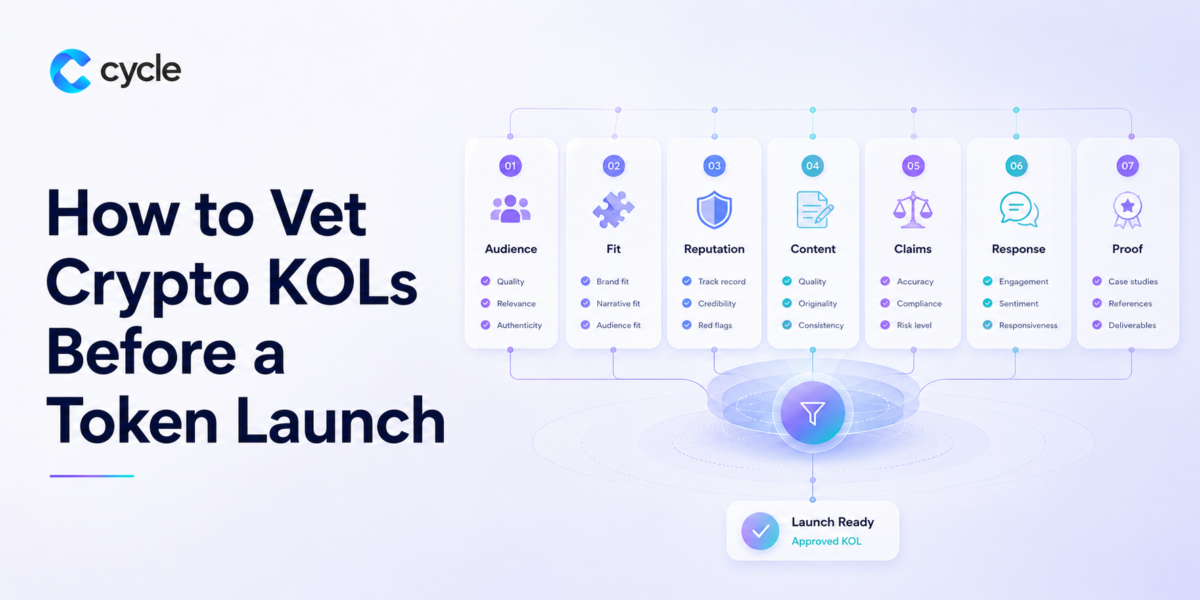
Short answer: vet crypto KOLs before a token launch by checking audience quality, category fit, reputation risk, content quality, disclosure behavior, claims discipline, and whether the creator can send attention toward a project surface that is ready for inspection. Do not choose KOLs only by follower count, rate card, or promised impressions.
A token launch creates a short window where attention is expensive and mistakes travel fast.
That is why KOL selection matters.
The wrong creator does not only waste budget. The wrong creator can attach the project to a weak audience, sloppy claims, low-quality engagement, hidden paid promotion, or reputation risk that becomes part of the launch story.
Most KOL mistakes happen because teams vet reach but not trust.
They check followers, views, rate, and availability.
They do not check whether the audience matches the launch, whether the creator can explain the project, whether the account is overloaded with paid campaigns, whether the engagement is real, whether the claims are safe, or whether the campaign leaves useful proof behind.
Before a token launch, that is not enough.
A token launch needs KOLs who can support trust, not only traffic.
The real job of a KOL before TGE
For campaign meaning, briefing, readiness, and measurement beyond creator screening, use the crypto KOL marketing guide.
Before TGE, KOLs should not be used as a substitute for product proof.
Their useful job is narrower:
- introduce the project to a relevant audience;
- explain why the launch matters;
- point people toward official proof;
- help the market understand the token story;
- create public conversation;
- support community activation;
- reinforce founder, PR, and launch messaging;
- leave behind content the project can reuse.
That only works when the project has a clear story and public surface.
If the website is vague, Telegram is confused, token utility is weak, or claim language is not controlled, KOLs will not fix the launch.
They will make the gaps more visible.
This is why token launch marketing and Trust Before TGE should come before creator spend.
The CYCLE Crypto KOL Vetting Framework
CYCLE uses seven checks before putting creator traffic around a launch, listing, fundraising, or high-attention campaign.
1. Audience quality
Follower count is the weakest useful metric.
Start with audience quality:
- Are replies coming from real accounts?
- Are the same low-quality profiles repeating under every post?
- Does engagement match account size?
- Is follower growth natural or spiky?
- Does the creator attract the region, language, and user type you need?
- Are comments specific, or do they look like engagement farming?
- Do previous sponsored posts get meaningful discussion or only emojis?
A smaller KOL with a real niche audience can be more valuable than a large account with inflated reach.
For a token launch, the question is not “how many people will see this?”
The question is:
How many relevant people will inspect the project with more confidence after seeing this?
2. Category fit
Crypto is not one audience.
A creator can be strong in one lane and useless in another.
Segment creators by category:
- DeFi users;
- memecoin traders;
- gaming communities;
- Telegram mini-app users;
- NFT collectors;
- airdrop hunters;
- builders and developers;
- infrastructure analysts;
- founders and investors;
- regional retail audiences;
- exchange users;
- RWA or DePIN communities.
A token launch should not buy “crypto audience” in the abstract.
It should buy access to a specific audience that matches the project’s stage and offer.
If the project needs credibility with partners, a hype account may be wrong.
If the project needs retail activation, a founder-heavy audience may be too cold.
If the project needs technical trust, a creator who only posts price speculation can weaken the story.
3. Reputation risk
The KOL’s reputation becomes part of the campaign.
Before choosing a creator, check:
- past paid promotions;
- frequency of sponsored posts;
- scam accusations or public callouts;
- deleted campaign history;
- whether they promote conflicting projects;
- whether they disclose paid work clearly;
- whether they overpromise price movement;
- whether serious people in the niche respect them.
A KOL can create reach and still damage trust.
This matters most before TGE because the market is already sensitive to token claims, listing rumors, and perceived insider promotion.
If the creator’s usual content trains their audience to expect price action, the project must be careful about what that audience will assume.
4. Content quality
A good creator can explain the project in their own voice without turning it into generic ad copy.
Review previous campaign content:
- Does the creator write original explanations?
- Can they make complex products understandable?
- Do they ask useful questions before posting?
- Do they adapt the angle to the audience?
- Do they avoid copy-paste promo language?
- Can they support a thread, video, AMA, Space, or follow-up post?
If a post could promote any token by changing the name, it is too weak.
A launch KOL needs a reason to talk about the project.
Possible reasons:
- product utility;
- user problem;
- founder story;
- community moment;
- ecosystem role;
- campaign or quest;
- technical milestone;
- listing-related context without promises;
- comparison to a known market problem.
The creator should amplify the reason, not only the ticker or launch date.
5. Claims and disclosure discipline
Token launches need claim control.
Before any creator posts, define:
- approved project description;
- approved token utility wording;
- banned price language;
- banned ROI language;
- banned guaranteed listing language;
- fundraising language to avoid;
- required risk-safe wording;
- disclosure expectations;
- official links only;
- response owner for questions.
The FTC’s influencer guidance says material connections should be disclosed clearly. Disclosure rules vary by jurisdiction, and this is not legal advice, but the operating principle is simple: do not build trust-sensitive campaigns around hidden paid promotion or claims the project cannot support.
In crypto, disclosure is not only a compliance detail.
It is a trust signal.
6. Landing path readiness
A creator post sends people somewhere.
Before the campaign, check the destination:
- Is the launch page clear?
- Is the X pinned post current?
- Is Telegram ready for new visitors?
- Does the website explain the token without hype?
- Are official links consistent?
- Is there a launch FAQ?
- Is there proof of product, roadmap, partners, or community?
- Does the CTA match the stage?
If this path is weak, do not buy reach yet.
Run a Social Proof Package or launch readiness sprint first.
The KOL can open the door. The project still has to look credible when people walk through it.
7. Measurement and follow-up
Do not measure KOLs only by views.
For a token launch, track:
- impressions;
- clicks;
- profile visits;
- Telegram joins;
- Discord joins;
- site sessions;
- waitlist or product actions;
- AMA attendance;
- wallet or app actions where appropriate;
- question quality;
- reply quality;
- sentiment;
- secondary mentions;
- conversion by creator;
- cost per meaningful action;
- post-campaign retention.
Also track durable proof:
- useful creator explanations;
- founder replies;
- high-quality community questions;
- AMA clips;
- launch recaps;
- comparison threads;
- content that can support partners, investors, or exchange conversations later.
The best KOL campaign leaves evidence behind.
The pre-launch KOL scorecard
Score each creator from 0 to 2 in seven areas.
| Area | 0 | 1 | 2 |
|---|---|---|---|
| Audience quality | Inflated or unclear | Some real engagement | Relevant, real, consistent audience |
| Category fit | Broad crypto noise | Partial fit | Clear fit for project stage and user type |
| Reputation risk | High-risk promo history | Mixed history | Trusted enough for the campaign role |
| Content quality | Copy-paste promo | Basic explanation | Original, audience-native explanation |
| Claims discipline | Unsafe or hype-driven | Needs strict control | Understands boundaries and disclosure |
| Landing path fit | Sends people into confusion | Usable but thin | Sends people into prepared proof layer |
| Follow-up value | One-off post only | Some reporting | Creates content, conversation, and reusable proof |
Interpretation:
- 0-6: do not use for launch-critical traffic.
- 7-10: use only with tight brief, limited role, and strong oversight.
- 11-14: viable for a controlled KOL campaign.
A creator does not need to be perfect.
But the team should know the risk before the post goes live.
Operational example: the wrong KOL for the right project
A Web3 infrastructure project prepares for TGE. The product is technical, but real. The founder has strong domain knowledge. The community is small but serious.
The team buys posts from large retail hype accounts because the numbers look strong.
The posts perform. Telegram fills with price questions, listing speculation, and airdrop farming. The founder is pulled into reactive explanations. The community team spends launch week correcting assumptions the campaign created. Serious partners see the noise and wait.
The project did not choose bad reach.
It chose the wrong role for the reach.
A better campaign would have used a smaller set of technical explainers, founder-led spaces, ecosystem commentators, a controlled retail layer, and a clear response path. The same budget would have created less noise and more trust.
What the KOL brief should include
A useful token launch KOL brief is short, specific, and hard to misunderstand.
Include:
- project one-liner;
- launch context;
- target audience;
- campaign goal;
- key message;
- proof points;
- token utility explanation;
- approved claims;
- banned claims;
- required disclosure;
- official links;
- CTA;
- timing;
- content format;
- community or AMA follow-up;
- reporting expectations;
- contact for questions.
Also include what the creator should not say.
For token launches, avoid:
- guaranteed price movement;
- guaranteed ROI;
- guaranteed exchange listing;
- guaranteed fundraising;
- unsupported user or revenue claims;
- fake urgency;
- language that makes paid promotion look independent.
This protects both the project and the creator.
Where CYCLE fits
CYCLE does not treat KOL selection as a spreadsheet of names.
The work starts with the GTM question: what should the market believe, what can it verify, and what sequence makes the campaign easier to trust?
Use Launch & Listing Readiness when the token story, claims, public channels, and launch sequence need to be prepared before attention scales.
Use Trusted Distribution System when KOLs, PR, AMAs, community, partner posts, and founder channels need to move around one story.
Use Social Proof Package when the project account, Telegram, founder signal, and proof assets are not yet ready for campaign traffic.
The goal is not to buy more influencers.
The goal is to make influencer attention land on something the market can understand, verify, and trust.
FAQ
How do you vet crypto KOLs?
Vet crypto KOLs by checking audience quality, category fit, reputation risk, previous sponsored content, disclosure behavior, content quality, claims discipline, and whether their audience matches the project’s stage. Do not choose only by follower count or promised impressions.
What makes a crypto KOL good for a token launch?
A good token launch KOL has a relevant audience, credible engagement, category fit, safe communication habits, and the ability to explain why the project matters without making unsupported price, listing, or ROI claims.
Should token projects use large KOLs or niche KOLs?
It depends on the campaign role. Large KOLs can create awareness, but niche KOLs often create better trust, education, and conversion. A strong campaign usually mixes roles instead of buying reach from one category of creators.
What should a KOL brief include?
A KOL brief should include the project one-liner, campaign goal, audience, approved claims, banned claims, proof points, official links, CTA, disclosure expectations, timing, content format, community follow-up, and reporting expectations.
When should a project delay KOL marketing?
Delay KOL marketing if the story is unclear, the website is weak, Telegram is not ready, token claims are uncontrolled, proof assets are missing, or the team cannot answer what new visitors should do after they click.