


Trust Before TGE: Why Token Launches Fail Before the Token Exists
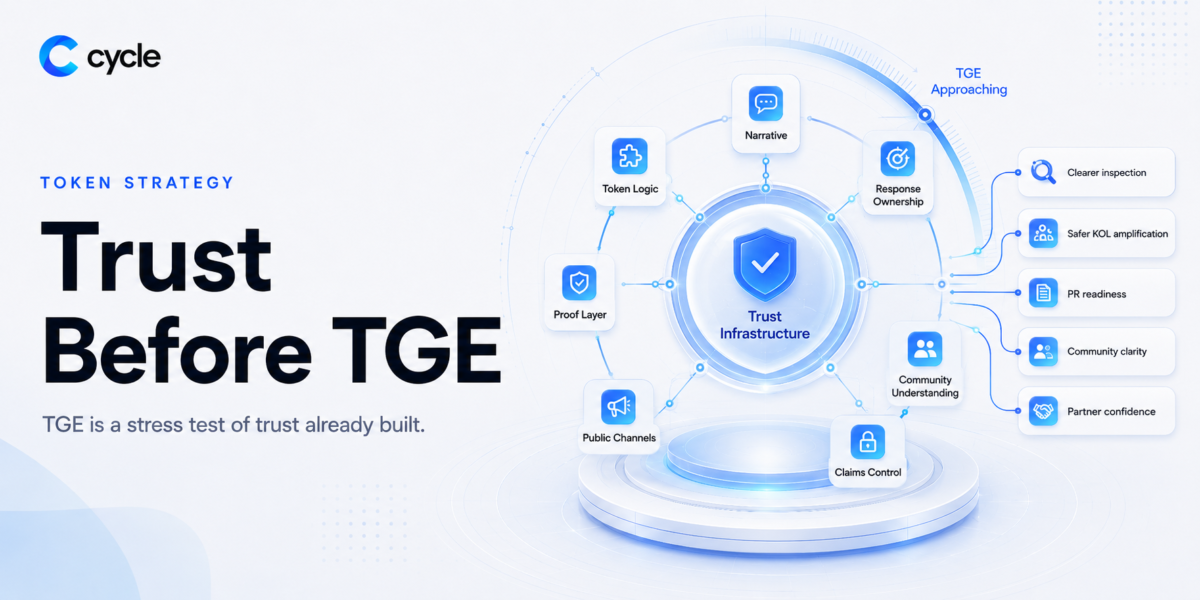
Short answer: trust before TGE is built when the market can understand the project, verify the proof, see why the token exists, inspect the public channels, and get clear answers before the launch moment. A TGE does not create trust. It pressure-tests whether trust already exists.
Most token launches do not fail on launch day.
They fail earlier.
They fail when the website is still vague, the token utility is hard to explain, the founder is invisible, the community surface feels rented, KOLs have no useful proof to amplify, Telegram cannot answer basic questions, and the team is still improvising claim language while the market is already watching.
Then the TGE arrives.
The project calls it a launch.
The market treats it as an inspection event.
The Broken Model: TGE As the Trust Moment
The weak model says:
- Announce the token.
- Push KOLs and PR.
- Drive people into Telegram.
- Let the TGE create belief.
That model breaks because Web3 buyers, users, investors, partners, exchanges, communities, and KOL audiences do not wait until the token exists to form an opinion.
They check early.
They check:
- what the product does;
- why the token needs to exist;
- whether the team can explain the market;
- whether public channels look alive;
- whether partner claims are real;
- whether the roadmap is credible;
- whether token language sounds reckless;
- whether the community understands the project;
- whether previous proof supports the launch.
This is why token launch marketing should not begin with distribution.
It should begin with trust readiness.
For the final month before the token goes live, the practical companion is a TGE marketing plan that turns trust readiness into weekly execution.
The sharper rule:
A TGE is not the start of trust. It is the first public stress test of trust.
What People Check Before TGE
Before the token moment, the market looks for signals that the project deserves attention.
The inspection surface usually includes:
- homepage and product explanation;
- token utility page or docs;
- founder and team profiles;
- roadmap and launch sequence;
- audit, security, or risk language where relevant;
- community channels;
- X profile and pinned posts;
- partner, ecosystem, or campaign proof;
- KOL and PR language;
- search results and reputation surface;
- FAQ and support path;
- claim discipline around price, listing, ROI, fundraising, and token value.
This is the same mechanism behind Web3 social proof. Attention does not validate the project. Attention sends people to inspect it.
The practical operator question is not: When is TGE?
The better question is:
What will the market find before the TGE gives it a reason to look harder?
The CYCLE Trust Before TGE Framework
CYCLE looks at TGE readiness as a trust layer with seven controls.
Before a token launch, listing-related announcement, community claim window, airdrop campaign, KOL wave, or PR push, we check whether these controls are ready.
1. Market-Readable Narrative
The project needs a story people can repeat without internal context.
Not:
- "a next-generation ecosystem";
- "a revolutionary token economy";
- "the future of AI-powered decentralized infrastructure."
Better:
- who the product is for;
- what problem it solves;
- why the token matters;
- what exists now;
- what happens next;
- what proof supports the sequence.
If the story is not readable before TGE, the token will not make it clearer.
It will make the confusion more expensive.
2. Token Logic
The token should not feel bolted onto the project.
Before TGE, the team needs a clear public explanation:
- what the token does;
- who needs it;
- what is live now versus planned;
- how incentives connect to product behavior;
- what the token does not promise;
- which terms require legal or compliance review;
- how the token story avoids price, ROI, listing, or fundraising promises.
This is where many launches weaken themselves.
The token may be strategically important, but the public explanation sounds like speculation.
3. Proof Layer
A token launch needs proof before reach.
Useful proof can include:
- product demo;
- screenshots;
- docs;
- testnet or app activity;
- ecosystem participation;
- partner context;
- community traction;
- founder history;
- previous campaigns;
- case evidence;
- technical or security materials;
- public roadmap progress.
The proof layer does not need to be perfect.
It needs to be findable, current, and honest.
This connects directly to Web3 social proof: before larger distribution, the public surface needs enough evidence for a serious person to keep moving.
For the crypto-specific version, see Crypto Social Proof: How to Make a Web3 Project Look Credible Before KOLs.
4. Public Channel Readiness
TGE traffic does not land on one page.
It lands across the project surface:
- X;
- Telegram;
- Discord;
- founder profile;
- docs;
- website;
- campaign page;
- launch FAQ;
- community replies;
- search results.
Each surface should tell the same story.
If Telegram says one thing, X says another, docs say a third, and KOLs say something more aggressive, the market reads the launch as uncontrolled.
5. Claims Control
Token launches are claim-sensitive.
Before launch communications, define:
- approved token utility language;
- approved roadmap language;
- approved partner language;
- approved community claim or airdrop wording;
- metrics that need context;
- sensitive phrases to avoid;
- what cannot be said about price, ROI, listing, liquidity, fundraising, or token value;
- who approves last-minute copy.
The team should not be writing claim boundaries during launch week.
By then, the market is already screenshotting.
6. Community Understanding
A large community is not enough.
The community needs to understand the project well enough to reduce confusion instead of multiplying it.
Before TGE, check whether the community can answer:
- what the product does;
- why the token exists;
- what happens before and after TGE;
- where official links are;
- what is not guaranteed;
- how to avoid scams;
- what action the user should take next.
This is why crypto KOL marketing and community growth should not run ahead of the trust layer. KOLs can create attention, but the community surface has to absorb it.
7. Response Ownership
The first 72 hours around a TGE can shape the next 72 days.
Questions will come from:
- users;
- Telegram;
- X;
- KOL comments;
- partner channels;
- media;
- investors;
- ecosystem contacts;
- support tickets;
- skeptical observers.
Someone needs to own the response path.
Not as generic moderation.
As market-facing execution.
Operational Example: The TGE Date Is Ready, But the Market Is Not
Imagine a DePIN project preparing a TGE and community claim window.
The team has a real product direction, a wallet flow, a technical roadmap, a founder who understands the market, and a community that has been waiting for the next step. There are KOLs ready to post. PR angles are being drafted. Telegram is active.
But the trust layer is not ready.
The website still explains the old product version. The token utility page is vague. The public roadmap has hard dates that may move. The community keeps asking whether tokens will be sellable immediately. KOL briefs use aggressive wording. The founder has not explained why TGE comes before broader ecosystem rollout. Telegram admins answer with "soon." There is no legal-safe FAQ, no claim boundary, no response owner, and no clean page where serious people can inspect the launch sequence.
The TGE is not the problem.
The unprepared trust layer is the problem.
Now reverse the same launch.
Before distribution, the team updates the product narrative, rewrites the token utility page, creates a TGE FAQ, removes hard claims that are not approved, prepares founder talking points, aligns KOL and PR briefs, updates pinned posts, maps the first 72-hour response path, and creates one public launch-readiness page with official links and proof.
The same TGE now has somewhere credible to send attention.
That is what trust before TGE looks like.
Trust Before TGE Scorecard
Use this scorecard before a TGE, token launch campaign, community claim window, airdrop, listing-related announcement, KOL wave, PR push, or partner amplification.
Score each area from 0 to 2:
- Market-readable narrative: 0 = story is vague or category-led; 1 = story is clear internally but not simple externally; 2 = story is specific, repeatable, and connected to the launch.
- Token logic: 0 = token purpose is unclear or speculative; 1 = token logic exists but is hard to explain; 2 = token role is clear, current, and carefully framed.
- Proof layer: 0 = claims exist without public evidence; 1 = some proof exists but is scattered; 2 = product, roadmap, partner, community, and founder proof are easy to inspect.
- Public channel readiness: 0 = X, Telegram, docs, website, or founder profiles contradict each other; 1 = channels are usable but incomplete; 2 = channels support the same launch story.
- Claims control: 0 = price, listing, ROI, liquidity, fundraising, or roadmap language is loose; 1 = some language is reviewed; 2 = approved, qualified, and banned claims are clear.
- Community understanding: 0 = community repeats confusion; 1 = community has some answers but no strong onboarding path; 2 = pinned messages, FAQ, admins, and content reduce confusion.
- Response ownership: 0 = nobody owns the first 72 hours; 1 = owners exist but scripts/assets are weak; 2 = media, KOL, community, founder, partner, and support responses are mapped.
Interpretation:
- 0-5: do not scale launch distribution yet. The TGE will expose trust gaps.
- 6-10: fix the weakest surfaces before KOL, PR, listing-related, or community pushes.
- 11-14: ready for controlled TGE distribution with clearer trust infrastructure.
The score is not a launch vanity check.
It tells the team whether the token moment will create useful inspection or uncontrolled doubt.
Want to use this before a launch push?
CYCLE can turn the Trust Before TGE Scorecard into a quick readiness review for your project: narrative, token logic, proof assets, public channels, claims control, community understanding, and response ownership.
A 10-Day Trust Before TGE Sprint
If the scorecard shows gaps, run a short readiness sprint before the next launch push.
Days 1-2: Map the trust gaps
Review website, docs, token page, roadmap, founder profiles, X, Telegram, Discord, partner proof, KOL drafts, PR drafts, and search results.
Output: ranked list of launch trust gaps.
Days 3-4: Lock the launch narrative
Write the one-sentence project story, token logic explanation, founder POV, launch sequence, and "what happens next" answer.
Output: narrative brief for founders, PR, KOLs, community, and partners.
Days 5-6: Build proof and claims control
Create or refresh product screenshots, docs, roadmap proof, FAQ, official links, partner context, token language, and banned claim list.
Output: proof pack and claim sheet.
Days 7-8: Clean public channels
Update website, launch page, X pinned post, Telegram pinned message, founder profile, docs links, and community FAQ.
Output: aligned public launch surface.
Days 9-10: Prepare response and distribution
Assign response owners, prepare scripts, align KOL/PR briefs, and start controlled distribution only after the trust layer is visible.
Output: launch attention that has somewhere credible to land.
Where CYCLE Fits
CYCLE treats TGE as a market inspection event, not only a campaign date.
The working sequence is:
- Make the project story readable.
- Explain token logic without speculative language.
- Build the proof layer before distribution.
- Align website, docs, X, Telegram, founder, KOL, and PR language.
- Control claims before attention arrives.
- Prepare the first 72-hour response path.
- Turn launch attention into reusable trust signals.
Use Launch & Listing Readiness when the team needs to prepare the public surface before TGE, listing-related communication, or launch distribution.
Use Social Proof Package when the project is stronger than it looks publicly and needs proof assets, channel fixes, and credibility signals before the launch push.
Use Trusted Distribution System when KOLs, PR, Telegram, X, AMAs, founder posts, and launch assets need to move together.
The goal is not to make the TGE louder.
The goal is to make the project easier to understand, trust, introduce, discuss, and act on before the token moment gives the market a reason to inspect it.
For proof context, Web3 Epic Challenge / Bybit Partnership shows how partner activation, quests, community mechanics, and public participation need a clear campaign surface. CYBERBASE Telegram Mini App shows why product and community surfaces need to work together when users arrive quickly.
FAQ
What does trust before TGE mean?
Trust before TGE means preparing the proof, narrative, token logic, public channels, claim boundaries, community answers, and response ownership before the token launch creates attention. It is the trust layer that helps the market inspect the project without confusion.
Why do token launches fail before TGE?
Token launches often fail before TGE because the public surface is not ready. The project may have unclear token utility, weak proof assets, inconsistent channels, aggressive claims, confused community answers, or no response owner for launch-week questions.
What should a Web3 team prepare before TGE?
Before TGE, prepare a clear project narrative, token utility explanation, product proof, official links, roadmap context, founder signal, launch FAQ, pinned community messages, KOL and PR briefs, approved claim language, and first 72-hour response path.
Is KOL marketing useful before TGE?
KOL marketing can be useful before TGE if the trust layer is ready. If the website, token logic, proof assets, Telegram, X, and claim boundaries are weak, KOL traffic can make the project look less credible faster.
How does CYCLE support TGE readiness?
CYCLE supports TGE readiness by connecting launch narrative, proof assets, social proof, claims control, founder-led communication, KOL and PR coordination, community readiness, and response ownership into one market-facing execution layer.