


Crypto Social Proof: How to Make a Web3 Project Look Credible Before KOLs
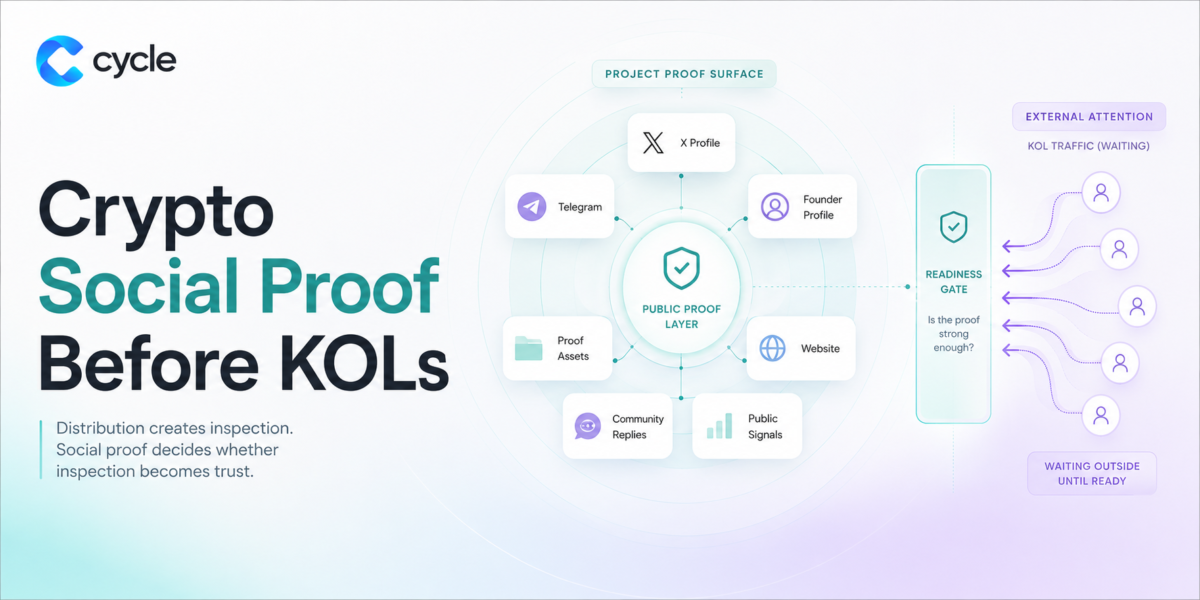
Short answer: crypto social proof is the visible trust layer that makes a Web3 project look alive, credible, and worth inspecting before KOLs, PR, listings, fundraising, or launch traffic arrives. It includes a clear story, active X and Telegram surfaces, founder/team signal, proof assets, useful community answers, credible engagement, and public evidence that the project is more than a claim.
A Web3 project can be real and still look weak.
That is the painful part.
The product may exist. The founder may know the market. The team may have partners, roadmap, traction, or technical work behind the scenes.
But the public surface tells a different story.
X looks quiet. Telegram looks staged or confused. The homepage is vague. The founder profile is hard to evaluate. Proof assets are scattered. KOLs have nothing specific to amplify. PR has no evidence to point to. New visitors click once, inspect quickly, and leave.
The project does not only have a marketing problem.
It has a credibility surface problem.
That is where crypto social proof matters.
Crypto social proof is not fake activity
Bad social proof means trying to make a project look bigger than it is.
Useful crypto social proof means making real credibility easier to see.
The difference matters.
Fake social proof creates noise:
- empty comments;
- low-quality reposts;
- bot-looking engagement;
- inflated followers;
- generic Telegram activity;
- vague hype from accounts that do not understand the project.
Real social proof creates confidence:
- clear explanation;
- visible founder or team signal;
- relevant public conversations;
- useful replies under important posts;
- community questions with good answers;
- proof assets that reduce doubt;
- partner, product, roadmap, or campaign evidence;
- active channels that match the project’s ambition.
The goal is not to perform popularity.
The goal is to reduce the feeling of risk for someone inspecting the project for the first time.
Why KOLs need social proof first
A KOL campaign does not create a clean project surface.
It sends attention to the surface that already exists.
If the surface is strong, KOL attention can help. People click through and see a project that looks understandable, alive, and credible.
If the surface is weak, KOL attention exposes the weakness faster.
The same applies to PR, ads, exchange listing conversations, fundraising intros, partner announcements, AMAs, and community pushes.
Distribution creates inspection.
Social proof decides whether that inspection becomes trust.
This is the same logic behind Web3 Social Proof: What to Fix Before KOLs, Ads, Listings, or Fundraising. This article goes one level more practical: what should a crypto project fix so it looks credible before a campaign starts?
The crypto credibility diagnostic
Before buying distribution, check seven surfaces.
1. The one-sentence story
A project looks weak when people cannot quickly understand what it is.
The first social proof signal is not the number of likes.
It is clarity.
A stranger should understand:
- what the project does;
- who it is for;
- why it matters now;
- what proof exists;
- what action they should take next.
Weak story:
- “the future of decentralized finance”;
- “AI-powered Web3 ecosystem”;
- “next-generation infrastructure for everyone.”
Stronger story:
- “a Telegram-native prediction game for sports communities”;
- “a DePIN energy network that turns local solar production into verifiable network participation”;
- “a wallet onboarding layer for consumer apps that need crypto without making users learn crypto first.”
Specificity makes the project easier to believe.
2. The X surface
X is often the first inspection layer in crypto.
A new visitor checks:
- bio;
- pinned post;
- recent posts;
- replies;
- quote posts;
- founder/team engagement;
- link consistency;
- whether the account looks alive now.
Healthy X social proof does not require huge numbers.
It requires the account to show motion and context.
A good X surface answers:
- What is happening now?
- What has the team shipped or learned?
- Why should I care?
- Are real people reacting?
- Does the founder or team understand the market?
- Is there a next step?
If a KOL sends people to a profile that looks abandoned or generic, the campaign leaks trust.
3. The Telegram or Discord surface
Telegram and Discord are not only community channels.
They are conversion rooms.
A new person scans:
- pinned onboarding;
- official links;
- admin responsiveness;
- quality of questions;
- repeated active members;
- moderation style;
- scam warnings;
- whether the group understands the project.
A quiet community is not automatically bad.
A confusing community is bad.
A smaller group with clear onboarding, useful answers, and credible activity can create more trust than a large group full of low-quality noise.
Before KOLs, prepare the community surface:
- update pinned messages;
- remove outdated links;
- write simple onboarding;
- prepare answers to predictable questions;
- make official links obvious;
- assign response owners;
- create a reason for new visitors to stay.
4. Founder and team signal
In trust-sensitive markets, people check who is behind the project.
The founder does not need to become an influencer.
But the founder or team surface should reduce doubt.
Useful signals:
- clear founder profile;
- relevant background;
- public explanation of the project;
- visible participation in key posts;
- founder quote or note around launches;
- interviews, AMAs, or technical explanations;
- no obvious mismatch between the project claim and team credibility.
If the team is anonymous or partly anonymous, the project needs stronger alternative proof: audits, demos, partners, ecosystem validation, open-source work, public contributors, or consistent operating updates.
Silence is not neutral.
In crypto, silence becomes an assumption.
5. Proof assets
A project needs assets that make claims easier to verify.
Depending on the category, proof can include:
- product demo;
- screenshots;
- roadmap progress;
- partner confirmation;
- ecosystem participation;
- traction recap;
- case study;
- security audit status;
- technical explainer;
- community recap;
- AMA recording;
- founder interview;
- launch FAQ;
- user story;
- public dashboard where relevant.
The best proof asset is not the most polished one.
It is the asset that answers the next objection.
If people doubt the product exists, show the product.
If people doubt the team can execute, show operating history.
If people doubt the community is real, show public conversations.
If people doubt the token story, explain utility and claim boundaries.
6. Engagement layer
Engagement is useful when it makes a real project look easier to trust.
It is not useful when it looks manufactured.
Before a campaign, check whether key posts have:
- relevant replies;
- founder or team responses;
- community questions;
- useful comments from credible accounts;
- reposts with context;
- discussions that help a new visitor understand the project.
The engagement layer should support the story.
A post about product utility should not be surrounded only by “to the moon” comments.
A launch post should not have replies that create unsupported price expectations.
A technical update should not look like a meme raid.
Social proof should make the project more credible, not less serious.
7. Response path
New attention creates questions.
Before KOLs, PR, or launch traffic, map the first questions:
- What is this project?
- Is it live?
- What does the token do?
- Where is the official link?
- Who is the team?
- What is the roadmap?
- Is there an audit?
- Is there a listing?
- Where should I join?
- What can I verify now?
Then assign owners.
A project looks credible when the first questions get clear answers quickly.
It looks weak when every answer is improvised.
The 14-point crypto social proof checklist
Score each item 0 or 1.
- The project has a clear one-sentence explanation.
- The homepage matches the current campaign.
- X bio and pinned post are current.
- Recent posts explain what is happening now.
- Telegram or Discord onboarding is clear.
- Official links are consistent.
- Founder or team signal is visible.
- Product, roadmap, partner, or traction proof exists.
- Claims are sourced or qualified.
- Token/listing/ROI language is controlled.
- Key posts have relevant replies or community signal.
- Predictable questions have prepared answers.
- KOL/PR/community briefs point to the same story.
- The campaign has a next step for new visitors.
Interpretation:
- 0-5: do not scale distribution yet. The project will likely look weak under inspection.
- 6-10: fix the weakest trust gaps before KOLs, PR, or listing attention.
- 11-14: the project is closer to campaign-ready, assuming the offer and timing are strong.
Operational example: the project is better than it looks
A Web3 gaming project has a working product, active players, and a useful launch coming up.
But the public surface is weak.
The homepage still talks like a broad ecosystem. X posts are inconsistent. Telegram has no onboarding. The founder has strong product insight but no public explanation. The product demo is buried. KOLs are being negotiated before the project has a clear landing path.
The project is not fake.
It just looks harder to believe than it should.
A 14-day social proof sprint fixes the surface:
- rewrite the one-sentence story;
- update X bio and pinned post;
- prepare the Telegram onboarding;
- create a product proof asset;
- write a founder note;
- build a launch FAQ;
- add credible replies and conversation around key posts;
- prepare KOL and community briefs;
- assign response owners.
Now a KOL campaign has somewhere credible to send attention.
The product did not change in two weeks.
The market’s ability to understand and trust it did.
Where CYCLE fits
CYCLE helps founder-led Web3 teams strengthen the public proof surface before larger distribution.
Use Social Proof Package when the project has substance but does not yet look credible enough for KOLs, PR, listings, fundraising, or launch traffic.
Use Proof Layer Audit when the team needs a fast diagnosis of what the market can verify and where the trust gaps are.
For technical founders, the proof layer should connect to a broader GTM system. See Technical Founder GTM and Founder-Led GTM Operator for how proof, narrative, and execution work together.
Use Trusted Distribution System when KOLs, PR, community, AMAs, and founder channels need to scale around one proof-backed story.
For proof context, the Web3 Epic Challenge / Bybit Partnership and CYBERBASE Telegram Mini App cases show how public activation, community signal, and campaign execution need a visible proof surface around them.
The goal is not to make the project look artificially popular.
The goal is to make real credibility easier to see.
FAQ
What is crypto social proof?
Crypto social proof is the visible evidence that a Web3 project is alive, credible, and worth engaging with. It can include active X and Telegram surfaces, founder/team signal, proof assets, community answers, public conversations, partner proof, product evidence, and credible engagement.
Why does social proof matter before KOLs?
KOLs send attention to the project’s public surface. If that surface looks weak, quiet, confusing, or unsupported, the KOL campaign can create doubt instead of trust. Social proof gives new visitors something credible to inspect after they click.
Is crypto social proof the same as buying engagement?
No. Buying low-quality engagement can make a project look worse. Useful crypto social proof makes real credibility easier to see through clear messaging, proof assets, public conversations, founder signal, community readiness, and relevant engagement.
What should a project fix before a KOL campaign?
Before a KOL campaign, fix the project story, X profile, pinned posts, Telegram onboarding, official links, founder/team signal, proof assets, claims control, community response path, and landing page CTA.
How does CYCLE help with crypto social proof?
CYCLE helps projects audit and strengthen the public proof surface before distribution. The work can include narrative cleanup, proof assets, founder visibility, X/TG engagement layer, community readiness, AMAs, KOL/PR coordination, and launch response planning.