


Crypto Social Media Marketing: A Pre-Launch Plan
Before you ask more people to visit your project, decide what they should be able to understand and do when they arrive. This guide takes a Web3 team from that decision to an X profile, a content plan, a partner conversation and a way to review the response.
For crypto Twitter marketing, start with the person you want to reach, the question they have and an action your product can support. Choose a useful destination before filling a publishing calendar.
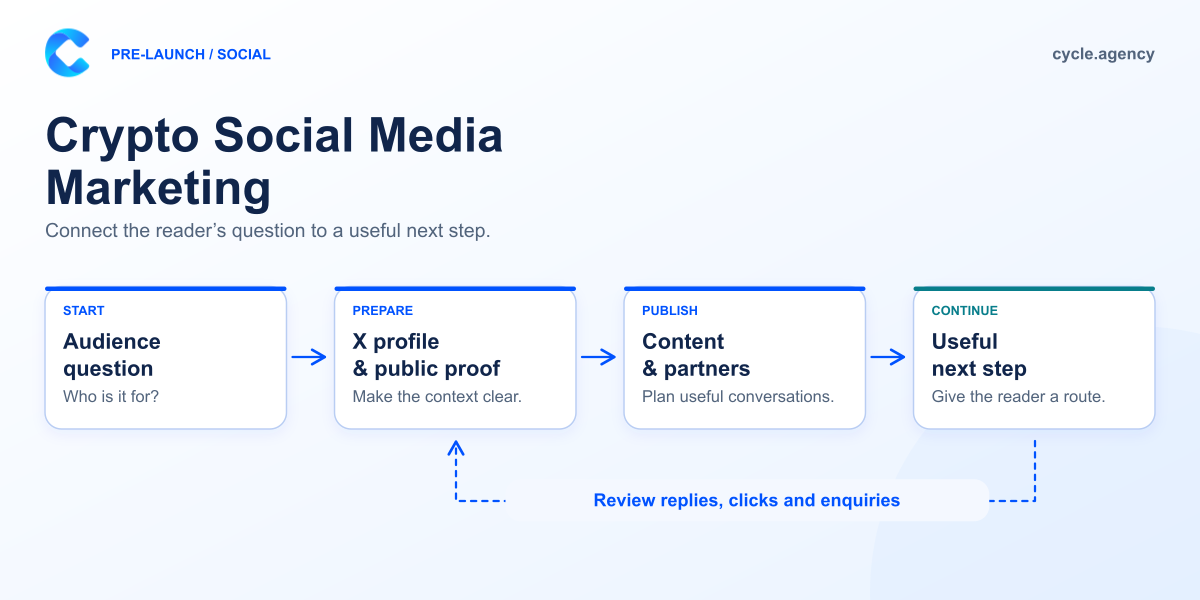
Start with one audience and one available action
Write a short brief before choosing formats. Name the audience by its task: a developer evaluating an integration, a community lead looking for an event partner, or someone trying the product. “Everyone in crypto” gives a writer too little to work with.
Choose an action that exists today. It might be opening documentation, trying a demo or asking a specific question. If the product is not available, explain what is available and what is still being built. Do not send a visitor through a “try now” link that ends in an unexplained waitlist.
- Audience: who needs this and what are they trying to do?
- Question: what would they need to know before taking the next step?
- Evidence: what public page, demonstration or authorised statement answers that question?
- Destination: where does the post send the reader?
- Owner: who can answer a follow-up accurately?
Check the X profile before publishing
X lets an account edit its bio and website link and pin a post to its profile. See the official profile instructions for the current controls. Use those fields to explain the project, rather than repeat a slogan.
Review the following items as pass, fix or not applicable. This is an editorial checklist, not a validated score or a prediction of campaign performance.
- The account name matches the name on the website.
- The bio identifies the product and the intended user.
- The website link opens the current official destination.
- The pinned post says what is available now.
- That post links to a working demonstration, documentation or useful explanation.
- A visitor can tell which statements are plans and which describe shipped work.
- Any partner mention identifies the actual collaboration and has permission.
- Recent posts answer different questions instead of repeating an announcement.
- People answering for the project can be identified as team members.
- A newcomer can find the official community or support route.
- The destination works on a phone without requiring a wallet connection just to read.
- Someone owns corrections when a link, date or product statement changes.
For the evidence behind those statements, use the crypto social proof evidence checklist. It explains the difference between your own product demonstration and an independent person's endorsement.
To decide which questions need a tutorial, comparison or evidence note before scheduling posts, use the crypto content planning matrix and brief.
Use a two-week content calendar as a working draft
The calendar below is a planning template. It does not prescribe a posting frequency or promise results in two weeks. Move or remove an entry when its evidence is not ready; leave room to answer questions from earlier posts.
| Planning slot | Reader question and material | What must exist before posting |
|---|---|---|
| Week 1: introduction | Who is this for? Explain one use case. | A current product description and working destination. |
| Week 1: demonstration | How does it work? Show a task from start to finish. | A demonstration labelled with its actual product status. |
| Week 1: discussion | What remains unclear? Answer a recurring product question. | An answer approved by the person responsible for that part of the product. |
| Week 2: partner topic | What can two teams explain together? Introduce a focused AMA topic. | A willing partner, a host and a topic both teams can discuss. |
| Week 2: follow-up | What did the discussion resolve? Publish an answer and the relevant resource. | Accurate notes; permission for any quotation or recording used. |
| Week 2: review | What changed? Summarise a shipped change or correct an earlier answer. | A traceable change, its limitations and an owner for follow-up. |
Add an owner, draft link, approval status and publication URL to each row in your own copy. A blank cell is a task to resolve, not an invitation to invent a result or a testimonial.
Give conversations a useful destination
For an AMA, choose a question that both audiences care about. A partner can contribute a different perspective or demonstrate how two products work together; a larger follower count alone does not establish that fit. Use the partner selection worksheet, then prepare the AMA brief and follow-up checklist.
Keep participation voluntary and relevant. X's authenticity policy prohibits artificial metric inflation and coordinated exchanges of engagement. Do not buy replies or organise activity whose purpose is to make an account appear more popular.
Measure the response at each step
Keep exposure, conversation, website activity and actual enquiries in separate columns. X says that repeat views can count in its public view counter; it is not a count of distinct potential customers. A reply may be useful without becoming a lead, and a contact-link click does not establish that a message was sent.
| Question | Record | Decision it supports |
|---|---|---|
| Was the material seen? | Post URL, observation window and the available view or impression metric, with its original label. | Whether there is enough exposure to interpret later steps. |
| Did it answer the right question? | Relevant replies, unanswered questions and repeated objections; separate team replies. | What the next explanation should address. |
| Did someone reach the destination? | Tagged website sessions or clicks, stating the tool and definition. | Whether to inspect the link, message or destination. |
| Did a suitable enquiry arrive? | Received enquiries and their fit, with the source recorded only when known. | Whether the activity is reaching a potential buyer. |
If you calculate a rate, write the numerator, denominator, source and time window beside it. For example, link clicks divided by impressions is a click-through rate only when both measurements cover the same posts and period. Missing values stay unknown. Do not treat them as zero or compare that rate with one based on followers.
For links shared on X, Google's campaign URL guidance explains source, medium and campaign parameters. Agree names before sharing links. Keep personal details out of the URL and keep campaign tags off links between your own pages.
End the review with a decision
Read the replies and inspect the destination before changing the whole plan. A recurring product question may need a clearer demonstration. Visitors reaching the site but not finding the relevant next step may need a better destination. A useful partner discussion may deserve a written follow-up. Record the explanation as a hypothesis until another observation supports it.
If you need help running the X, engagement or partnership work, see CYCLE's pre-marketing scope. This guide is a working method; it does not report client results or establish a guaranteed launch outcome.