


How to Choose Web3 Co-Marketing Partners
A co-marketing partner should help you answer a question for a relevant audience. Before comparing follower counts, write down the shared topic, what each team contributes and why either audience would want the collaboration.
This worksheet supports a focused choice: a joint AMA, a product explanation or a useful resource. It does not rank projects by token value, claim that a large audience will convert or provide a validated partner score.
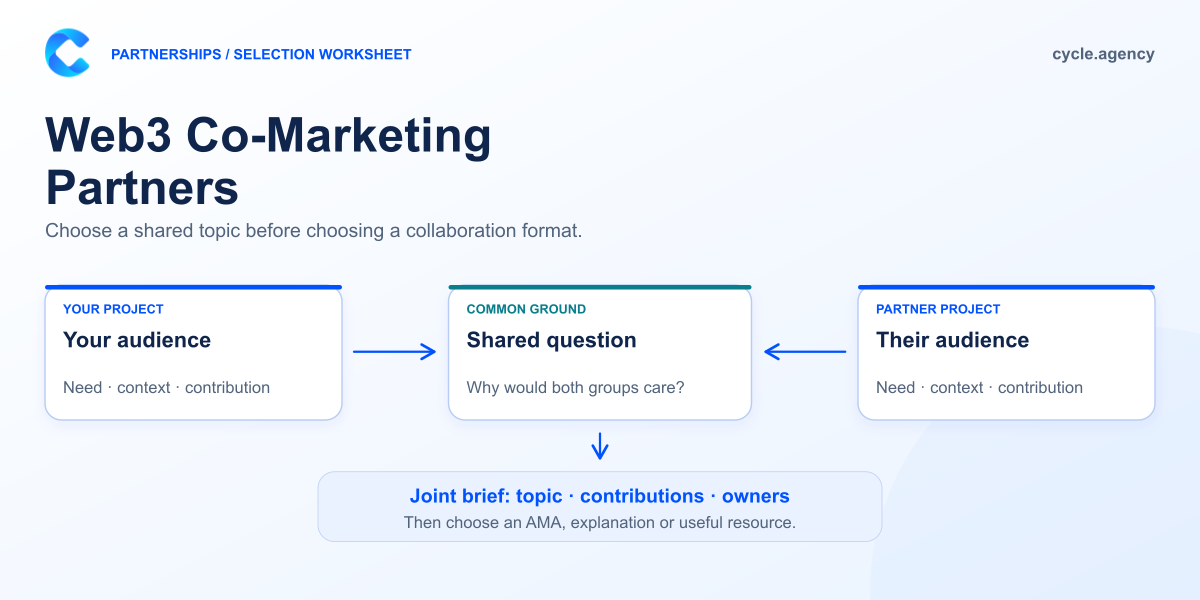
Look for a shared task
Describe the intended reader or listener by what they are trying to do. Then look at the potential partner's public material: who asks questions, what those questions concern and whether the project can contribute to your topic. A product integration, a shared user task or complementary expertise can give a collaboration a specific purpose.
Follower count is context. It does not tell you whether the two audiences have the same task or whether the person operating the account can commit the team to a collaboration. Verify the proposed contact through the project's official channels before sharing private material.
Use evidence, conditions and open questions
| Check | Evidence to record | Reason to pause |
|---|---|---|
| Audience fit | Relevant public discussions and the user task they concern. | The proposed topic has no clear use for either audience. |
| Product fit | Official documentation or a demonstration related to the topic. | The collaboration depends on a feature that is not available. |
| Contribution | Named speaker, expertise, resource or production work from each team. | Only one side is expected to contribute useful work. |
| Public claims | What can be said, its source and who approves it. | The wording implies an integration, investment or endorsement that does not exist. |
| Working agreement | Owner, format, timing, permissions and follow-up. | No one can approve the material or answer follow-up questions. |
| Integrity | How the collaboration will be promoted. | It depends on fabricated participants, purchased replies or metric inflation. |
Mark each check as supported, unresolved or unsuitable, and retain the relevant link. Avoid turning those labels into a numerical ranking with invented weights. An unresolved permission is not cancelled out by a large following.
Offer a collaboration that fills a specific gap
A useful proposal explains the shared question, the material you can contribute and the work requested from the partner. Read the partner's existing guide or event programme first. If it already answers the question thoroughly, find a different contribution or leave it alone.
For an AMA, bring a draft brief and a realistic division of responsibilities. For a joint guide, identify the section each team can substantiate. Agree approval and attribution before using a name, quotation or logo. A participation agreement does not automatically permit a broader “strategic partner” claim.
Do not make a backlink, a repost or a quota of replies the condition for a purported editorial endorsement. For activity on X, follow its authenticity policy, including restrictions on exchanging engagement and artificially inflating metrics.
Choose a small, inspectable next step
Decide whether to proceed, clarify a condition or pass. Record why, the person responsible and the next date for a decision. A single focused collaboration gives both teams a clearer thing to review than an undefined promise to “build an ecosystem together.”
Afterward, review the actual resource or event, the questions it generated and any known visits or enquiries. Keep unknown attribution unknown. If the next step is an event, use the partner AMA checklist; if the public profile still needs work, return to the X profile checklist.
CYCLE's pre-marketing offer includes a discussion of relevant partnerships and AMA work. This worksheet is not a list of partners available for sale or a promise that a named project will participate.