


Crypto Content Marketing: Plan Topics, Proof and Distribution
A crypto content marketing plan should help someone understand a product, evaluate a claim or complete a task. Start with the questions your team needs to answer, then choose the material that can answer each one with evidence you can publish.
This guide provides a content matrix and a reusable brief for a Web3 team preparing public explanations before a launch or campaign. It covers topics, formats, evidence and distribution. For the day-to-day X profile, publishing calendar and engagement workflow, use the crypto social media marketing plan.
Choose a reader question
Name the reader by what they need to do. A developer checking an integration needs different information from a community lead considering an AMA. Write the question in their terms, then identify who on the team can answer it accurately.
Use questions from product conversations, public replies and support discussions where you have permission to use them. Record the question without copying personal details into a public brief. A repeated question is a useful editorial signal; it does not establish search volume or prove that everyone asking is a potential customer.
Choose a destination that is available now: documentation, a demonstration, a product page or a contact route. If a feature is planned, say so. A reader should be able to distinguish an explanation of shipped work from a proposal for future work.
Match the question to a useful format
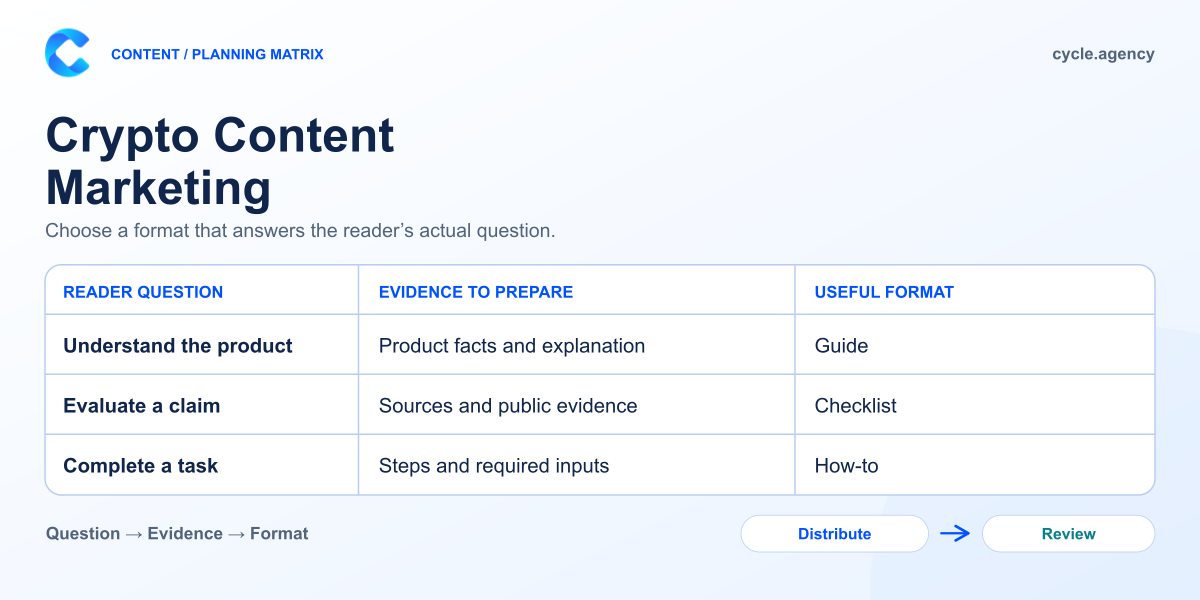
Copy this matrix into your planning document and replace each example with a real question. These are planning examples, not results from a CYCLE client or a prescribed publishing schedule.
| Reader question | Useful format | Evidence needed | Next step |
|---|---|---|---|
| What task does this product solve? | A use-case explanation with a concrete workflow. | Current product description and an owner who can confirm availability. | Open the relevant product page. |
| How would I use it? | A tutorial or annotated demonstration. | A reproducible path, prerequisites and known limitations. | Try the documented task. |
| Which approach fits my situation? | A comparison using explicit criteria. | Current primary sources for each option and the date checked. | Read the documentation for the applicable option. |
| What supports this claim? | An evidence note or a case with permission. | The original observation, its period and what it can actually establish. | Inspect the source or ask a specific question. |
| What does the collaboration involve? | A joint explanation or an AMA follow-up. | Agreed scope, named contributors and permission for quotations. | Read the resource each team contributed. |
| What changed since the last explanation? | A product update or correction. | A traceable change and a person responsible for confirming it. | Read the updated instructions. |
Prioritise material that resolves a question blocking a useful next step. If the evidence is missing, assign its collection before commissioning polished copy. Keep an unanswered question visible in the plan rather than filling the gap with an unsupported statement.
Write a brief someone can execute
A working brief gives a writer enough context to make decisions and gives a reviewer something specific to check. Copy the fields below and keep the finished material focused on the chosen question.
- Reader and question: who needs the answer, and what are they trying to decide or do?
- Answer: what can the team substantiate today?
- Format and destination: where will the full answer live, and what useful action follows?
- Evidence: source links, product status, dates and limitations for material claims.
- Owner and reviewer: who writes, who verifies the product facts and who can approve publication?
- Distribution: which audience needs each version, and what does that version add?
- Review: what response will you inspect, and when will you decide whether to update the answer?
The brief can remain short. A product explanation may need a walkthrough and a source; a comparison may need several primary sources and clearer boundaries. Length follows the question. An unsupported superlative does not become useful because it appears in a longer article.
Check the evidence before distribution
Review claims separately from the prose. For a feature, check what is available and to whom. For a number, retain the source, period and definition. For a partner or customer reference, confirm what can be said and who approved it. A logo or a speaker appearance does not establish a broader commercial relationship.
Use the social proof evidence checklist when an explanation depends on credibility. Before a token-related announcement, also check the public information checklist for dates, destinations and ownership.
Separate editorial advice from measured outcomes. This matrix is a working method; it is not a validated scoring system, evidence of client performance or a promise of a successful launch. If a case cannot be published, explain the mechanism without disguising an invented project as a real example.
Give each version a reason to exist
Keep one complete answer at a stable public URL. Adapt the introduction and level of detail for the audience receiving it: a short X explanation can introduce a question, documentation can provide the steps, and an AMA follow-up can resolve what the discussion left open. Link to the part that answers the reader's next question.
A partner should contribute relevant expertise or a useful resource. Use the co-marketing partner worksheet to assess that fit. Agree attribution and permissions before turning a conversation into a joint publication.
When sharing on X, avoid bulk unsolicited replies, repeated identical messages and coordinated metric inflation. Those behaviours are covered by X's authenticity policy. Publishing a useful resource does not justify inserting its link into unrelated conversations.
Review comprehension and the next step
Record what readers ask after seeing the material, whether the linked resource answers those questions and whether a suitable enquiry actually arrives. Keep views, site visits, contact clicks and received enquiries separate. X's view count guidance says repeated views can count, so that number does not represent distinct potential buyers.
For external campaign links, Google's campaign URL guidance describes source, medium and campaign parameters. Agree labels before distributing the material; keep personal details out of URLs and do not add campaign tags to links between your own pages.
Finish with a decision: clarify an answer, fix a destination, prepare a missing demonstration or leave the material in place while gathering more observations. Record the reason. A content review is more useful when it changes a specific piece of work than when it produces another list of posts.
For help preparing X, engagement and relevant partnership activity before a campaign, see CYCLE's pre-marketing scope. The product page sets out what to discuss before work begins.