


What Is a Proof Layer Audit?
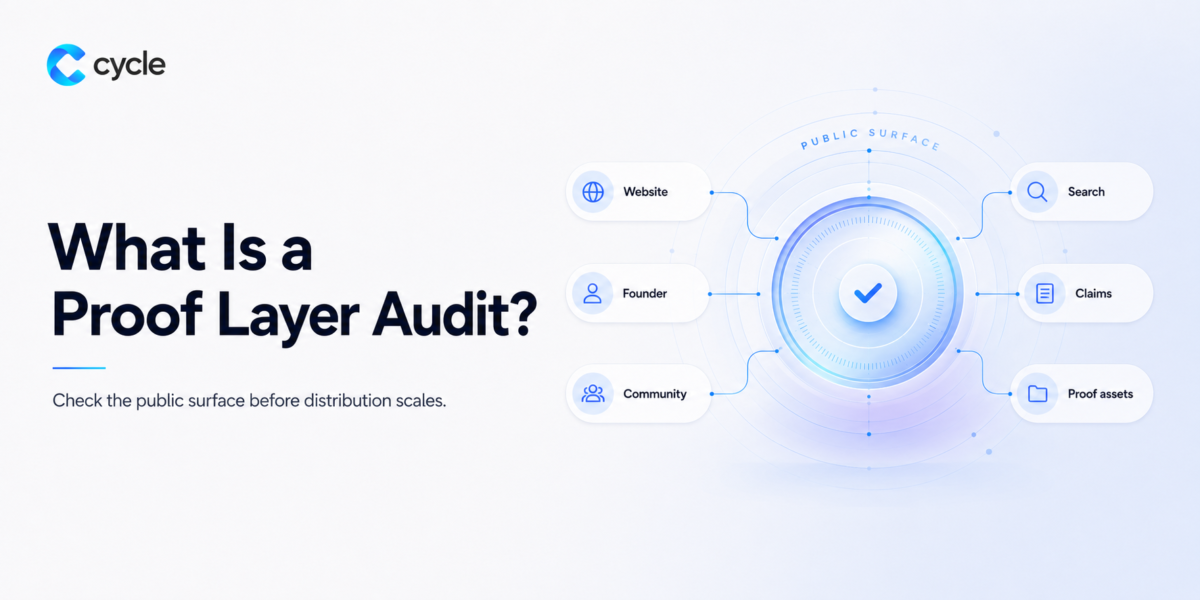
Short answer: a proof layer audit checks whether the public surface gives enough evidence for the market to understand, trust, introduce, discuss, and act on a company before distribution scales. It reviews the website, founder profile, social channels, community, claims, proof assets, partner references, search surface, and conversion path.
A lot of GTM problems are not distribution problems.
They are proof problems.
The team wants more KOLs, PR, ads, partnerships, listings, founder content, community activity, or sales outreach. But when new attention arrives, the market cannot quickly verify the story.
The website is vague. The founder profile is quiet. Proof points are scattered. Community answers are inconsistent. Partner claims are not linked. Product evidence is buried. Search results show old or mixed signals. The CTA does not match the campaign.
More distribution does not fix that.
It sends more people into the gap.
A proof layer audit finds the gap before spend scales.
What Is the Proof Layer?
The proof layer is the public evidence system around a company.
It includes every surface a serious outsider might inspect before trusting, introducing, discussing, buying from, investing in, listing, partnering with, or joining the company.
For a Web3, AI, fintech, infrastructure, or trust-sensitive B2B team, that surface often includes:
- homepage;
- service or product pages;
- founder profile;
- X / LinkedIn;
- Telegram / Discord;
- docs;
- case studies;
- partner references;
- media links;
- KOL or creator mentions;
- search results;
- FAQs;
- community responses;
- launch or campaign pages;
- sales or investor assets.
The proof layer does not need to be perfect.
It needs to be coherent enough for the market to keep moving.
Why a Proof Layer Audit Matters
Distribution creates inspection.
When you run PR, people inspect the company. When KOLs post, people inspect the company. When fundraising starts, investors inspect the company. When a listing, TGE, partner campaign, or community push begins, the market inspects the company.
That is why crypto PR needs a proof layer: media attention expands inspection instead of replacing it.
If the proof layer is weak, attention turns into doubt.
The team may still get traffic, mentions, joins, or impressions. But the public surface does not convert that attention into trust.
A proof layer audit helps answer:
Can the company survive the attention it is about to create?
What Gets Audited
1. Website
The audit checks whether the website makes the company easy to understand.
Questions:
- Is the value proposition clear?
- Is the category readable?
- Are claims supported?
- Are CTAs aligned with the current GTM goal?
- Do pages explain who the product is for and why now?
- Are proof points visible or buried?
A website can look polished and still fail the proof test.
2. Founder Profile
For founder-led teams, the founder is a market signal.
The audit checks:
- profile clarity;
- pinned context;
- recent activity;
- founder POV;
- credibility markers;
- consistency with company narrative;
- whether the founder makes the company easier to trust.
Founder visibility is not about vanity. It is about market interpretation.
3. Social Channels
The audit reviews X, LinkedIn, Telegram, Discord, or other relevant channels.
The question is not “are they active?”
The question is:
Do they help outsiders understand and verify the story?
4. Community Surface
For Web3 projects, community is part of the public proof layer.
A practical companion is crypto social proof before KOL traffic, especially when X, Telegram, and founder signal are the first surfaces people inspect.
The audit checks:
- pinned messages;
- FAQ quality;
- answer consistency;
- moderation readiness;
- campaign context;
- official links;
- response ownership;
- quality of visible activity.
See Community Growth for the full community proof surface model.
5. Proof Assets
The audit checks whether proof exists, is current, and is easy to find.
Proof assets can include:
- case studies;
- demos;
- product screenshots;
- docs;
- partner announcements;
- user/customer evidence;
- traction recaps;
- founder explainers;
- media coverage;
- technical/security materials;
- campaign results.
A common problem: proof exists, but only the internal team knows where to find it.
6. Partner and Media Claims
The audit checks whether partner, media, investor, ecosystem, or customer claims are supported.
Questions:
- Is the claim precise?
- Is there a public source?
- Does the link still work?
- Is the relationship overstated?
- Does the wording create legal or reputational risk?
Proof should strengthen trust, not invite skepticism.
7. Search Surface
People often search before they decide.
The audit checks branded and high-intent search surfaces:
- what ranks;
- what is outdated;
- what is missing;
- whether negative/mixed results need context;
- whether source-of-truth pages are visible.
This matters for reputation-sensitive GTM.
8. CTA and Activation Path
Proof must lead somewhere.
The audit checks whether a visitor knows what to do next:
- book a call;
- join community;
- read docs;
- inspect proof;
- apply;
- start product flow;
- request audit;
- contact founder/operator.
Without a next step, trust decays.
What Proof Gaps Look Like
Common proof gaps include:
- the homepage makes a broad claim but no page proves it;
- the founder says one thing and the website says another;
- Telegram points to old campaigns;
- KOL briefs use language that the site cannot support;
- PR mentions are not linked;
- partner logos lack context;
- case studies show activity but not market signal;
- search results surface outdated positioning;
- CTAs do not match current intent;
- service pages use old naming while internal strategy changed;
- metrics appear without explanation.
The problem is rarely one page.
It is usually the system.
The CYCLE Proof Layer Audit Framework
CYCLE audits the proof layer across six controls.
1. Narrative
Can the market understand what the company is, who it serves, and why it matters now?
2. Evidence
Can the market verify the main claims with public proof?
3. Founder Signal
Can the market see judgment, context, and ownership from the founder or operator?
4. Public Surface
Do website, social, community, docs, and search tell one coherent story?
5. Claims Control
Are sensitive claims disciplined, supported, and safe to distribute?
6. Action Path
Does proof turn into the right next step?
Proof Layer Audit Scorecard
Score each from 0 to 3.
| Control | 0 | 1 | 2 | 3 | | — | — | — | — | — | | Narrative | unclear | partly clear | understandable | easy to repeat | | Evidence | missing | scattered | present | organized | | Founder signal | absent | weak | visible | strategic | | Public surface | fragmented | active but inconsistent | mostly aligned | coherent | | Claims control | risky | uneven | mostly safe | disciplined | | Action path | vague | present | clear | campaign-aligned |
Interpretation:
- 0-7: do not scale distribution yet.
- 8-13: fix the obvious proof gaps first.
- 14-18: ready for more structured distribution, with monitoring.
What the Team Receives
A useful proof layer audit should not be a vague strategy deck.
It should produce:
- prioritized proof gaps;
- page/channel observations;
- claim risks;
- missing proof assets;
- quick-win fixes;
- internal link opportunities;
- public surface cleanup list;
- recommended campaign sequence;
- next actions for founder, team, and vendors.
The output should make execution easier within days, not months.
When to Run a Proof Layer Audit
Run it before:
- KOL campaigns;
- PR outreach;
- TGE;
- listing push;
- fundraising;
- investor visibility;
- partner announcement;
- product launch;
- paid acquisition;
- reputation-sensitive campaign;
- major website repositioning.
If attention is about to increase, the proof layer should be checked first.
When CYCLE Fits
Use Proof Layer Audit when the team needs to know what the market will find before more distribution enters the room.
Use Social Proof Package when the audit reveals that the company needs to actively build proof assets, public signal, founder visibility, community readiness, and trusted activity.
For technical teams, proof work should connect to the broader GTM operating layer. Read Technical Founder GTM for the market-translation side, and Founder-Led GTM Operator for the role that coordinates proof, narrative, and execution.
Use GTM Control Room when the proof layer, vendor coordination, and execution rhythm need ongoing ownership.
FAQ
What is a proof layer audit?
A proof layer audit checks whether the public surface gives enough evidence for the market to understand, trust, introduce, discuss, and act on a company before distribution scales.
What pages are included in a proof layer audit?
Usually the website, founder profile, social channels, community, docs, cases, partner/media claims, search results, CTAs, and campaign surfaces.
Is a proof layer audit only for Web3?
No. It is especially useful in Web3, but the same logic applies to SaaS, AI, fintech, infrastructure, and trust-sensitive B2B teams.
When should a team run the audit?
Before PR, KOLs, ads, fundraising, TGE, listings, partner campaigns, product launches, or any moment that will bring new attention.
What is the difference between social proof and proof layer?
Social proof is part of the proof layer. The proof layer is broader: it includes narrative, founder signal, product evidence, community, third-party proof, search surface, claims control, and action path.