


Crypto PR Is Distribution, Not Proof
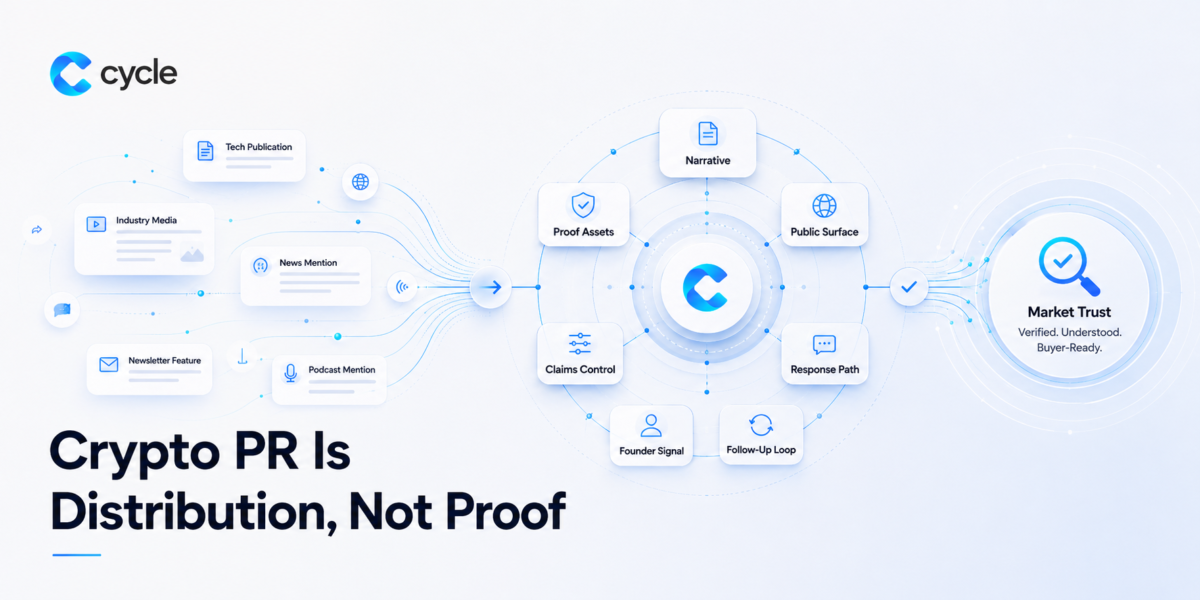
Short answer: crypto PR can create attention, but it does not create trust by itself. A media article sends people to inspect the project: website, X, Telegram, founder profile, partner claims, product proof, docs, community replies, and search results. If that proof layer is weak, coverage does not validate the project. It exposes the gap.
Most Web3 teams do not have a press problem first.
They have an inspection problem.
A founder wants coverage in CoinDesk, Cointelegraph, Forbes, Bloomberg, The Block, Decrypt, TechCrunch, or a respected regional outlet. The team writes an announcement, prepares a quote, hires a crypto PR agency, lines up distribution, adds a few KOL posts, and waits for the market to react.
But the market does not only read the article.
It checks the company.
People click the website. They scan X. They enter Telegram. They look at the founder profile. They search the brand. They check whether the partner claim exists anywhere else. They look for product evidence, roadmap proof, audit language, user traction, community answers, and whether the story feels like a real company or a thin announcement.
That is where crypto PR usually breaks.
The coverage lands. The public proof surface does not.
The broken model: PR as validation
The old PR model treats coverage as validation.
The sequence is simple:
- Get the article.
- Share the article.
- Let the article create trust.
That can work in slower categories where readers have fewer ways to inspect the company immediately.
Crypto is not that market.
In Web3, the audience reacts while the story is still forming. X threads appear before the official recap. Telegram starts asking questions before the announcement is fully understood. KOLs add interpretation. Search results surface old claims. Founder history becomes part of the narrative. Product, token, partner, and community signals are checked in public.
This is why crypto PR is not a standalone press-release function.
It is part of the market-facing execution layer.
The sharper rule:
Crypto PR is distribution. Proof is what makes distribution believable.
If PR sends attention into a weak public surface, the campaign can create more doubt than trust.
What a crypto PR agency should actually prepare
A useful crypto PR agency should not only ask, “Which outlets do you want?”
It should ask, “What will the market find after the article sends attention to you?”
That question changes the work.
A media push needs more than a press release. It needs:
- a one-sentence narrative the market can repeat;
- proof assets that support the claim;
- a current website and official channel surface;
- founder or team signal;
- approved claims and banned claims;
- a community response path;
- KOL, partner, and founder amplification briefs;
- a follow-up plan that turns coverage into reusable proof.
This is the difference between press distribution and media readiness.
Distribution buys or earns attention.
Media readiness makes that attention land on something credible.
What people check after a crypto PR hit
A media article points attention somewhere.
That destination is not only the landing page. It is the whole public proof surface:
- website and product page;
- X profile, pinned post, and recent replies;
- Telegram or Discord pinned messages;
- founder and team profiles;
- docs, demo, product screenshots, or technical proof;
- partner pages and ecosystem references;
- previous media and case evidence;
- search results and reputation surface;
- claims around tokens, listings, funding, users, traction, or roadmap;
- response path for the first hard questions.
This is the same mechanism behind Web3 social proof before KOLs, ads, listings, or fundraising. Distribution helps only when the project gives visitors enough proof to continue.
The practical operator question is not: Can we get coverage?
The better question is:
What will people see after coverage sends them to inspect us?
The CYCLE PR Proof Layer Framework
The PR Proof Layer is the set of narrative, proof, channel, claim, response, founder, and follow-up assets that make a Web3 story easier to believe when media attention arrives.
Before a serious Web3 PR push, CYCLE checks seven controls.
1. Narrative readability
The story has to be repeatable.
Weak PR angles sound like category filler:
- “the future of decentralized finance”;
- “a revolutionary Web3 ecosystem”;
- “an AI-powered platform changing crypto forever.”
A readable PR angle answers sharper questions:
- What market problem is being solved?
- Why does it matter now?
- Who is the product for?
- What has already been built?
- What can an outsider verify?
- Why should this be covered now?
If a journalist, partner, KOL, investor, or community member cannot repeat the story in one sentence, the campaign is not ready.
2. Proof assets
Crypto audiences are trained to doubt claims.
That is not a problem. It is the environment.
The proof layer should make the right evidence easy to find:
- product demo or screenshots;
- traction recap;
- partner or ecosystem proof;
- founder background;
- technical explainer;
- roadmap progress;
- security audit or risk disclosure when relevant;
- community recap;
- case evidence;
- launch, listing, or fundraising context;
- FAQ for predictable objections.
The best proof asset is not the prettiest one. It is the asset that removes the next objection.
This is where PR & Media Readiness connects directly with the Social Proof Package: media outreach works better when the project already has proof the media, partners, and community can point to.
3. Public surface readiness
A good article can still fail if the project’s own channels look stale.
Before PR, check:
- Is the latest X activity current and useful?
- Is the pinned post aligned with the announcement?
- Does Telegram explain what is happening now?
- Are admins ready for predictable questions?
- Is the founder profile credible and current?
- Are official links consistent?
- Is the website specific enough for a first-time visitor?
- Can proof be found without asking the team privately?
This is not cosmetic.
It is conversion infrastructure.
PR creates a spike of inspection. The public surface decides whether that inspection turns into trust, follows, inbound interest, partner confidence, investor attention, or nothing.
4. Claims control
Crypto PR gets risky when teams overstate what can be promised.
Before outreach, define:
- approved claims;
- claims that need qualification;
- claims that should not be made;
- numbers that need sources;
- partner language that needs confirmation;
- token, listing, fundraising, ROI, performance, or roadmap language to avoid;
- how to describe uncertainty without weakening the story.
Bad claims travel faster than corrections.
A clean PR process makes the story sharper without making it reckless.
5. Response path
PR does not end when the article goes live.
The first 24 to 72 hours matter because that is when the market asks:
- What does this mean?
- Is the team real?
- Where is the proof?
- Why now?
- What happens next?
- Why should anyone care?
Someone has to own the response path across media, X, Telegram, partner channels, founder posts, KOL amplification, and inbound questions.
If nobody owns that loop, the article becomes a broadcast moment instead of a trust-building moment.
6. Founder and team signal
In Web3, the founder is often part of the proof layer.
People do not only check the product. They check who is behind it, what the team has done before, whether the founder can explain the market clearly, and whether the team looks credible enough to carry the announcement.
Before PR, the founder and team surface should support the story:
- current founder profile;
- clear product context;
- relevant background;
- visible point of view;
- public links that match the announcement;
- no obvious gap between the media claim and the team signal.
The founder does not need to become the only channel.
But in trust-sensitive markets, the founder often needs to be the clearest narrator.
7. Follow-up asset loop
A media hit should not be used once and forgotten.
Good PR becomes reusable proof.
After coverage goes live, the team should know how the article will be used across sales, investor updates, partner follow-up, community recaps, founder posts, landing pages, pitch decks, and future campaigns.
If coverage is only reposted once on X, the campaign loses most of its value.
The question is not only “did we get covered?”
The better question is:
What does this coverage help us prove next?
Operational example: coverage creates inspection
Imagine a Web3 infrastructure project announces a major partnership.
The press release says the partnership will expand access to a new user segment. A few outlets cover it. KOLs repost it. Telegram gets a spike. The founder posts the announcement.
Then inspection starts.
The website still describes last year’s product. The X pinned post is unrelated. The partner page does not mention the collaboration. Telegram admins cannot explain what changes for users. The founder profile has no clear product context. The media kit has no screenshots, no proof assets, and no simple FAQ.
The announcement creates attention, but the project gives that attention nowhere credible to land.
That is not a PR failure at the outlet level.
It is a proof-layer failure.
Now reverse the same situation.
Before outreach, the team prepares a one-sentence narrative, product screenshots, partner context, founder note, Telegram FAQ, updated pinned posts, approved claim language, and a 72-hour response map. The article still matters, but it is no longer asked to carry trust alone.
That is what crypto media readiness looks like in practice.
PR Proof Layer Scorecard
Use this scorecard before crypto PR, token launch PR, partnership announcements, funding news, listing campaigns, or major product media outreach.
Score each area from 0 to 2:
- Narrative readability: 0 = story sounds generic or hard to repeat; 1 = story is clear internally but not market-ready; 2 = one-sentence angle is clear, specific, and repeatable.
- Proof assets: 0 = claims exist without visible evidence; 1 = some proof exists but is hard to find; 2 = proof assets are public, current, and easy to link.
- Public surface: 0 = website, X, Telegram, docs, or founder profiles look stale; 1 = main channels are usable but inconsistent; 2 = public channels support the PR angle and answer basic questions.
- Claims control: 0 = token, listing, funding, or traction claims are loose; 1 = sensitive claims are partly reviewed; 2 = approved and banned claims are clear before outreach.
- Response path: 0 = nobody owns the first 72 hours; 1 = owners exist but scripts/assets are thin; 2 = media, community, KOL, founder, and partner responses are mapped.
- Founder/team signal: 0 = founder or team credibility is hard to inspect; 1 = basic profiles exist but do not support the story; 2 = founder/team signal makes the company easier to trust.
- Follow-up asset loop: 0 = coverage will be shared once and forgotten; 1 = some reuse is planned; 2 = coverage becomes proof for sales, partners, community, and future campaigns.
Interpretation:
- 0-5: do not start outreach yet. The public surface will likely expose trust gaps.
- 6-10: fix the weakest proof gaps before pitching media or scaling KOL traffic.
- 11-14: ready for a controlled PR push with clear ownership and follow-up.
The score is not a branding exercise.
It tells the team whether more attention will help or simply make the weak parts easier to see.
A 7-day crypto PR readiness sprint
If the scorecard shows gaps, run a short readiness sprint before outreach.
| Day | Focus | Output |
|---|---|---|
| 1 | Inspect the public surface | Ranked list of trust gaps across website, X, Telegram, founder profiles, docs, search, and proof assets |
| 2 | Lock the narrative | One-sentence story, media angle, “why now,” and founder POV |
| 3 | Build the proof library | Screenshots, demo assets, traction recap, partner context, FAQ, or technical explainer |
| 4 | Clean the channels | Updated pinned posts, official links, community FAQ, founder profile, landing page CTA |
| 5 | Control claims | Approved claims, qualified claims, banned claims, and source requirements |
| 6 | Build the response path | Owner map for media, community, KOLs, partners, investors, and users |
| 7 | Start controlled distribution | PR, KOL, founder, partner, and community amplification that has somewhere credible to send attention |
Where CYCLE fits
CYCLE treats crypto PR as part of the market-facing execution layer, not as isolated press release distribution.
The working sequence is:
- Make the story readable.
- Build the proof layer.
- Prepare the public proof surface.
- Control claims.
- Coordinate PR, KOLs, community, founder channels, and partner follow-up.
- Turn each coverage moment into reusable proof for the next campaign.
Use PR & Media Readiness when the story needs to be sharpened before outreach.
Use Social Proof Package when the project is stronger than it looks publicly and needs visible credibility before larger distribution.
Use Trusted Distribution System when media, creators, AMAs, Telegram, X, and launch assets need to move together.
Scored below 11/14? CYCLE can review your proof layer before you scale media, KOLs, or launch attention through a PR & Media Readiness engagement.
The goal is not to make the project louder.
The goal is to make the project easier to understand, trust, introduce, discuss, and buy from.
For proof context, the OKX CIS Brand Awareness case shows how visibility needs credible campaign context around it. The Choise.ai SERM & Reputation Repair case shows why search, reputation, and public narrative matter before new attention is pushed.
FAQ
What is crypto PR?
Crypto PR is media and communications work for Web3, crypto, blockchain, token, exchange, wallet, infrastructure, gaming, DeFi, or related projects. Useful crypto PR connects media outreach with narrative, proof assets, founder visibility, community readiness, KOL coordination, and claims control.
What should a crypto PR agency do before outreach?
A serious crypto PR agency should prepare the story, proof assets, public surface, claim boundaries, founder signal, media kit, community response path, and follow-up plan before outreach. Outlet access matters, but it is not enough if attention lands on a weak project surface.
Why does crypto PR fail?
Crypto PR fails when teams treat coverage as the trust layer. A media article creates attention, but users, investors, partners, KOLs, and communities still inspect the website, X, Telegram, founder profiles, product proof, public claims, and search history.
What should a Web3 project prepare before media outreach?
Before Web3 media relations, prepare a clear narrative, proof assets, current public channels, founder or team signal, approved claims, FAQ, media kit, community response plan, and owner for the first 24 to 72 hours after coverage goes live.
Is a press release enough for a token launch?
No. Token launch PR usually needs a broader readiness layer: token utility explanation, roadmap proof, risk language, community onboarding, KOL and PR briefs, founder visibility, launch FAQ, support flow, and public assets that explain why the token matters without promising price, listing, or investment outcomes.
How does CYCLE support crypto PR?
CYCLE supports crypto PR by connecting media readiness with social proof, founder-led GTM, KOL coordination, community activity, launch readiness, proof assets, claims control, and execution rhythm. The goal is to make coverage easier to believe and easier to convert into trust.