


What Is a GTM Operator? The Founder-Led Role
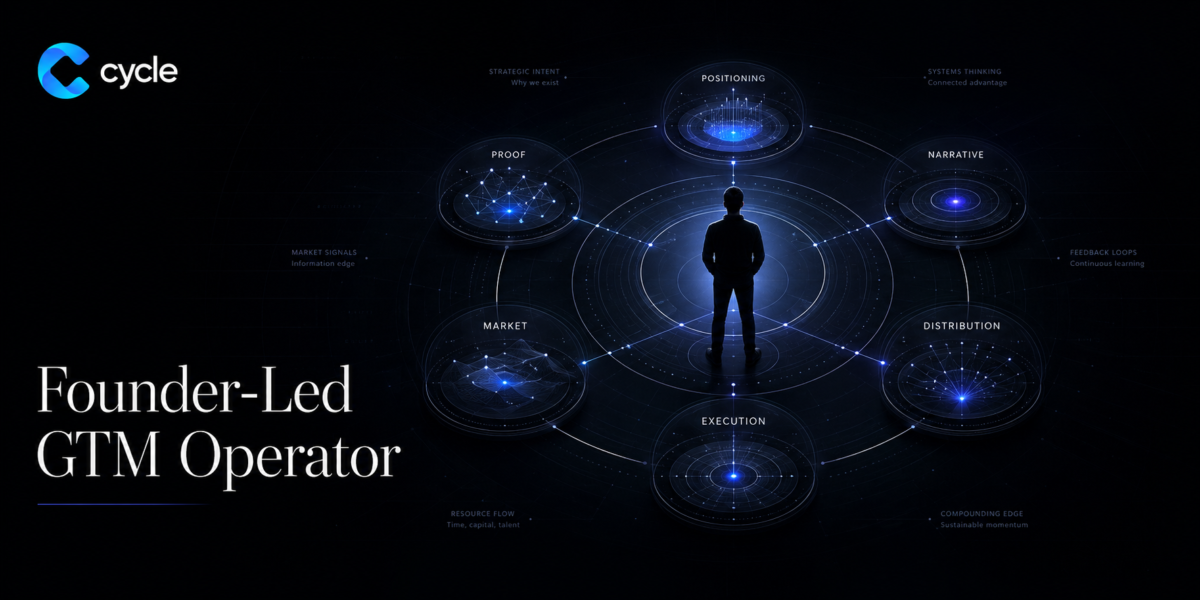
Short answer: a founder-led GTM operator is the person or external team that turns a founder's product knowledge into a working go-to-market system. The role connects positioning, proof, narrative, launch readiness, content, PR, partnerships, community, and vendor execution so the company becomes easier to understand, easier to trust, and easier to buy from.
This is different from hiring another agency to “run marketing.” A founder-led GTM operator does not simply take channel requests and execute them. The operator helps decide what should be said, what should be proven, which channels matter now, what must be fixed before distribution, and how each moving part should support the same market story.
That distinction matters most for technical, trust-sensitive companies: AI startups, FinTech teams, Web3 projects, B2B SaaS platforms, DevTools, infrastructure companies, cybersecurity products, and deep-tech founders. In those markets, the buyer rarely converts because of a clever tagline alone. They need to understand the category, trust the team, believe the proof, and see why the timing matters.
The problem: founders know the product, but the market sees fragments
Technical founders usually have more substance than their public surface shows. They know the product, the constraints, the roadmap, the tradeoffs, the customer pain, and the reason the company should exist.
But the market often sees a fragmented version:
- a homepage that explains features but not urgency;
- a pitch deck that sounds sharper than the public website;
- PR announcements without enough proof;
- content that educates but does not create demand;
- founder posts that are thoughtful but disconnected from pipeline;
- vendor work that looks active but does not compound;
- launch plans that start with distribution before the trust layer is ready.
The result is not “no marketing.” It is a GTM system without an operating layer.
A founder-led GTM operator exists to create that operating layer.
What a GTM Operator Does and Owns
The operator owns the connection between strategy and execution. That does not mean owning every task personally. It means owning the system that decides what gets done, why it matters, how it fits together, and whether it is making the company more market-readable.
A useful founder-led GTM operator usually touches seven areas.
| Area | What the operator fixes | Why it matters |
|---|---|---|
| Positioning | Category, ICP, claim hierarchy, timing | The market needs a simple reason to care |
| Proof layer | Evidence, traction, customers, partners, product signals | Distribution only works when attention lands on proof |
| Founder narrative | POV, credibility, public voice, investor/buyer logic | The founder becomes a trust signal |
| Public surface | Website, deck, case studies, FAQ, launch pages | Buyers and partners inspect before they reply |
| Distribution | PR, content, partnerships, community, paid, creators | Channels need one story and one proof system |
| Vendor coordination | Briefs, priorities, feedback loops, accountability | Fragmented vendors create fragmented market perception |
| Operating cadence | Weekly priorities, launch sequence, metrics, next actions | GTM needs rhythm, not random activity |
This is why CYCLE frames the work as an external GTM Control Room. The value is not just a strategy document. It is the operating rhythm around the founder, the product, and the market.
When you need one
You likely need a founder-led GTM operator when the company has substance but the market does not yet read it clearly.
Common signals:
- The founder can explain the company better on calls than the website can.
- The product is strong, but the category story feels complicated.
- The team is preparing for launch, fundraising, listing, major PR, or market expansion.
- Multiple vendors are active, but nobody owns the narrative system.
- Content, PR, sales materials, and founder posts all sound slightly different.
- Paid or influencer distribution is being considered before the proof layer is ready.
- The company keeps getting “interesting, but what exactly do you do?” feedback.
- The founder is still the strongest source of trust, but that trust is not being operationalized.
In those situations, hiring another channel vendor can increase activity without increasing clarity. The better move is often to build the GTM operating layer first.
What the operator should not become
A founder-led GTM operator should not become a vague “marketing person” who does everything. That leads to bottlenecks and low-quality output.
The role should also not replace every specialist. PR experts, designers, content producers, paid media specialists, sales operators, community leads, and product marketers may still matter. The operator makes those specialists more effective by giving them clearer positioning, proof, sequencing, briefs, and feedback.
Think of the role as orchestration plus judgment.
The operator asks:
- What does the market need to believe before this campaign works?
- Which proof assets are missing?
- Which claims are too broad or unsupported?
- What should the founder say publicly?
- What should be fixed before we buy attention?
- Which vendor work compounds and which is just noise?
- What should we measure this week?
That is a different job from “post more content.”
The CYCLE operating model
CYCLE's model is built around four layers.
1. Narrative clarity
The first layer is making the company easier to understand. This includes category language, buyer pain, founder POV, timing, competitive framing, and the reason the company deserves attention now.
For technical companies, this often means translating product depth into market language without flattening the substance.
2. Proof layer
The second layer is making the company easier to trust. That means visible evidence: customer signals, partner proof, product screenshots, metrics, use cases, case studies, media assets, founder credibility, community activity, technical proof, or investor-facing traction.
CYCLE treats the Proof Layer Audit as infrastructure because every channel depends on it.
3. Distribution readiness
The third layer is deciding which channels should be activated and in what sequence. PR, content, partnerships, community, paid, creators, and founder channels should not operate as disconnected motions. They should send attention toward the same proof system.
4. Execution cadence
The fourth layer is weekly operating rhythm: priorities, owners, assets, review, publishing, internal links, campaign sequencing, and measurement. GTM improves when the system learns, not when teams keep restarting from scratch.
What Founder-Led GTM Means: Founder-Led, Not Founder-Only
Founder-led GTM means the founder supplies product judgment and market signal while the operator turns them into a repeatable system; it does not mean the founder executes every channel.
Founder-led GTM does not mean the founder writes every post or manages every channel. It means the founder's judgment, context, and credibility are built into the system.
That can show up as:
- sharper homepage positioning;
- founder POV essays;
- investor narrative;
- launch statements;
- media angles;
- customer proof;
- partner announcements;
- sales decks;
- category education;
- internal briefs for vendors.
The founder remains the source of strategic signal. The operator turns that signal into market-facing assets and execution.
A simple readiness checklist
A founder-led company is ready for an operator when these questions need one connected answer:
- What is the strongest market claim we can make honestly?
- What proof already exists, and what proof is missing?
- What should the founder be known for?
- Which audience needs to understand us first?
- Which public pages or assets fail to carry trust?
- Which channels should wait until proof improves?
- Which vendors need a clearer brief?
- What does the next 30-90 days need to achieve?
If those questions are answered separately by different people, GTM becomes fragmented. If they are answered together, the company starts to feel coherent from the outside.
How this should be used inside a company
A founder-led GTM operator is most useful when the company treats the role as an operating system, not as another advice layer.
In practice, that means the operator should leave behind visible assets and decisions every week:
- a clearer claim hierarchy;
- a sharper homepage or landing-page section;
- a better founder POV draft;
- a proof asset that can be reused by sales, PR, investors, or partners;
- a cleaner vendor brief;
- a launch sequence with fewer loose ends;
- a short decision log that explains what changed and why.
This matters because GTM ambiguity compounds. If the homepage is unclear, PR angles become weaker. If proof is thin, paid traffic performs worse. If the founder narrative is not written down, agencies and freelancers guess. If channels are activated without shared context, the company looks busier but not more credible.
A good operator reduces that ambiguity. The company should feel easier to explain after every sprint.
How this connects to existing CYCLE work
CYCLE already has a live article on why the company works as an external GTM control room. This page is the broader definition: what the founder-led GTM operator role is, when it is needed, and how to decide whether that operating layer is missing.
For the adjacent product-to-market problem, use the technical founder GTM guide to turn product depth into positioning, proof, and demand.
For teams that need a practical diagnostic, the next step is usually to inspect the proof layer. The live explainer What Is a Proof Layer Audit? explains how CYCLE looks at the public evidence a company shows before distribution, PR, KOLs, paid acquisition, or fundraising.
The service bridge is the GTM Control Room: the operating model that turns founder signal, proof, narrative, and execution into a working weekly cadence.
FAQ
Is a founder-led GTM operator the same as a fractional CMO?
Not exactly. A fractional CMO usually brings senior marketing direction. A founder-led GTM operator is more focused on the operating layer between founder context and execution: proof, positioning, narrative, channel sequence, vendor briefs, and weekly movement. For a direct comparison, see fractional CMO vs GTM operator for technical founders.
Does this replace agencies?
No. It makes agencies and specialists easier to use. The operator clarifies what should be done and why, then specialist vendors can execute against a stronger brief.
Is this only for Web3 companies?
No. Web3 is one proof market for CYCLE, but the model also fits AI, FinTech, B2B SaaS, DevTools, infrastructure, cybersecurity, and other trust-sensitive technical categories.
Bottom line
A founder-led GTM operator is not a replacement for the founder. It is not a traditional agency wrapper. It is the operating layer that helps a technical company become market-readable.
For CYCLE, this is the work: connect founder signal, proof, narrative, public surface, and distribution into one GTM system.
If the product is real but the market still needs help understanding why it matters, the next step is not always louder marketing. It is a stronger control room.